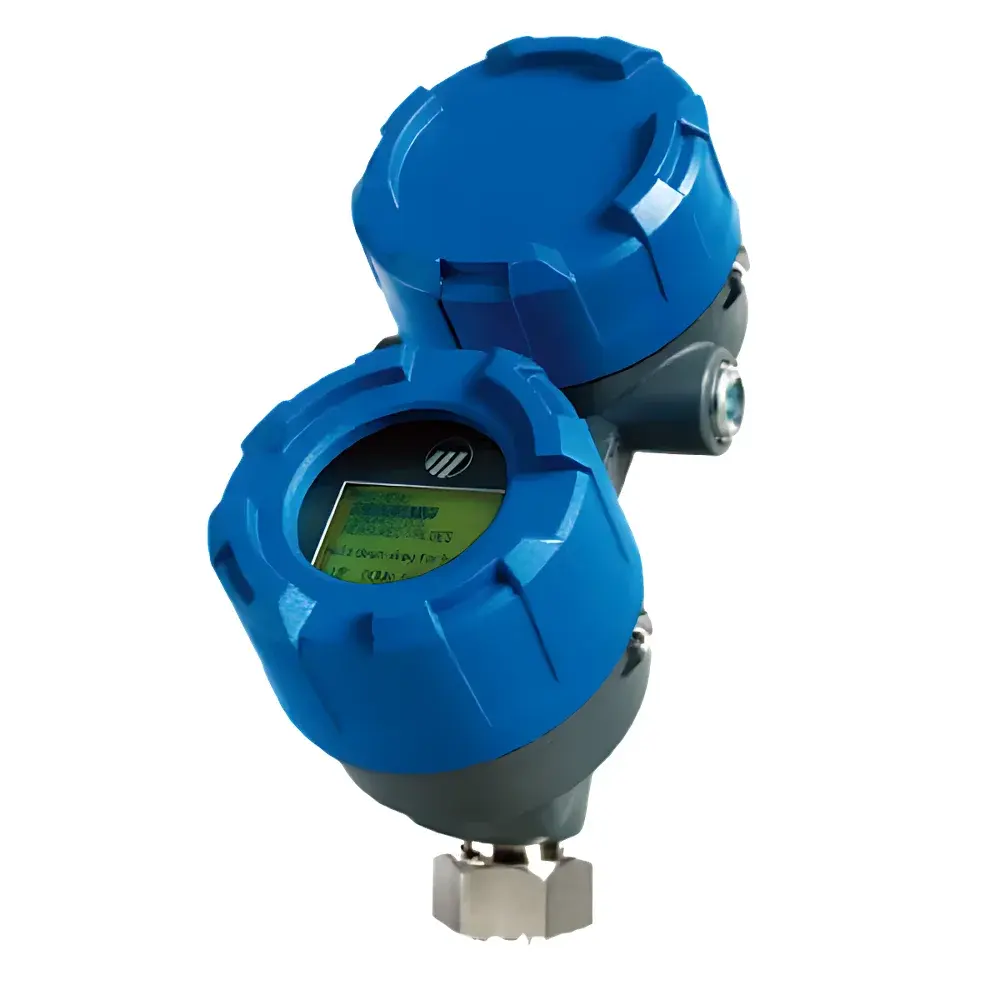
MAGNETROL Eclipse® 706 Series Guided Wave Radar (GWR) Level Transmitter
| Brand | MAGNETROL |
|---|---|
| Model | Eclipse® 706 Series |
| Measurement Principle | Time-Domain Reflectometry (TDR) |
| Power Supply | 24 VDC loop-powered |
| Output Signal | HART® or Foundation Fieldbus™ or Modbus RTU |
| Explosion Protection | Intrinsically Safe (IS), Flameproof (Ex d), Non-incendive (NI) certified |
| Process Pressure Range | Full vacuum to 43 MPa (6250 psi) |
| Process Temperature Range | –196 °C to +450 °C (–320 °F to +850 °F) |
| SIL Rating | SIL 2/3 compliant (SFF = 93% |
| Diagnostic Capability | Advanced self-diagnostics with echo curve visualization |
| Probe Types | Rigid rod, flexible cable, coaxial, and dual-rod configurations |
| Display Option | Integrated LCD with real-time echo profile |
| Compliance | IEC 61508, IEC 61511, ATEX, IECEx, CSA, FM, NEMA 4X/IP66 |
Overview
The MAGNETROL Eclipse® 706 Series Guided Wave Radar (GWR) Level Transmitter is an industrial-grade, loop-powered level measurement instrument engineered for high-reliability continuous level monitoring in demanding process environments. Utilizing time-domain reflectometry (TDR), the device transmits low-energy microwave pulses along a probe immersed in the process medium; the time delay between pulse transmission and reflected signal return is precisely measured to determine liquid or interface level with millimeter-level resolution. Unlike non-contact radar or ultrasonic technologies, GWR maintains stable performance under conditions of heavy foam, turbulent surfaces, vapor layers, condensation, and low-dielectric media (εr ≥ 1.4), making it suitable for applications where conventional methods fail—such as cryogenic LNG storage, high-pressure steam drums, viscous polymer reactors, and high-temperature molten salt tanks.
Key Features
- True 24 VDC loop-powered operation with integrated diagnostics—no external power supply required for basic configuration
- Enhanced signal-to-noise ratio (SNR) and proprietary pulse shaping algorithms ensure robust echo detection even in challenging dielectric conditions
- No zero or span calibration needed post-installation; factory-trimmed probe geometry and built-in temperature compensation eliminate drift-related recalibration
- Multiple certified hazardous area approvals: ATEX II 1G Ex ia IIC T6 Ga, IECEx ia IIC T6 Ga, FM Class I Div 1 Groups A–D, CSA Class I Div 1 Groups A–D, and non-incendive variants for Class I Div 2
- Full vacuum to 43 MPa (6250 psi) pressure rating and –196 °C to +450 °C (–320 °F to +850 °F) operational temperature range support extreme process conditions
- SIL 2/3 certified per IEC 61508 and IEC 61511; Safety Failure Fraction (SFF) of 93% verified by third-party FMEDA analysis (report available upon request)
- Configurable LCD display with real-time graphical echo curve, distance-to-liquid, signal strength, and diagnostic status indicators
Sample Compatibility & Compliance
The Eclipse® 706 accommodates diverse process media—including hydrocarbons, solvents, acids, caustics, liquefied gases, and molten salts—without requiring media-specific tuning. Its probe materials (e.g., 316L SS, Alloy C-276, PTFE-coated stainless steel) are selected per chemical compatibility requirements and ASME B16.5/B16.47 flange standards. The transmitter complies with electromagnetic compatibility (EMC) per IEC 61326-1, environmental protection per IEC 60529 (IP66/NEMA 4X), and functional safety lifecycle management per IEC 61511. All units undergo traceable factory verification against NIST-traceable reference standards and are supplied with calibration certificates compliant with ISO/IEC 17025 requirements when requested.
Software & Data Management
Configuration and diagnostics are supported via MAGNETROL’s free Echolog® PC software or field handheld communicators compatible with HART® 7 and Foundation Fieldbus™ (FF) profiles. The device supports full FF Device Description (DD) and HART Device Description (HDD), enabling integration into DCS, PLC, and asset management systems (AMS, DeltaV, PCS7). Digital communication channels provide access to raw echo data, signal quality metrics, historical diagnostics, and event logs with timestamping. For regulated industries, audit trail functionality—including user login, parameter change history, and firmware version tracking—is enabled and configurable to align with FDA 21 CFR Part 11 and GAMP 5 guidelines.
Applications
- High-pressure boiler drum level control in power generation (ASME Section I compliant installations)
- LNG and LPG storage tanks operating at cryogenic temperatures and elevated pressures
- Chemical reactor interface level measurement between immiscible phases (e.g., aqueous/organic)
- Pharmaceutical bulk solvent storage with strict hygiene and validation requirements (validated per GMP Annex 15)
- Refinery fractionator sump level monitoring under high-temperature, high-vapor-pressure conditions
- Wastewater treatment digesters with heavy foam layers and variable dielectric properties
FAQ
Does the Eclipse® 706 require periodic recalibration?
No. The device employs factory-calibrated probe geometry and embedded thermal compensation algorithms, eliminating routine recalibration. Verification may be performed using known reference points during scheduled maintenance.
Can it measure interface level between two liquids?
Yes—provided the dielectric contrast between upper and lower phases is ≥ 10 units (e.g., oil/water, solvent/aqueous). Dual-rod or coaxial probe configurations are recommended for improved interface resolution.
Is remote configuration supported over HART or Fieldbus?
Yes. Full parameter configuration, diagnostic interrogation, and echo curve download are supported without physical access to the device.
What documentation is provided for SIL compliance validation?
A complete FMEDA report, safety manual, and certificate of conformity issued by TÜV Rheinland or exida are available upon order confirmation.
How does it handle heavy condensation on the probe?
The TDR waveform processing includes adaptive baseline correction and reflection filtering to distinguish true level echoes from condensate-induced artifacts, ensuring stable measurement in saturated vapor spaces.