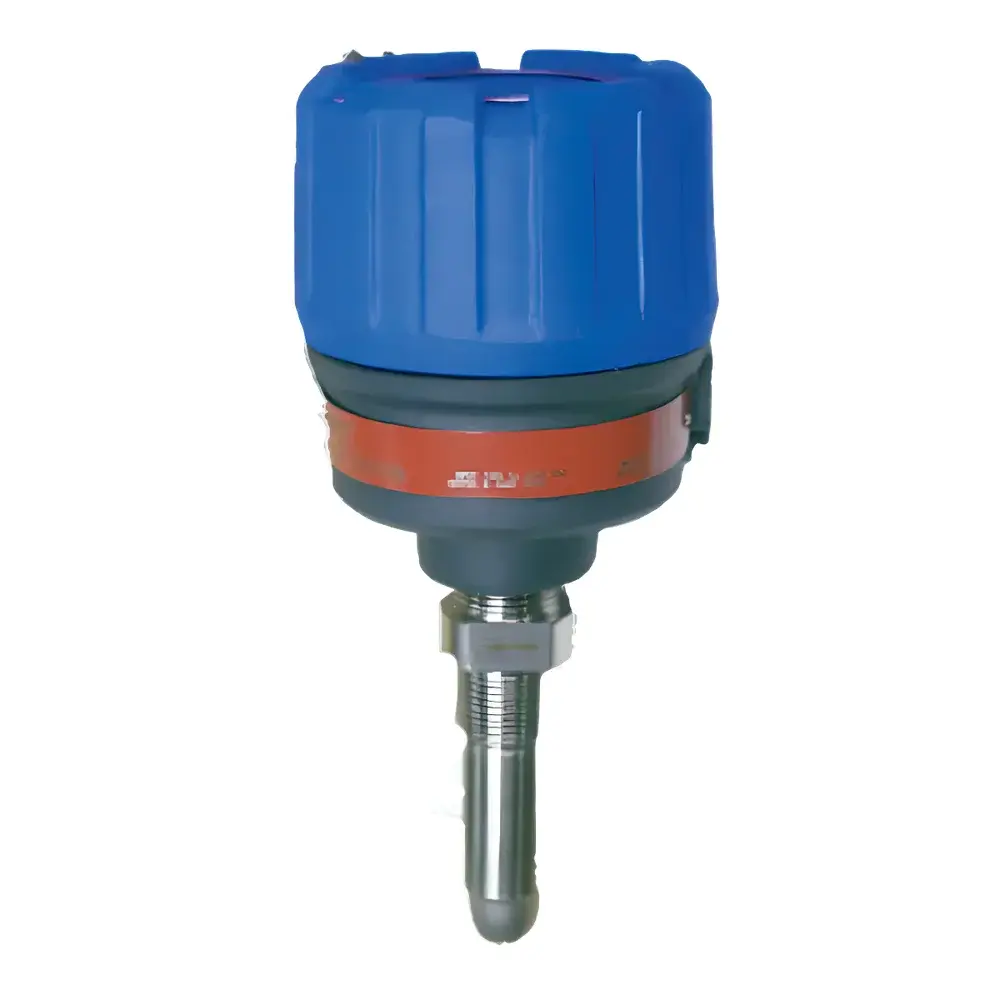
MAGNETROL Thermatel® TD1/TD2 Thermal Flow & Level Switch
| Brand | MAGNETROL |
|---|---|
| Model | Thermatel® TD1/TD2 |
| Type | Thermal Dispersion Flow & Level Switch |
| Operating Principle | Thermal dispersion (heat transfer differential detection) |
| Max. Process Temperature | 450 °C |
| Max. Process Pressure | 410 bar |
| Output Options | Relay (TD1), 4–20 mA with diagnostics (TD2) |
| Probe Configurations | Standard, Extended, Sanitary, High-Temp |
| Housing | IP67-rated stainless steel |
| Electrical Interface | Conduit or M20 cable gland |
| Certifications | ATEX, IECEx, FM, CSA, SIL 2 (IEC 61508), CE, RoHS |
| Compliance | Designed for compliance with IEC 61511 (functional safety), ISO 9001 manufacturing, and applicable regional hazardous area directives |
Overview
The MAGNETROL Thermatel® TD1 and TD2 are intrinsically reliable thermal dispersion switches engineered for continuous, contactless detection of flow presence/absence, liquid level, or liquid-liquid interface in demanding industrial process environments. Based on the principle of convective heat transfer, these devices measure the differential cooling effect exerted by a flowing or static medium on a heated sensor element — typically a dual-RTD probe configured in constant-temperature difference mode. When fluid motion increases (or liquid rises to submerge the probe), convective heat loss rises, altering the power required to maintain the temperature differential between the sensing and reference RTDs. This change is converted into a deterministic switching action (TD1) or a scalable 4–20 mA analog output with embedded diagnostic status (TD2). Unlike mechanical float or ultrasonic solutions, the Thermatel® design eliminates moving parts, seals, or acoustic path dependencies — delivering high long-term stability, minimal maintenance, and immunity to coating, vibration, foam, or turbulence.
Key Features
- True thermal dispersion measurement with dual-RTD probe architecture for high repeatability and drift resistance
- Continuous self-diagnostic capability: real-time monitoring of heater integrity, RTD continuity, and thermal response deviation
- Automatic temperature compensation across full process range (−40 °C to +450 °C), ensuring consistent setpoint accuracy independent of ambient or process temperature fluctuations
- Configurable alarm setpoint and adjustable time delay (0.1–100 s) to suppress transient spikes during pump start-up or level surges
- Robust pressure rating up to 410 bar (6,000 psi), validated per ASME B16.5 and PED 2014/68/EU for critical high-pressure services
- TD2 variant provides HART-enabled 4–20 mA output with simultaneous transmission of process variable and diagnostic health status (e.g., “sensor fouling detected”, “open circuit”, “over-temperature”)
- Wide probe material selection: 316L SS, Alloy C-276, and Hastelloy B-2 for aggressive chemical, high-temperature, or sanitary applications
- Optional local LED display with push-button programming for field commissioning without handheld communicator
Sample Compatibility & Compliance
The Thermatel® TD1/TD2 is suitable for conductive and non-conductive liquids (including hydrocarbons, solvents, cryogens, molten sulfur, and caustic solutions), gases (air, nitrogen, natural gas, steam), and vapor-liquid interfaces. It is not recommended for low-thermal-conductivity gases (e.g., helium) or highly viscous media (>10,000 cP) where convective heat transfer is insufficient. The device meets IEC 61508 SIL 2 requirements for safety instrumented functions (SIFs) when integrated into a certified SIS architecture. All variants comply with ATEX Directive 2014/34/EU (II 1G Ex ia IIC T4 Ga), IECEx (Ex ia IIC T4 Ga), FM Class I Div 1 Groups A–D, and CSA C/US Class I Div 1. Electromagnetic compatibility conforms to IEC 61326-1 (industrial environment) and EMC Directive 2014/30/EU.
Software & Data Management
While the TD1/TD2 operates as a standalone hardwired switch or analog transmitter, its TD2 variant supports HART 7 communication for integration into DCS, PLC, or asset management systems (AMS, DeltaV, Emerson Smart Wireless). Configuration is performed via HART handheld communicator or PC-based software (MAGNETROL Insight™), enabling remote calibration verification, event logging, and firmware updates. Audit trails include timestamped parameter changes, diagnostic alarms, and operational uptime statistics — supporting GLP/GMP documentation requirements and FDA 21 CFR Part 11 compliance when deployed with validated electronic record systems. No cloud connectivity or proprietary cloud platform is embedded; all data remains under end-user control at the plant network layer.
Applications
- Pump dry-run protection in boiler feedwater, condensate return, and chemical injection skids
- Low-flow detection in heat exchanger coolant loops and reactor jacket circuits
- High-level/low-level alarm in storage tanks, surge drums, and separator vessels
- Interface detection between immiscible liquids (e.g., oil/water, solvent/aqueous phases) in API separators and decanters
- Steam trap monitoring and condensate line verification in refineries and power plants
- Sanitary CIP rinse validation and fill-level confirmation in biopharma batch vessels (with 3-A certified probe options)
FAQ
Can the TD1/TD2 be used in steam service?
Yes — both models are rated for saturated and superheated steam up to 450 °C and 410 bar, provided the probe is specified with appropriate thermal shielding and high-temp RTD construction.
What is the minimum flow velocity detectable?
Typical sensitivity starts at 0.02 m/s for water-equivalent fluids; exact threshold depends on fluid thermal properties, probe geometry, and installation orientation — consult MAGNETROL Application Engineering for site-specific validation.
Does the device require periodic recalibration?
No routine recalibration is needed due to inherent drift compensation and stable RTD physics; however, functional safety testing per IEC 61511 is recommended annually for SIL-critical installations.
Is third-party SIL certification available?
Yes — TÜV Rheinland and exida have certified the TD2 as SIL 2 capable per IEC 61508 Ed. 2, with documented PFDavg of 4.2 × 10⁻³ for single-channel configuration.
Can the same probe be used for both flow and level detection?
Yes — the same thermal dispersion probe can serve either function depending on mounting location and setpoint configuration; level detection requires fixed probe immersion depth, while flow detection requires full pipe coverage and axial alignment.
Related Products