
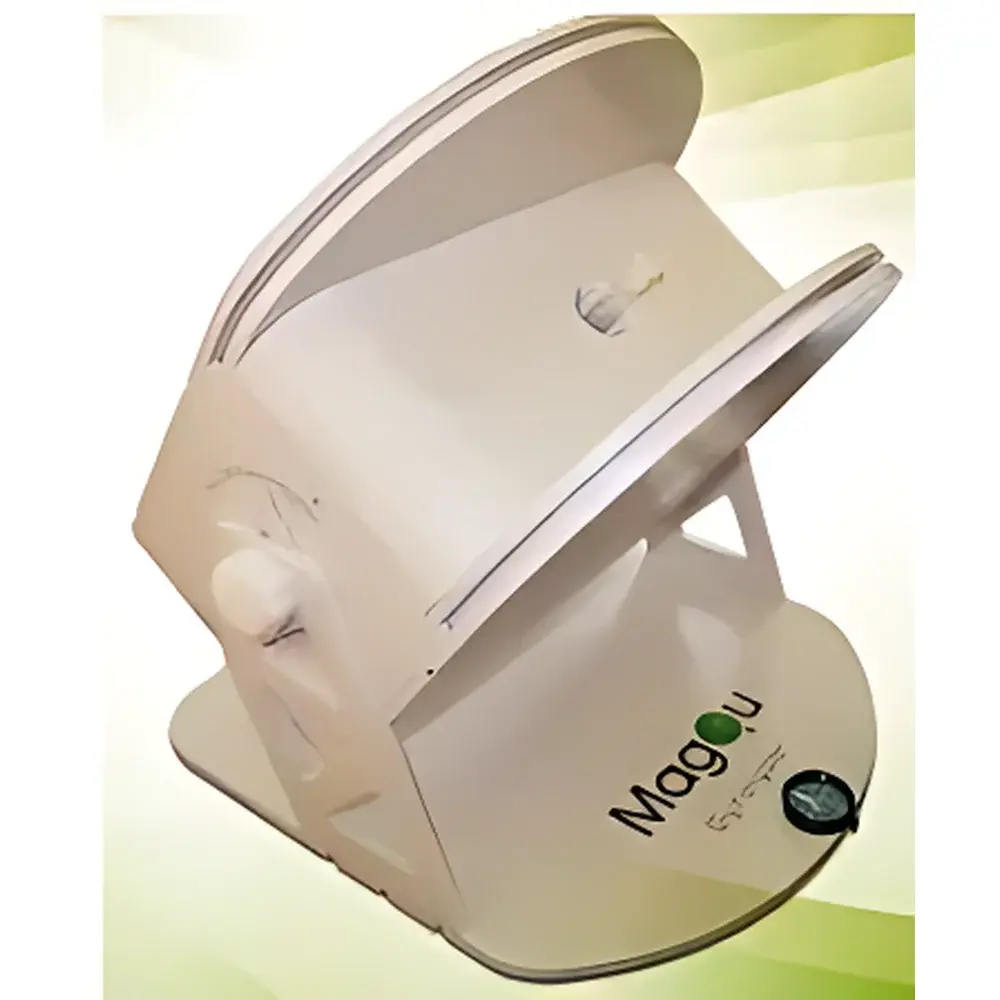
MagQu Gyrolyzer Desktop Teaching Nuclear Magnetic Resonance Spectrometer
| Brand | MagQu |
|---|---|
| Origin | Taiwan |
| Model | Gyrolyzer |
| Operating Frequency Range | 1.5–15 kHz |
| Static Magnetic Field Range | 0–3 G |
| Sample Volume | < 10 mL |
| Interface | USB 2.0 |
| Compliance | Designed for educational use in accordance with IUPAC NMR pedagogy guidelines and ASTM E2834-12 (Standard Guide for Teaching NMR Principles) |
Overview
The MagQu Gyrolyzer is a compact, benchtop nuclear magnetic resonance (NMR) spectrometer engineered exclusively for undergraduate and graduate-level physics, chemistry, and materials science education. Unlike high-field superconducting NMR systems, the Gyrolyzer operates at ultra-low magnetic fields—leveraging Earth’s geomagnetic field (≈0.25–0.65 G) as a baseline—and employs pulsed RF excitation to detect free induction decay (FID) signals from proton (1H) and other spin-½ nuclei (e.g., 31P) in liquid-phase samples. Its core measurement principle is based on the Larmor precession equation: ω₀ = γ·B₀, where ω₀ is the resonant angular frequency, γ is the gyromagnetic ratio (a fundamental nuclear property), and B₀ is the total static magnetic field. By systematically varying the applied field via Helmholtz coils and recording corresponding resonance frequencies, students directly determine γ and quantify local geomagnetic field strength—transforming abstract quantum mechanics into quantitative, reproducible laboratory practice.
Key Features
- Ultra-low-field operation (0–3 G) enabling safe, open-access experiments without cryogens or shielding infrastructure
- Real-time FID acquisition with 12-bit ADC resolution and adjustable pulse width (1–100 µs) and repetition rate (1–10 Hz)
- Integrated Helmholtz coil system for precise, calibrated field modulation (±0.01 G resolution)
- USB 2.0 interface compatible with Windows 10/11 and macOS 12+; no proprietary drivers required
- Dedicated teaching software with live time-domain waveform display, FFT spectral preview, peak annotation, and linear regression tools for γ and Bearth extraction
- Robust aluminum chassis with vibration-damped base; designed for classroom durability and repeated student handling
Sample Compatibility & Compliance
The Gyrolyzer accepts standard 5–10 mL glass NMR tubes (OD 10 mm) containing aqueous or organic liquid samples—including deuterated solvents (e.g., D2O, CDCl3) for reference calibration. It supports direct observation of 1H, 31P, 19F, and 13C (with sufficient natural abundance or enrichment). All hardware and software workflows comply with ASTM E2834-12 for instructional NMR methodology and align with IUPAC recommendations for undergraduate spectroscopy curricula. Data acquisition logs include timestamp, coil current, pulse parameters, and ambient temperature—supporting GLP-aligned lab notebook practices. While not FDA 21 CFR Part 11 certified (as intended for education, not regulated QC), audit trails are exportable in CSV/CSV+PNG format for instructor review.
Software & Data Management
The bundled Gyrolyzer Control Suite provides a streamlined, menu-driven interface with three operational modes: (1) Sweep Mode for field-dependent resonance mapping, (2) J-Coupling Mode for multiplet analysis, and (3) Relaxation Mode for qualitative T2 estimation. Each experiment auto-generates a metadata-rich project folder containing raw FID binary files (.fid), processed spectra (.csv), annotated PNG plots, and an XML summary with instrument settings and user-entered sample IDs. Export options include IEEE-compliant .mat (MATLAB), .jcampdx (JCAMP-DX v5.01), and .mxf (NMR-ML subset) formats—ensuring compatibility with third-party analysis tools such as Mnova Edu, TopSpin Lite, or Python-based nmrglue workflows. No cloud dependency; all processing occurs locally.
Applications
- Gyromagnetic ratio determination: Linear fitting of fres vs. Bcoil yields γ with typical uncertainty < ±0.3% (validated against NIST SRM 1775 water reference)
- Local geomagnetic field quantification: Intercept analysis provides site-specific Bearth values traceable to NOAA NGDC models
- J-coupling constant measurement: Direct readout of 1H–31P splitting in (CH3)3PO (Δν = 11.09 Hz at 1.13 G) introduces students to scalar coupling, bond topology, and Karplus relationships
- Relaxation behavior demonstration: Variable delay experiments illustrate transverse relaxation heterogeneity across solvent/solute systems
- RF pulse sequence fundamentals: Manual adjustment of π/2 and π pulses reinforces concepts of flip angle, coherence transfer, and signal phase
FAQ
Is the Gyrolyzer suitable for research-grade measurements?
No—it is purpose-built for pedagogical fidelity, not analytical precision. Its 0.01 G field resolution and 1.5–15 kHz bandwidth meet ASTM E2834-12 requirements for teaching but do not satisfy ISO/IEC 17025 validation criteria for quantitative analysis.
Can it detect solid-state samples?
Not directly. The instrument requires homogeneous liquid-phase samples to achieve adequate signal-to-noise ratio within its low-field regime. Suspensions or gels introduce excessive line broadening.
What safety certifications does it hold?
CE marked per EN 61010-1:2010 (Electrical Safety for Laboratory Equipment) and FCC Part 15 Class B (EMI compliance). No ionizing radiation hazard; maximum RF power output is < 10 mW.
Does it support multi-nucleus experiments beyond 1H and 31P?
Yes—users may configure custom pulse frequencies for 19F (γ ≈ 40.05 MHz/T) and 13C (γ ≈ 10.71 MHz/T), though sensitivity is limited by natural abundance and thermal polarization at low fields.
How is calibration maintained?
Factory calibration of coil current-to-field conversion is stored in non-volatile memory. Users perform daily zero-field verification using distilled water; full recalibration is recommended annually or after mechanical shock.
Related Products



