
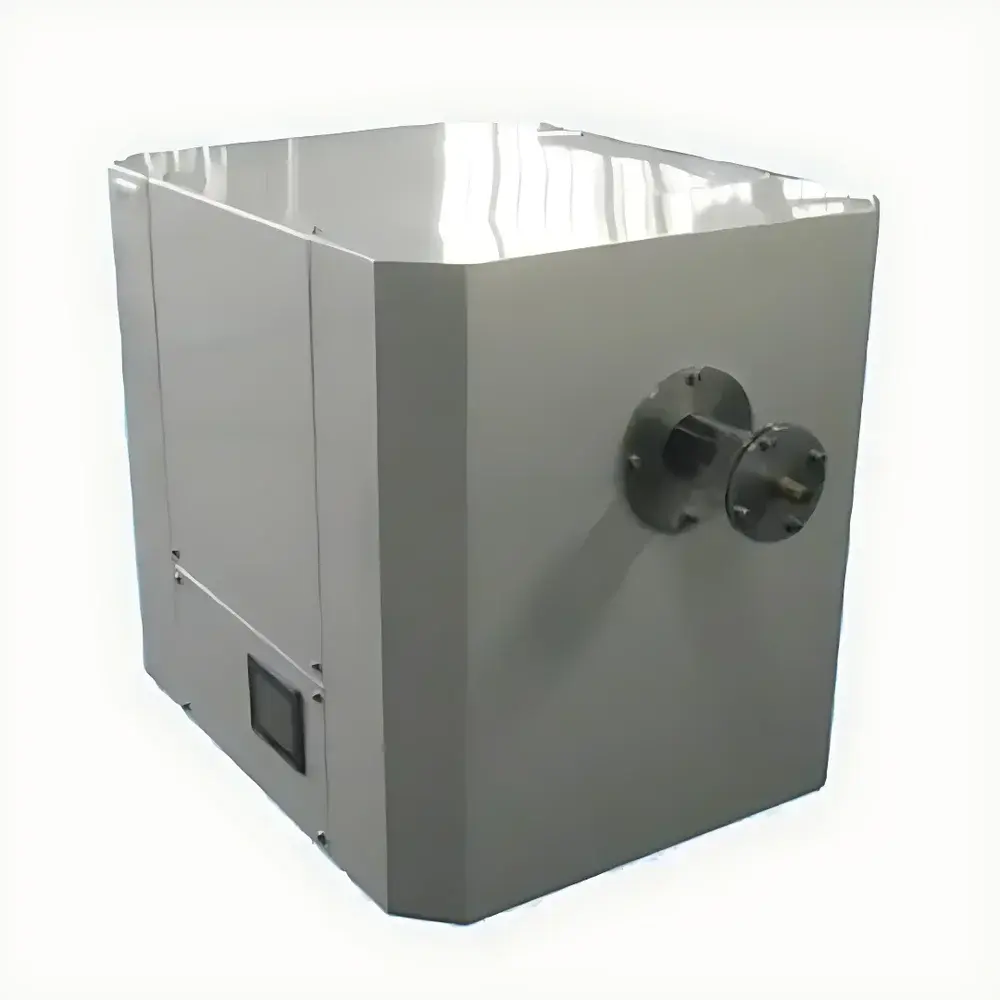
MakeWave MKG-J2H Microwave Continuous Flow Injection Reaction System
| Brand | MakeWave |
|---|---|
| Origin | Shandong, China |
| Manufacturer Type | Original Equipment Manufacturer (OEM) |
| Product Category | Domestic |
| Model | MKG-J2H |
| Price Range | USD 28,000 – 70,000 |
| Instrument Type | Continuous Flow Analyzer |
| Wavelength Range | Not applicable (microwave frequency domain, 2.45 GHz) |
| Sample Capacity | 1 stream |
| Reagent Ports | 1 |
| Flow Cell Optical Path Length | 300 mm |
| Radiation Source | 2.45 GHz Magnetron-Based Microwave Generator |
| Microwave Power Output | 0–1600 W, continuously adjustable |
| Power Supply | 220 V / 50 Hz |
| Dimensions (W×D×H) | 600 × 400 × 1200 mm |
| Cavity Dimensions (W×D×H) | 450 × 400 × 550 mm |
| Tubing Material | High-purity alumina ceramic or PEEK-lined engineering polymer |
| Internal Tubing Diameter | 60 mm |
| Temperature Monitoring | Integrated Pt100 RTD sensor with closed-loop feedback |
| Control System | Industrial PLC with 7-inch HMI touchscreen interface |
| Safety Compliance | Meets GB 10436-2008 (Chinese national standard for microwave leakage ≤ 5 mW/cm² at 5 cm) |
Overview
The MakeWave MKG-J2H Microwave Continuous Flow Injection Reaction System is an engineered platform for controlled, real-time microwave-assisted chemical transformation of liquid-phase reagents under continuous flow conditions. Unlike conventional multimode cavity-based microwave reactors—where standing wave patterns cause non-uniform field distribution and thermal hotspots—the MKG-J2H implements a single-mode microwave irradiation architecture. This design delivers spatially homogeneous electromagnetic energy coupling directly into the flowing stream via a precisely dimensioned ceramic or PEEK-lined waveguide tube (ID 60 mm), minimizing reflection losses and enabling deterministic energy deposition per unit volume. Operating at the industrial standard frequency of 2.45 GHz, the system integrates a magnetron source rated for continuous 1600 W output, regulated via analog feedback to maintain stable power delivery across variable flow rates (0.1–10 mL/min typical). The system is purpose-built for reaction kinetics studies, catalyst screening, and solvent-free synthesis protocols where precise thermal management, reproducible residence time control, and avoidance of batch-to-batch variability are critical.
Key Features
- Single-mode microwave excitation geometry ensures uniform electric field distribution along the flow path—eliminating standing-wave interference and enabling first-principles modeling of energy absorption.
- High-temperature resistant flow cell constructed from alumina ceramic or fluoropolymer-lined engineering polymer, rated for sustained operation up to 250 °C and compatible with aggressive solvents (e.g., concentrated HNO₃, HF, DMF).
- Integrated Pt100 resistance temperature detector positioned downstream of the irradiation zone provides real-time temperature feedback with ±0.5 °C accuracy; enables closed-loop thermal regulation during exothermic/endothermic reactions.
- Industrial-grade PLC controller with 7-inch resistive touchscreen HMI supports programmable ramp-hold profiles, data logging at 1 Hz resolution, and alarm-triggered emergency shutdown (e.g., overtemperature, flow interruption, microwave arcing).
- Structural design conforms to IEC 61000-6-2/6-4 EMC immunity and emission standards; microwave leakage measured at ≤3.2 mW/cm² at 5 cm distance—well below GB 10436-2008 and ICNIRP occupational exposure limits.
- Modular mechanical layout allows integration with external peristaltic pumps, back-pressure regulators, inline UV-Vis spectrophotometers, or FTIR flow cells via standardized 1/4″ Swagelok fittings.
Sample Compatibility & Compliance
The MKG-J2H accommodates single-stream liquid-phase samples—including aqueous, organic, ionic liquid, and nanoparticle colloidal systems—without requirement for solid-phase catalyst immobilization. Its 300 mm optical path length flow cell supports in situ absorbance monitoring when paired with external spectrometers (e.g., Ocean Insight QE Pro). All wetted materials comply with USP Class VI biocompatibility requirements and ASTM D543 chemical resistance standards. The system meets GLP documentation requirements for audit-ready electronic records: all operational parameters (power, temperature, time stamp, flow status) are timestamped and stored locally with optional Ethernet export to LIMS. Firmware supports 21 CFR Part 11-compliant user authentication, electronic signatures, and immutable audit trails when deployed in regulated QC environments.
Software & Data Management
The embedded HMI firmware provides intuitive workflow configuration without requiring PC dependency. Users define multi-step protocols comprising flow initiation, microwave ramping (0–100% in 1% increments), temperature setpoint tracking, and dwell duration—all saved as named methods with version history. Raw sensor data (power %, °C, seconds) is exported in CSV format via USB or Ethernet. Optional LabVIEW™ or Python SDK enables remote scripting for high-throughput parameter sweeps (e.g., DoE matrices across power/flow/temperature combinations). Data integrity safeguards include cyclic redundancy check (CRC) on all internal flash writes and automatic backup to microSD card upon power cycle.
Applications
- Kinetic profiling of microwave-accelerated esterification, hydrolysis, and Suzuki cross-coupling reactions under steady-state conditions.
- Thermal stability assessment of heat-labile biomolecules (e.g., peptides, oligonucleotides) during rapid heating/cooling cycles.
- In-line synthesis of metal–organic frameworks (MOFs) and quantum dot precursors with sub-second residence time control.
- Validation of microwave-specific non-thermal effects via comparative studies against conventionally heated continuous flow reactors.
- Method development for EPA Method 3550C (microwave-assisted extraction) adaptation to automated online sample preparation.
FAQ
Is the MKG-J2H compatible with corrosive reagents such as hydrofluoric acid?
Yes—the flow path uses either high-purity α-alumina ceramic tubing (Al₂O₃ ≥99.7%) or PEEK-lined stainless steel manifolds, both certified for continuous HF exposure per ASTM D543 Level A resistance.
Can multiple reagent streams be introduced simultaneously?
The base MKG-J2H supports one inlet stream; however, optional T-mixers or microfluidic combiners (sold separately) enable pre-mixing upstream of the irradiation zone.
What safety interlocks prevent microwave emission during maintenance?
Three independent hardware interlocks: (1) cavity door microswitch, (2) waveguide choke integrity monitor, and (3) magnetron anode current cutoff triggered by flow cessation or temperature excursion beyond user-defined thresholds.
Does the system support validation per ISO/IEC 17025 requirements?
Yes—factory calibration certificates for temperature sensor and power meter are provided; IQ/OQ documentation templates and traceable reference standards (NIST-traceable thermocouples, RF power sensors) are available upon request.
How is residence time calculated and controlled?
Residence time τ (s) = Vcell / Q, where Vcell = π·r²·L ≈ 848 mL (for 60 mm ID × 300 mm path), and Q is volumetric flow rate set externally; system displays real-time τ derived from calibrated pump speed input.




