
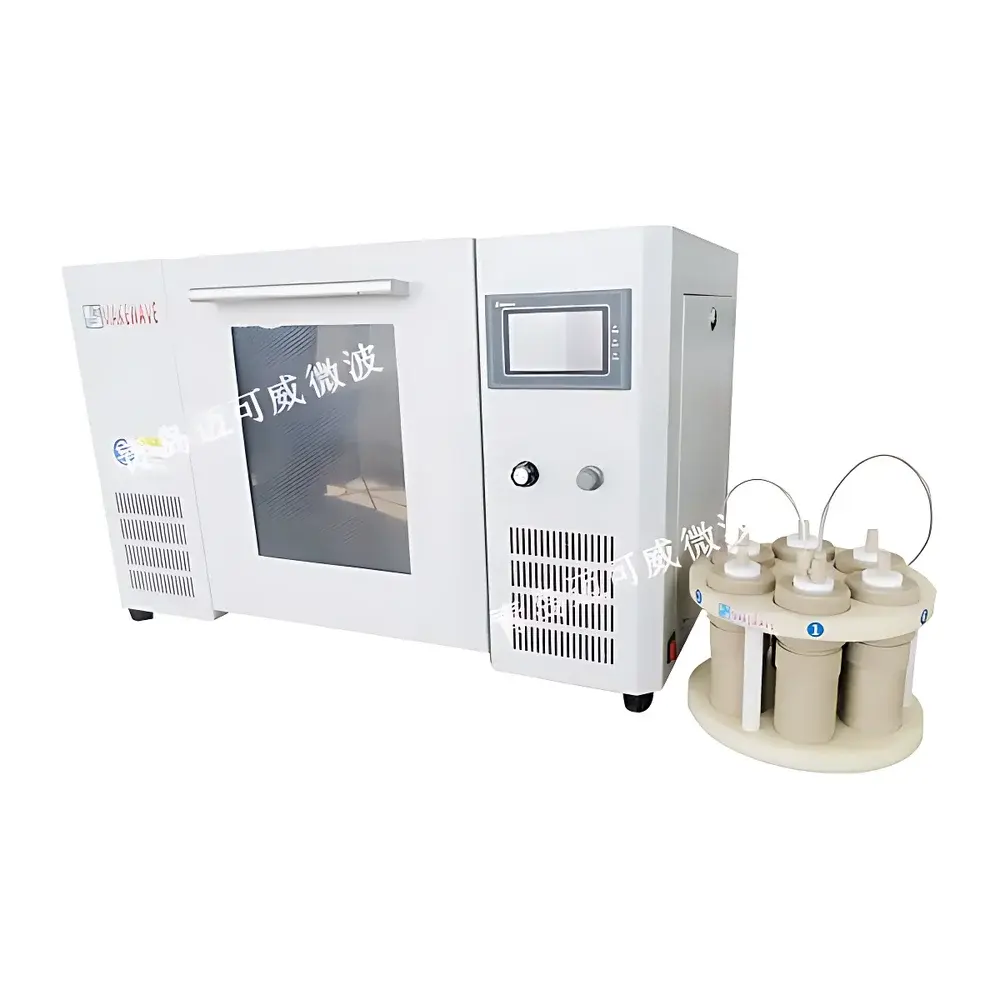
MakeWave MKX-H1G6A Microwave-Hydrothermal Parallel Synthesis System
| Brand | MakeWave |
|---|---|
| Origin | Shandong, China |
| Manufacturer Type | Direct Manufacturer |
| Country of Origin | China |
| Model | MKX-H1G6A |
| Price Range | USD 150–750 (FOB) |
| Temperature Range | 0–220 °C (short-term max 230 °C) |
| Pressure Range | 0–2.5 MPa (short-term max 3 MPa) |
| Microwave Power | 800 W (continuous, non-pulsed, 2450 MHz) |
| Stirring Mode | Reciprocating 360° rotary motor drive |
| Total Reaction Volume | ~20 L (6 × 80 mL PFA-lined hydrothermal vessels) |
Overview
The MakeWave MKX-H1G6A Microwave-Hydrothermal Parallel Synthesis System is an engineered platform for high-throughput, controlled-condition hydrothermal and solvothermal synthesis under microwave irradiation. It integrates resonant 2450 MHz microwave energy delivery with pressurized, temperature-regulated reaction environments—enabling accelerated reaction kinetics, improved phase purity, and enhanced reproducibility in nanomaterial crystallization, metal-organic framework (MOF) formation, ceramic precursor synthesis, and catalytic material development. Unlike conventional oil-bath or autoclave-based methods, this system applies volumetric dielectric heating directly to reaction mixtures within sealed PFA vessels, minimizing thermal gradients and enabling precise control over nucleation and growth dynamics. The system operates within a rigorously engineered stainless-steel cavity conforming to IEC 61000-4-3 EMI immunity standards and complies with national safety limits for microwave leakage (<5 mW/cm²), verified per GB 10436-2008.
Key Features
- Continuous-wave 800 W microwave generator operating at 2450 MHz with non-pulsed, infinitely adjustable power output—ensuring stable energy coupling without thermal shock.
- Reinforced 304 stainless-steel monolithic cavity with multi-layer PTFE (Teflon™) interior coating—resistant to concentrated acids (e.g., HF, HNO₃), alkalis, and sustained temperatures up to 230 °C.
- Six independent 80 mL PFA-lined hydrothermal vessels with integrated pressure/temperature monitoring—each equipped with rupture-disc safety mechanisms and threaded sealing for repeatable 2.5 MPa operation.
- Fiber-optic temperature sensing (insertion-type) with ±0.5 °C accuracy and contact-based piezoresistive pressure transducers calibrated to ±0.05 MPa—providing real-time, vessel-level process feedback.
- Reciprocating 360° rotary motor drive system ensuring uniform angular displacement and consistent microwave field exposure across all six vessels—eliminating hot-spot accumulation and improving inter-vessel reproducibility.
- Integrated LED cavity illumination and reinforced borosilicate observation window—enabling visual verification of vessel integrity, stirring motion, and reaction homogeneity during operation.
Sample Compatibility & Compliance
The MKX-H1G6A accommodates a broad range of chemically aggressive media, including aqueous mineral acid solutions (up to 12 M HCl), alkaline hydroxides (e.g., 10 M NaOH), organic solvents (ethanol, ethylene glycol, DMF), and mixed-phase suspensions containing metal salts, oxides, or carbon precursors. All wetted parts—including vessel liners, gaskets, and sensor housings—are constructed from PFA (perfluoroalkoxy alkane), certified to ASTM D1711 and compliant with USP Class VI biocompatibility requirements. The system meets CE electromagnetic compatibility directives (2014/30/EU), conforms to ISO 17025-relevant calibration traceability for temperature and pressure sensors, and supports GLP-compliant data integrity through audit-trail-enabled software logging.
Software & Data Management
Control is executed via a PLC-based embedded system with a 7-inch capacitive touchscreen HMI. The interface displays synchronized real-time curves for temperature, pressure, microwave power, and elapsed time—with configurable alarm thresholds and automatic hold-to-cool protocols. Up to 99 programmable method templates can be stored locally, each defining ramp rates, dwell times, power profiles, and safety interlocks. All operational data—including timestamped sensor readings, event logs (e.g., door open/close, pressure limit breach), and user authentication records—are exportable in CSV format. Optional integration with LIMS platforms is supported via Modbus TCP protocol, and the system architecture permits validation documentation (IQ/OQ/PQ) in accordance with FDA 21 CFR Part 11 requirements when deployed in regulated QC laboratories.
Applications
This instrument is routinely employed in academic and industrial R&D for the parallel synthesis of transition metal oxides (e.g., LiCoO₂, TiO₂ anatase), perovskite quantum dots (CsPbBr₃), layered double hydroxides (LDHs), zeolitic imidazolate frameworks (ZIF-8), and doped phosphors (YAG:Ce³⁺). Its ability to maintain sub-1 °C thermal uniformity across six vessels enables statistically robust screening of precursor concentration, pH, fill ratio, and heating rate—critical for DOE (Design of Experiments) workflows. The system also supports digestion protocols aligned with EPA Method 3052 and ASTM D5630 for polymer ash content analysis, as well as low-temperature hydrolysis of silica precursors for mesoporous SBA-15 synthesis.
FAQ
What is the maximum recommended fill volume per 80 mL vessel?
For safe operation at 2.5 MPa and 220 °C, the recommended maximum fill ratio is 60% (i.e., ≤48 mL), accounting for thermal expansion and headspace required for pressure equilibration.
Can the system be used with organic solvents such as DMF or NMP?
Yes—provided vessels are rated for solvent compatibility and vapor pressure at target temperature; PFA liners exhibit excellent resistance to these solvents below 200 °C, but users must validate flash point margins against setpoint temperatures.
Is third-party calibration certification available for temperature and pressure sensors?
Yes—NIST-traceable calibration certificates (ISO/IEC 17025 accredited) can be supplied upon request, covering both fiber-optic probe and pressure transducer units.
Does the system support remote monitoring or network connectivity?
Standard configuration includes RS-485 and Ethernet ports; optional OPC UA server module enables secure SCADA integration and remote parameter adjustment via authenticated TLS 1.2 connections.
How is maintenance performed on the microwave magnetron and waveguide components?
The magnetron is field-replaceable with alignment-free mounting; waveguide integrity is verified annually using VNA-based S-parameter measurement—service manuals and torque specifications are provided with equipment documentation.



