
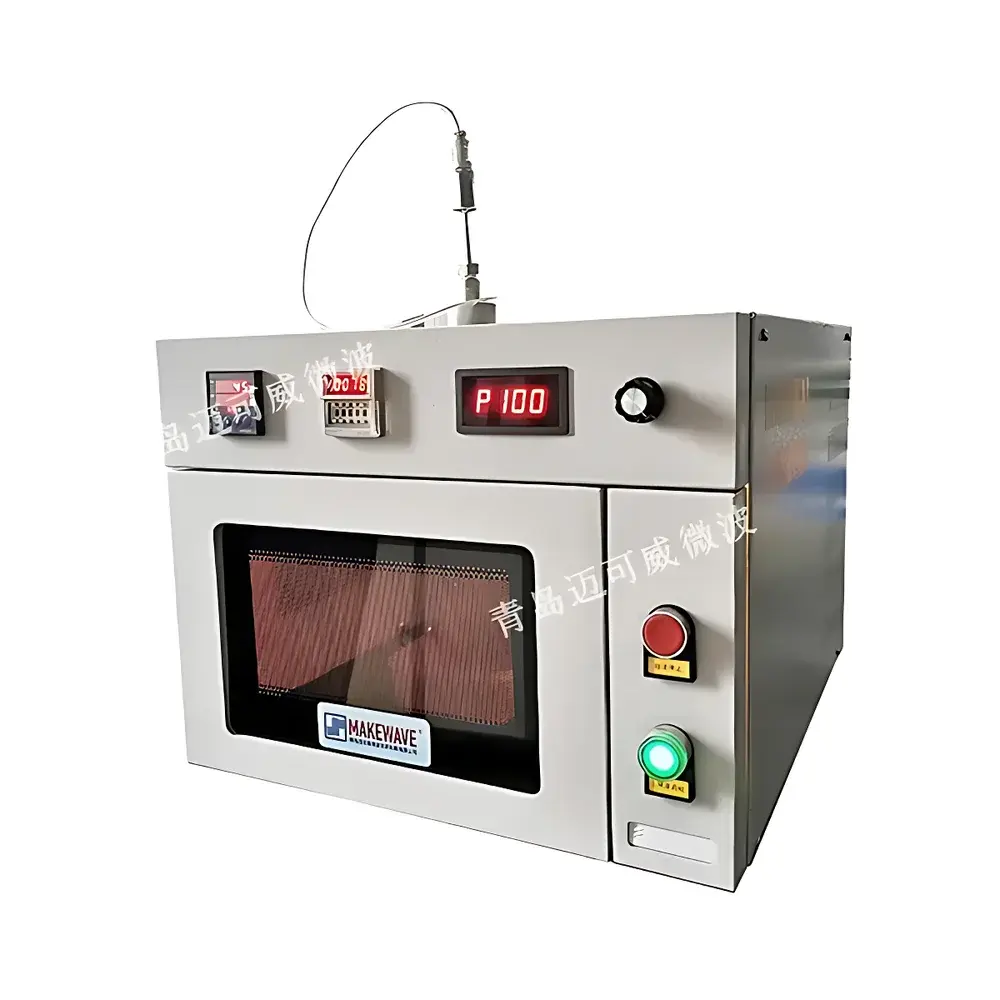
MakeWave MKX-J1A Microwave Performance Tester for Plastic Foodservice Ware
| Brand | MakeWave |
|---|---|
| Origin | Shandong, China |
| Manufacturer Type | Direct Manufacturer |
| Origin Category | Domestic (China) |
| Model | MKX-J1A |
| Pricing | Upon Request |
Overview
The MakeWave MKX-J1A Microwave Performance Tester is a purpose-built laboratory-grade microwave system engineered for standardized evaluation of microwave safety and thermal stability in plastic foodservice ware. Designed explicitly to fulfill the test requirements of GB 18006.1–2009 *General Technical Requirements for Disposable Plastic Tableware*, this instrument performs two critical regulatory assessments: (i) high-frequency heating performance (Clause 5.4.7.1), verifying absence of arcing, physical defects, off-odor, or abnormal behavior under controlled microwave exposure; and (ii) microwave thermal resistance (Clause 5.4.7.2), assessing deformation, leakage, cracking, or functional degradation after sustained heating. It also supports compliance verification per SN/T 1891 series standards—*Hygienic Standards for Microwave-Food Packaging Containers and Materials for Import and Export*. Unlike consumer-grade ovens, the MKX-J1A delivers metrologically traceable, repeatable exposure conditions via non-pulsed, continuously adjustable 2450 MHz microwave energy—enabling precise simulation of real-world microwave oven environments under documented laboratory controls.
Key Features
- Non-pulsed, continuously variable microwave output at 2450 MHz with nominal rated power of 800 W—ensuring stable, linear power delivery without duty-cycle artifacts that compromise thermal uniformity or test repeatability.
- Integrated thermocouple-based contact temperature measurement system, supporting insertion-type monitoring across a validated operational range of 0–300 °C with direct digital readout and real-time logging capability.
- Programmable control interface enabling independent setting and synchronization of microwave power level, exposure duration (0.1–9999 s resolution), and target temperature thresholds—fully compliant with GB-defined test protocols.
- Rotating glass turntable (standard configuration) to promote homogeneous field distribution and minimize localized hot-spot formation during testing—critical for evaluating spatially consistent thermal response in multi-component tableware.
- λ/4 choke-sealed door assembly with dual interlock circuitry: automatic microwave cutoff upon door actuation and RF leakage suppression maintained below 5 mW/cm² (measured per GB 5959.6 and IEC 60705)—exceeding national regulatory limits for occupational safety.
- Front-mounted observation window with RF-shielded quartz glass allows visual verification of sample integrity and dynamic behavior (e.g., warping, bubbling, arcing) throughout the entire test cycle without interrupting operation.
Sample Compatibility & Compliance
The MKX-J1A accommodates standard-sized plastic food containers, trays, lids, cups, and cutlery conforming to typical dimensions used in GB 18006.1–2009 validation studies (max. cavity volume ~18 L). Its chamber geometry and field homogeneity profile support representative testing of both single-layer and multilayer co-extruded polymer structures—including PP, PS, PET, PLA, and composite barrier materials. The system supports full documentation traceability required for GLP-compliant laboratories and quality assurance departments performing internal audits or supplier qualification. While not FDA-cleared as a medical device, its operational parameters align with test methodologies referenced in USP for polymeric packaging characterization and are routinely cited in technical dossiers submitted to Chinese NMPA and CIQ for import/export certification under SN/T 1891.
Software & Data Management
The MKX-J1A employs embedded microcontroller-based automation with local parameter storage (up to 99 user-defined test profiles). All active measurements—including real-time thermocouple voltage, applied power percentage, elapsed time, and door status—are timestamped and stored internally with non-volatile memory retention. Data export is supported via USB interface in CSV format for post-test analysis in Excel, MATLAB, or LIMS platforms. Audit trails include operator ID (optional password protection), session start/stop timestamps, and parameter change logs—facilitating adherence to ISO/IEC 17025 documentation requirements and supporting 21 CFR Part 11 readiness when integrated into validated QA workflows.
Applications
- Regulatory conformance testing for manufacturers seeking GB 18006.1–2009 certification of “microwave-safe” labeling claims.
- Pre-market validation of new polymer formulations intended for microwave-heated food packaging applications.
- Root-cause analysis of field failures (e.g., warping, odor generation, seal delamination) linked to microwave exposure conditions.
- Comparative thermal stress screening across material grades, wall thicknesses, or mold gate configurations.
- Supporting R&D labs in developing ASTM WK72843 (proposed standard for microwave susceptibility of food-contact plastics).
FAQ
Does the MKX-J1A meet international electromagnetic compatibility (EMC) standards?
Yes—the unit complies with GB/T 18268.1–2010 (equivalent to IEC 61326-1) for laboratory equipment EMC requirements, including radiated and conducted emissions testing.
Can the system be upgraded to support 2000 W testing per GB’s alternative protocol?
No—the MKX-J1A is calibrated and certified for 800 W continuous operation. For 2000 W capability, the MKX-J2A model is specified separately and includes reinforced magnetron cooling, enhanced waveguide design, and extended thermal management architecture.
Is third-party calibration documentation available?
Yes—each unit ships with a factory calibration certificate traceable to CNAS-accredited reference standards for power output (±3% accuracy) and thermocouple response (Class B tolerance per IEC 60584-2).
What maintenance intervals are recommended?
Annual inspection of door seal integrity, waveguide cleanliness, and thermocouple calibration drift is advised. No routine magnetron replacement is required under normal usage (<2 h/day average duty cycle).




