
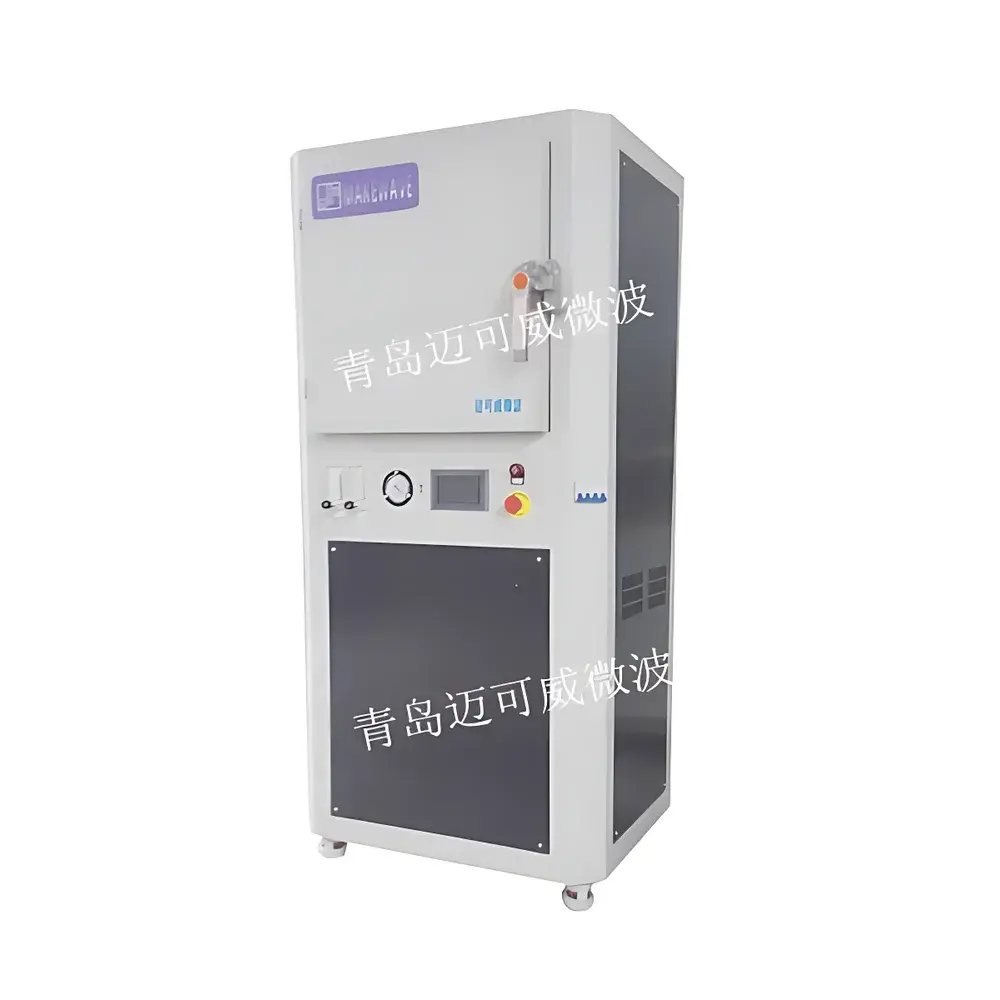
MakeWave MKZ/MGZ Series Microwave Vacuum Low-Temperature Dryer
| Brand | MakeWave |
|---|---|
| Origin | Shandong, China |
| Manufacturer Type | Direct Manufacturer |
| Country of Origin | China |
| Model Series | MKZ/MGZ |
| Price Range | USD 14,000 – 42,500 |
| Microwave Frequency | 2450 MHz |
| Max. Microwave Power | 1600 W (MKZ-G2A) / 3200 W (MKZ-G4A) / 8000 W (MGZ-G10A) |
| Cavity Volume | 28 L / 100 L / 300 L |
| Construction Material | AISI 304 Stainless Steel, Fully Welded Vacuum Chamber |
| Vacuum Level | −0.093 MPa (measured at Qingdao elevation) |
| Temperature Range | 0–300 °C (infrared non-contact measurement) |
| Pressure Monitoring | Full-range vacuum pressure sensor |
| Control System | PLC-based HMI with color touchscreen, multi-segment program storage & parameter export |
| Safety Compliance | Microwave leakage <5 mW/cm² (GB 10436-2008), interlocked door, explosion-proof design, corrosion-resistant coating (PTFE optional) |
| Dimensions (W×D×H) | 655×550×800 mm / 1360×800×1600 mm / 1550×900×1800 mm |
Overview
The MakeWave MKZ/MGZ Series Microwave Vacuum Low-Temperature Dryer is an engineered solution for gentle, high-efficiency sample dehydration in research laboratories, pharmaceutical development, and materials science applications. Unlike conventional vacuum ovens relying on conductive or convective heat transfer—processes severely impeded under low-pressure conditions—this system integrates resonant 2450 MHz microwave energy with high-vacuum environments to enable volumetric, selective heating of water molecules. The result is rapid, uniform internal moisture migration aligned with natural diffusion gradients, minimizing thermal degradation while preserving structural integrity, bioactivity, and chemical composition. Designed for operation between 30–60 °C under controlled vacuum (−0.093 MPa), the dryer supports lyophilization-grade outcomes without cryogenic infrastructure—eliminating sublimation energy demands inherent to freeze-drying. Its architecture complies with fundamental principles outlined in ASTM E2777-21 (Standard Guide for Validation of Drying Processes) and aligns with GLP-compliant environmental control expectations for pre-analytical sample stabilization.
Key Features
- Hybrid drying platform combining microwave dielectric heating (2450 MHz) and high-vacuum environment (≤−0.093 MPa), delivering ≥4× faster drying kinetics versus conventional vacuum ovens.
- Non-contact infrared temperature sensing (0–300 °C range) enables real-time, spatially resolved thermal feedback without probe interference or contamination risk.
- Closed-loop PID-controlled variable-frequency microwave power supply ensures continuous, non-pulsed output (0–1600/3200/8000 W), eliminating thermal inertia and enabling precise reaction endpoint control.
- Vacuum chamber constructed from fully welded AISI 304 stainless steel with optional PTFE anti-corrosion coating—designed for long-term exposure to organic solvents, acids, and alkaline residues.
- Integrated LED illumination and reinforced borosilicate viewport allow visual process monitoring without vacuum break or thermal interruption.
- Comprehensive safety architecture includes electromagnetic shielding (<5 mW/cm² per GB 10436-2008), door-position interlocks, explosion-relief venting, and redundant vacuum pressure monitoring.
Sample Compatibility & Compliance
The MKZ/MGZ series accommodates diverse sample formats—including powders, gels, biological tissues, polymer films, and botanical extracts—via configurable tray systems (single 260 mm disc; triple 350 mm stack; six-tier 500 mm configuration). Its low-temperature operational envelope preserves thermolabile compounds (e.g., enzymes, flavonoids, peptides) and prevents Maillard reactions or caramelization commonly observed above 60 °C. Vacuum compatibility extends to volatile solvent removal (e.g., ethanol, acetone, ethyl acetate) under Class IIA biosafety cabinet–compatible exhaust routing. System validation documentation supports IQ/OQ protocols required for ISO/IEC 17025-accredited labs and FDA-regulated environments where 21 CFR Part 11 data integrity is mandated.
Software & Data Management
Equipped with a programmable logic controller (PLC) and industrial-grade color touchscreen HMI, the dryer supports up to 20 independent drying programs with multi-stage time–power–vacuum profiles. All parameters—including real-time cavity temperature, vacuum level, cumulative microwave dose (kW·min), and elapsed cycle time—are timestamped and stored internally. Data export via USB or RS485 interface enables traceable integration into LIMS or ELN platforms. Audit trail functionality records operator ID, parameter changes, and alarm events—meeting ALCOA+ principles for data reliability in regulated quality systems.
Applications
- Pharmaceutical R&D: Stabilization of active pharmaceutical ingredients (APIs) and excipients prior to dissolution testing or solid-state characterization (XRD, DSC).
- Biological Sample Preparation: Dehydration of cell cultures, microbial pellets, and tissue sections without protein denaturation or nucleic acid fragmentation.
- Materials Science: Solvent removal from MOFs, aerogels, and nanocomposite precursors while retaining porosity and surface area.
- Food & Agricultural Research: Preservation of antioxidant capacity and pigment stability in fruit pulps, herbs, and algae biomass.
- Environmental Analysis: Concentration and stabilization of aqueous extracts from soil, sediment, or wastewater prior to GC-MS or ICP-MS analysis.
FAQ
What vacuum level can the MKZ/MGZ achieve, and how is it maintained?
The system achieves a base vacuum of −0.093 MPa using either a water-ring pump or oil-lubricated rotary vane pump (user-selectable), with continuous digital pressure monitoring and automatic pump modulation to sustain setpoint stability across drying cycles.
Is the microwave output truly continuous, or does it use duty-cycle pulsing?
It employs a frequency-tuned magnetron with analog power regulation—delivering smooth, non-pulsed microwave energy across the full 0–100% output range, critical for reproducible thermal profiles in sensitive samples.
Can this system be validated for GMP compliance?
Yes—hardware design (traceable component IDs, calibrated sensors, deterministic control logic) and software features (audit trail, electronic signatures, parameter lockout) support qualification per Annex 15 and EU GMP guidelines when implemented with documented SOPs and third-party calibration.
What maintenance is required for long-term vacuum integrity?
Routine inspection of O-rings, cleaning of vacuum line filters, and annual verification of pressure transducer accuracy are recommended; stainless steel chamber construction eliminates gasket degradation risks common in elastomer-sealed alternatives.
How does infrared temperature measurement perform inside a microwave field?
The IR sensor is shielded within a waveguide-isolated port and calibrated for emissivity compensation across common biological and polymeric surfaces—ensuring ±2 °C accuracy without perturbing the microwave mode distribution.



