
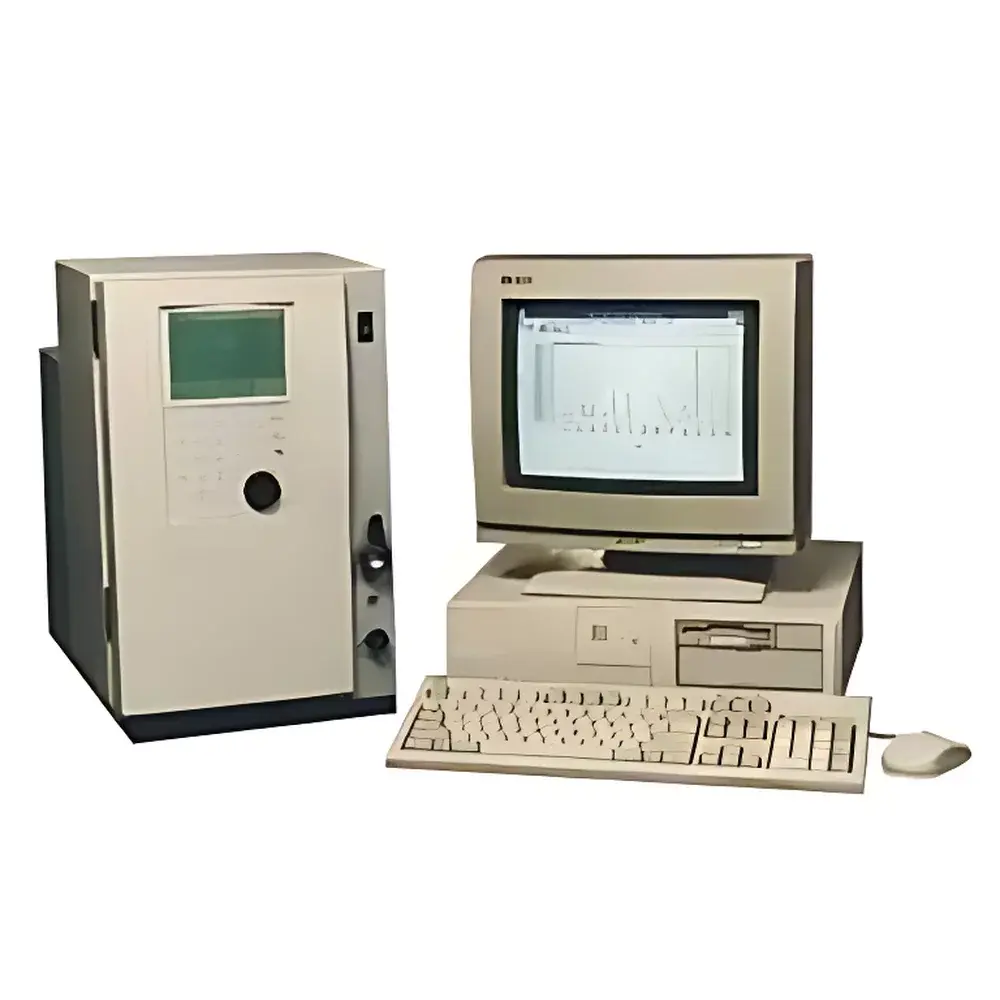
Malvern Panalytical Mastersizer 2000 Nanoparticle Size Analyzer
| Origin | USA |
|---|---|
| Manufacturer Type | Authorized Distributor |
| Origin Category | Imported |
| Model | Mastersizer 2000 |
| Price | Upon Request |
| Dispersion Method | Dry & Wet Dispersion |
| Measurement Range | 10 nm – 3 µm |
| Repeatability | <1% RSD |
| Analysis Time | ≤10 minutes |
Overview
The Malvern Panalytical Mastersizer 2000 Nanoparticle Size Analyzer is a high-precision laser diffraction-based instrument engineered for rapid, robust, and statistically rigorous particle size distribution (PSD) analysis across the nanoscale to sub-micron range. Unlike conventional ensemble-averaging techniques that rely on mathematical inversion algorithms and implicit assumptions about particle shape or refractive index, the Mastersizer 2000 implements a hybrid measurement architecture integrating patented Capillary Hydrodynamic Fractionation (CHDF) pre-separation with orthogonal laser diffraction detection. In CHDF mode, particles are physically segregated by hydrodynamic diameter within precision-bore capillaries under laminar flow conditions—enabling true physical fractionation prior to optical interrogation. This eliminates model-dependent bias in multimodal or polydisperse systems and delivers experimentally resolved, assumption-free distributions. The system operates independently of particle density, morphology, or optical anisotropy—making it uniquely suited for colloidal dispersions, protein aggregates, liposomes, metal oxides, and polymer nanoparticles where conventional dynamic light scattering (DLS) or standard laser diffraction yield ambiguous or non-reproducible results.
Key Features
- True physical fractionation via Capillary Hydrodynamic Fractionation (CHDF), enabling resolution of particle populations differing by ≥10% in hydrodynamic diameter
- Measurement range spanning 10 nm to 3 µm with single-run capability and no manual range switching
- Analysis time ≤10 minutes per sample—including dispersion, equilibration, and full distribution acquisition
- Integrated environmental monitoring: real-time pH, conductivity, and temperature logging during analysis
- Thermostatically controlled sample cell (optional Peltier module) for temperature-dependent stability studies
- Disposable, pre-calibrated CHDF capillaries—eliminating carryover and reducing maintenance downtime
- Dual dispersion compatibility: fully automated dry powder dispersion (via Aero S disperser) and wet dispersion (via Hydro EV or Hydro SM cells)
- 24/7 operational readiness with optional Autosampler (up to 120 vials), supporting unattended QC batch analysis
Sample Compatibility & Compliance
The Mastersizer 2000 accommodates aqueous and organic suspensions, emulsions, nanoemulsions, lyophilized reconstitutes, and low-concentration colloids without dilution artifacts. Its CHDF-based workflow complies with ISO 13320:2020 (laser diffraction particle sizing) and supports audit-ready workflows aligned with FDA 21 CFR Part 11 requirements when deployed with Malvern’s certified software configuration. Instrument qualification protocols (IQ/OQ/PQ) are documented per GMP Annex 15 and ASTM E2918–22 (standard guide for validation of particle characterization methods). All hardware components—including optical bench, detector array, and fluidic modules—undergo factory calibration traceable to NIST SRM standards.
Software & Data Management
Controlled by Malvern’s proprietary Mastersizer Software v6.x, the platform provides validated, role-based access control, electronic signature support, and full audit trail functionality for GLP/GMP environments. Data export conforms to ASTM E1447 and USP guidelines. The software includes advanced deconvolution tools for resolving overlapping modes, statistical comparison modules (e.g., Kolmogorov–Smirnov test), and customizable reporting templates compliant with internal SOPs or regulatory submission formats (e.g., CTD Module 3.2.P.5). Raw intensity data, Mie theory fitting parameters, and CHDF residence time histograms are retained in native .dat format for secondary analysis.
Applications
This instrument is routinely deployed in pharmaceutical development (nanomedicine formulation, vaccine adjuvant characterization), semiconductor slurry QC (CMP slurries), battery cathode nanomaterial grading, catalyst nanoparticle sintering analysis, and advanced coating R&D (e.g., TiO₂ pigment dispersion stability). Its ability to resolve bimodal distributions—such as primary nanoparticles versus agglomerates—in complex matrices has been cited in peer-reviewed publications from University of Delaware (Langmuir, 2021) and Yonsei University (ACS Nano, 2023). Industrial users—including BASF, Dow Chemical, Intel Corp., and Procter & Gamble—leverage its CHDF capability for release testing of nanoscale excipients and process consistency verification across manufacturing sites.
FAQ
Does the Mastersizer 2000 require refractive index input for accurate sizing?
No—CHDF separation is hydrodynamic-diameter-based and independent of optical properties; refractive index is only required if Mie theory modeling is applied post-acquisition for comparative interpretation.
Can it distinguish between crystalline and amorphous nanoparticles of identical size?
Not directly—the system reports hydrodynamic size distribution only; complementary techniques (e.g., XRD or DSC) are recommended for phase identification.
Is method transfer possible between different Mastersizer 2000 units?
Yes—hardware standardization, NIST-traceable calibration, and identical CHDF capillary geometry ensure inter-instrument comparability per ISO 21501-4.
What maintenance is required for CHDF capillaries?
Capillaries are single-use consumables; no cleaning or recalibration is needed. Each batch is supplied with certificate of conformance and dimensional verification report.
How does it handle highly viscous or shear-sensitive samples?
Low-shear CHDF flow profiles (Re < 1) and programmable flow rate ramping minimize disruption to fragile aggregates or viscoelastic colloids.



