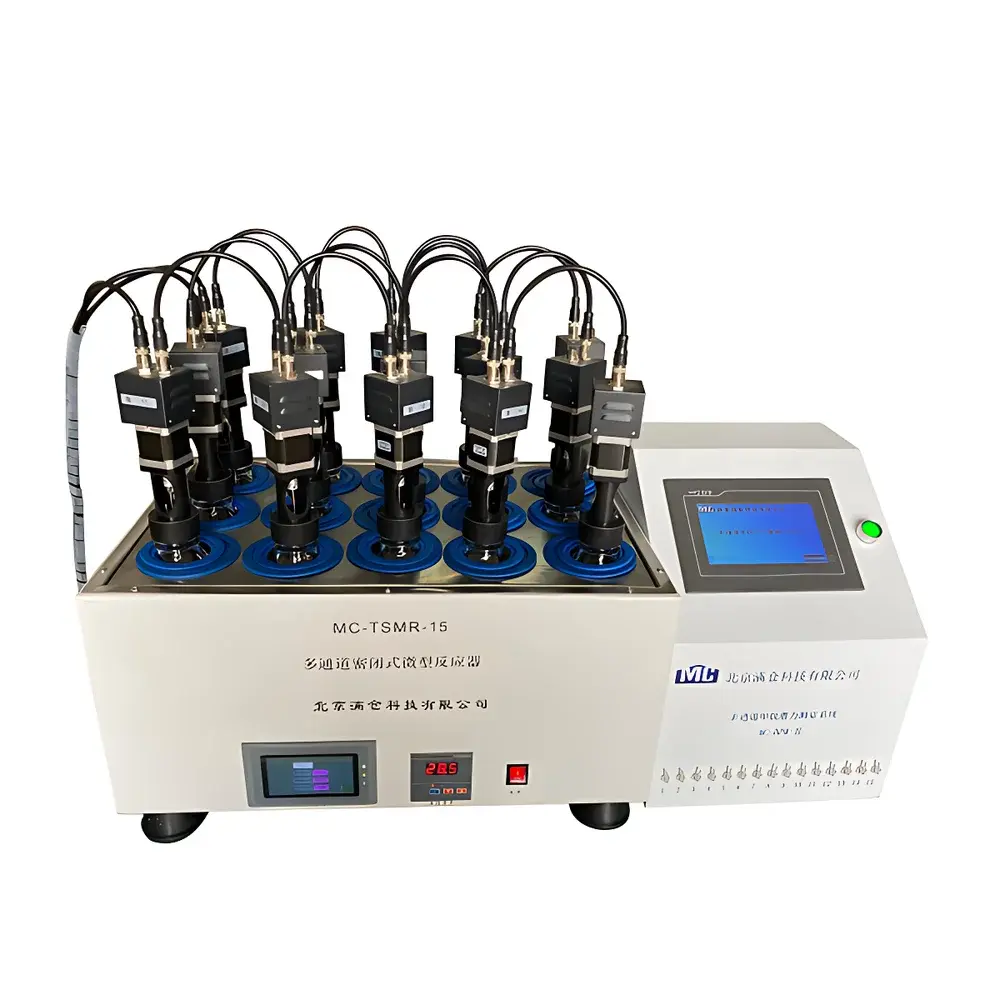
Mancang MC-BMP-II Biochemical Methane Potential (BMP) Test System
| Brand | Mancang |
|---|---|
| Origin | Beijing, China |
| Manufacturer Type | Direct Manufacturer |
| Model | MC-BMP-II |
| Reactor Volume | 0.5 L (500 mL) |
| Max. Reactors per System | 15 |
| Gas Flow Range | 0–6000 mL/h |
| Resolution | 8 mL |
| Measurement Accuracy | ±0.01 mL |
| Temperature Control Range | Ambient to 95 °C (±0.1 °C) |
| Stirring Speed | 10–250 rpm (adjustable) |
| CO₂ Absorption Efficiency | >98% |
| CO₂ Absorption Vessel Capacity | 100 mL (80 mL of 3 M NaOH + indicator) |
| Power Supply | 24 V DC / 220 V AC adapter |
| Display | 7-inch color touchscreen |
| Compliance | Designed for ASTM D5210, ISO 11734, and EU Directive 2009/28/EC compliant BMP testing protocols |
Overview
The Mancang MC-BMP-II Biochemical Methane Potential (BMP) Test System is a dedicated laboratory-scale platform engineered for precise, reproducible quantification of methane yield from organic substrates under controlled anaerobic digestion conditions. It operates on the principle of volumetric gas displacement with real-time temperature- and pressure-corrected measurement, converting raw gas volume into standardized conditions (273.15 K, 101.325 kPa) using integrated PT sensors. This ensures comparability across experiments and alignment with internationally recognized BMP test standards—including ASTM D5210 (“Standard Test Method for Determining the Anaerobic Biodegradation of Plastic Materials in the Presence of Municipal Sewage Sludge”), ISO 11734 (“Anaerobic Biodegradation of Organic Compounds in Aqueous Medium—Determination of the Ultimate Anaerobic Biodegradability”), and the European Union’s Renewable Energy Directive (2009/28/EC) requirements for biogas feedstock characterization. The system supports batch-mode parallel fermentation across up to 15 independent reactors, enabling statistically robust evaluation of substrate-specific methanogenic activity, process kinetics, and inhibition thresholds.
Key Features
- Hermetic Mechanical Stirring Seals: Each high-borosilicate glass reactor (500 mL) employs a precision-engineered rotating shaft seal that eliminates CH4 leakage while maintaining strict anaerobic integrity—critical for accurate cumulative gas yield calculation.
- High-Resolution Multi-Channel Gas Quantification: Eight-milliliter resolution across a 8–6000 mL/h flow range, with coefficient of variation ≤0.1% and detection limit below 1 mL/day—optimized for low-rate, long-duration BMP assays typical of lignocellulosic or inhibitory substrates.
- Real-Time Environmental Compensation: Onboard temperature and absolute pressure sensors continuously correct measured gas volumes to STP, eliminating post-hoc normalization errors and ensuring metrological traceability.
- Modular CO2 Scrubbing Architecture: Configurable absorption train with up to 15 dedicated 100 mL scrubbers containing 80 mL of 3 M NaOH + phenolphthalein indicator; achieves >98% CO2 removal efficiency to isolate CH4-specific volume data.
- Integrated Touchscreen Control Interface: 7-inch color LCD display provides live visualization of cumulative CH4 volume, instantaneous production rate (mL CH4/h), reactor temperature, stirring speed, and historical trend overlays—all accessible without external PC dependency.
- Expandable Sensor Integration: Pre-wired ports support optional add-on modules including online pH monitoring (±0.1 pH unit), ORP sensing (±10 mV), and infrared-based CH4 concentration analysis (0–100% v/v), enabling advanced process diagnostics beyond volumetric yield.
Sample Compatibility & Compliance
The MC-BMP-II accommodates diverse feedstocks relevant to environmental engineering and circular bioeconomy research: municipal wastewater sludge, food waste, agricultural residues (e.g., corn stover, rice straw), energy crops, co-digestion blends, and pretreated biomass. Its inert wetted path—comprising borosilicate glass reactors, PTFE-coated fittings, and chemically resistant tubing—is compatible with mildly corrosive biogas constituents (H2S ≤ 500 ppm, NH3 ≤ 200 ppm). All operational protocols adhere to GLP-aligned documentation practices: audit-trail-enabled data logging, timestamped event records, and U盘-exportable CSV/Excel files meet minimum requirements for regulatory submissions under EPA Method 9040C and EU Water Framework Directive Annex V reporting frameworks.
Software & Data Management
Embedded firmware delivers full-cycle data governance: continuous acquisition at 1 Hz sampling, automatic baseline drift correction, and real-time curve fitting (first-order kinetic modeling, Gompertz parameter estimation). Data are stored locally on internal flash memory (≥12 months at 1-min intervals for 15 channels) and exportable via USB 2.0 to portable drives in ISO-compliant formats. No proprietary software installation is required; exported datasets conform to FAIR principles (Findable, Accessible, Interoperable, Reusable) and integrate natively with MATLAB, Python (pandas/scipy), and R for advanced statistical analysis. Audit logs record operator ID, method version, calibration timestamps, and sensor health status—supporting 21 CFR Part 11 readiness when paired with institutional electronic signature infrastructure.
Applications
- Quantitative assessment of biochemical methane potential (BMP) for novel organic feedstocks prior to full-scale digester deployment.
- Comparative evaluation of pretreatment efficacy (thermal, enzymatic, alkaline) on methane yield and lag-phase reduction.
- Co-digestion synergy screening across binary/multi-component substrate mixtures to maximize volumetric productivity.
- Acute toxicity testing of inhibitors (e.g., heavy metals, antibiotics, VFAs) on methanogenic consortia using IC50 derivation.
- Long-term stability monitoring of inoculum activity across sequential batch assays under varying OLRs and HRTs.
- Method validation studies supporting accreditation to ISO/IEC 17025 for environmental testing laboratories.
FAQ
What standards does the MC-BMP-II comply with for BMP testing?
The system is designed to execute test protocols aligned with ASTM D5210, ISO 11734, and OECD 311, with hardware specifications (temperature stability, gas measurement uncertainty, CO2 scrubbing efficiency) validated against these normative references.
Can the system operate unattended for extended periods (e.g., 60+ days)?
Yes—the embedded controller maintains stable thermal regulation (±0.1 °C), continuous gas logging, and automatic error recovery; power loss events trigger safe state retention and resume-on-power restoration.
Is third-party calibration certification available?
Mancang provides NIST-traceable calibration reports for pressure and temperature sensors; flow calibration uses certified dry gas meters per ISO 6145-1, with optional UKAS-accredited verification.
How is data integrity ensured during multi-user lab environments?
Each assay session requires operator login; all modifications to methods or parameters are logged with user ID and timestamp, satisfying basic ALCOA+ data governance criteria.
What maintenance is required for long-term reliability?
Annual replacement of NaOH absorbent solution and periodic inspection of stirrer O-rings and gas-tight seals constitute routine upkeep; no consumables beyond reagents are required for core operation.
Related Products