Mancang MC-BMP-III Automated Biochemical Methane Potential (BMP) Test System
| Brand | Mancang |
|---|---|
| Origin | Beijing, China |
| Manufacturer Type | Direct Manufacturer |
| Model | MC-BMP-III |
| Application Fields | Environmental Engineering (Wastewater Treatment, Activated Sludge Assessment) |
| Gas Measurement Resolution | 3.5 mL |
| Gas Flow Range | 0–6000 mL/h |
| Reactor Volumes | 250 mL / 500 mL / 1000 mL |
| Maximum Concurrent Reactors per System | 3 / 6 / 9 / 12 / 15 / 20 channels |
| Temperature Control Range | Ambient to 95 °C (±0.1 °C accuracy) |
| Stirring Speed | 10–250 rpm (magnetically coupled, gas-tight) |
| CO₂ Absorption Efficiency | >98% (using 3 M NaOH) |
| Data Interface | 15″ capacitive touchscreen HMI with embedded PLC control (MCBIO-6000 platform) |
| Software Features | Real-time cumulative CH₄ volume & instantaneous production rate calculation, ASTM/ISO-compliant BMP reporting, GLP-aligned audit trail, USB data export, remote desktop & mobile app supervision |
Overview
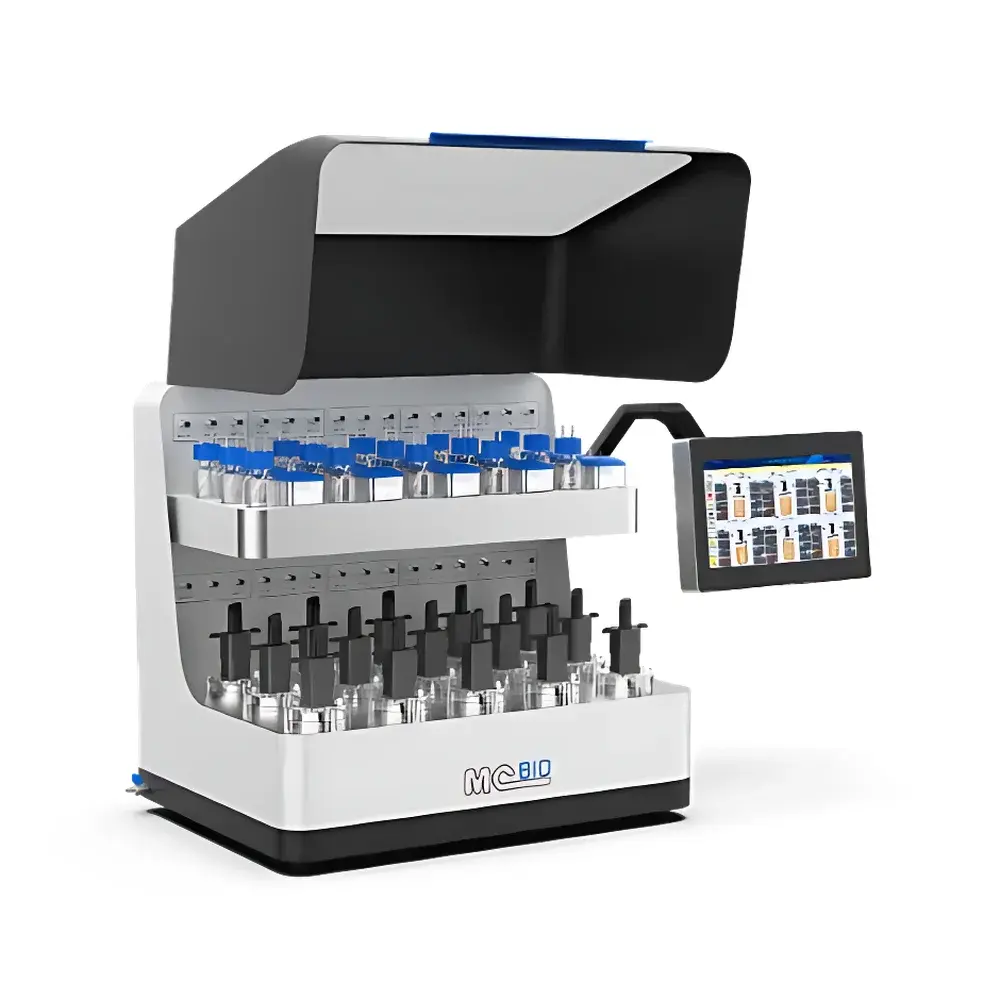
The Mancang MC-BMP-III Automated Biochemical Methane Potential (BMP) Test System is an engineered solution for standardized, high-reproducibility quantification of methane yield from organic substrates under controlled anaerobic digestion conditions. Based on the internationally recognized BMP assay protocol (ISO 11734, ASTM D5210, and VDI 4630), this system implements a gravimetrically calibrated water displacement principle—modified with real-time temperature and pressure compensation—to convert raw gas volume readings into normalized methane volumes at standard temperature and pressure (STP: 273.15 K, 101.325 kPa). Designed specifically for environmental laboratories conducting process feasibility studies, substrate co-digestion optimization, and biogas plant design validation, the MC-BMP-III delivers trace-level gas resolution (3.5 mL) and sub-daily detection sensitivity (<1 mL/d), enabling statistically robust kinetic modeling of methanogenic activity across diverse feedstocks—including sewage sludge, agricultural residues, food waste, and industrial effluents.
Key Features
- Gas-tight magnetic coupling agitation: Eliminates shaft seals and mechanical penetrations, ensuring zero methane leakage during long-term incubation (up to 60 days) and preserving stoichiometric integrity of measured CH₄ accumulation.
- Multi-channel volumetric gas measurement: Simultaneous monitoring of up to 20 independent reactors via precision-displacement sensors, each equipped with integrated PT (pressure–temperature) transducers for automatic STP correction.
- Modular CO₂ scrubbing architecture: Configurable 15-position NaOH absorption manifold (3 M solution, pH-indicated) achieving >98% CO₂ removal efficiency—critical for isolating CH₄-specific yield without chromatographic separation.
- Embedded MCBIO-6000 control platform: Industrial-grade PLC core with 15″ capacitive touchscreen HMI; supports programmable ramp profiles for temperature, stirring speed (10–250 rpm), and timed sampling events.
- Compliance-ready software stack: Local touchscreen interface + Windows-based desktop client + cross-platform mobile application (iOS/Android); all modules enforce user role management, electronic signatures, and FDA 21 CFR Part 11–compatible audit trails.
- Expandable sensor integration: Optional plug-in modules for in situ pH, ORP, dissolved CH₄ concentration (via infrared or electrochemical sensors), and automated liquid dosing—enabling dynamic process parameter feedback loops.
Sample Compatibility & Compliance
The MC-BMP-III accommodates heterogeneous solid–liquid mixtures typical of environmental engineering workflows: suspended solids up to 15% TS, fibrous lignocellulosic biomass, granular anaerobic sludge, and pre-acidified substrates. All wetted components—including 500 mL borosilicate glass or optically transparent acrylic reactors—are chemically resistant to alkaline digestates and sulfide-rich headspace environments. The system conforms to ISO 11734:1995 (determination of BMP of organic materials), ASTM D5210-92 (standard test method for determining anaerobic biodegradation of plastic materials), and VDI 4630 (German guideline for biogas yield testing). Full traceability is maintained through timestamped metadata embedding (reactor ID, inoculum ratio, TS/VS loading, pH initial value) directly into exported CSV/Excel reports compliant with GLP documentation requirements.
Software & Data Management
Data acquisition, visualization, and post-processing occur within a unified software environment featuring dual-mode operation: standalone HMI mode (touchscreen only) and networked supervisory mode (remote desktop or mobile app). Each reactor channel displays real-time cumulative CH₄ (mL CH₄-STP/g VS added), instantaneous production rate (mL CH₄-STP/h), and derivative metrics including lag phase duration, maximum specific methane yield (SMP), and hydrolysis rate constants. All raw sensor data are logged at 1 Hz resolution with automatic backup to internal eMMC storage and external USB drives. Export formats include ISO-compliant BMP summary tables, time-series graphs (PNG/SVG), and machine-readable JSON for integration with LIMS or MATLAB-based kinetic modeling suites. Audit logs record every parameter change, user login/logout, calibration event, and report generation—satisfying GxP and regulatory inspection readiness.
Applications
- Feasibility screening of novel feedstocks (e.g., microalgae, spent coffee grounds, distillers grains) prior to full-scale digester commissioning.
- Quantitative assessment of inhibitory effects (ammonia, VFAs, heavy metals) on methanogenic consortia using dose–response BMP assays.
- Optimization of co-digestion ratios between low-C:N and high-N substrates to maximize methane yield while maintaining process stability.
- Validation of pretreatment efficacy (thermal, enzymatic, ultrasonic) on recalcitrant lignocellulosic materials.
- Supporting carbon credit verification under methodologies such as VM001 (Verra) or AMS-III.AU (CDM), where BMP-derived baseline methane yields inform emission reduction calculations.
- Academic research in microbial ecology, syntrophic acetate oxidation, and interspecies electron transfer mechanisms in anaerobic consortia.
FAQ
What standards does the MC-BMP-III comply with for BMP testing?
The system implements measurement protocols aligned with ISO 11734, ASTM D5210, and VDI 4630. Its STP correction algorithm, CO₂ scrubbing validation, and reporting templates are structured to meet peer-review and regulatory submission requirements.
Can the system operate unattended for extended incubation periods?
Yes—designed for continuous 24/7 operation over 60+ days, with battery-backed real-time clock, non-volatile data logging, and automatic error recovery after power interruption.
Is it possible to integrate third-party gas analyzers (e.g., GC or NDIR) with this system?
The MC-BMP-III provides analog (4–20 mA) and digital (RS485 Modbus RTU) I/O ports for synchronization with external CH₄/CO₂ analyzers, enabling hybrid volumetric–compositional yield determination.
How is temperature uniformity maintained across multiple reactors?
Each reactor sits in a precision water bath (480 × 340 × 250 mm) with PID-controlled heating and circulation; thermal mapping confirms ±0.1 °C deviation across all positions at setpoints between 35 °C (mesophilic) and 55 °C (thermophilic).
Does the software support statistical comparison of BMP results across experimental groups?
Yes—the desktop analysis module includes built-in ANOVA, Tukey’s HSD, and regression tools for inter-group significance testing, with confidence intervals calculated per ISO 11734 Annex B guidelines.