
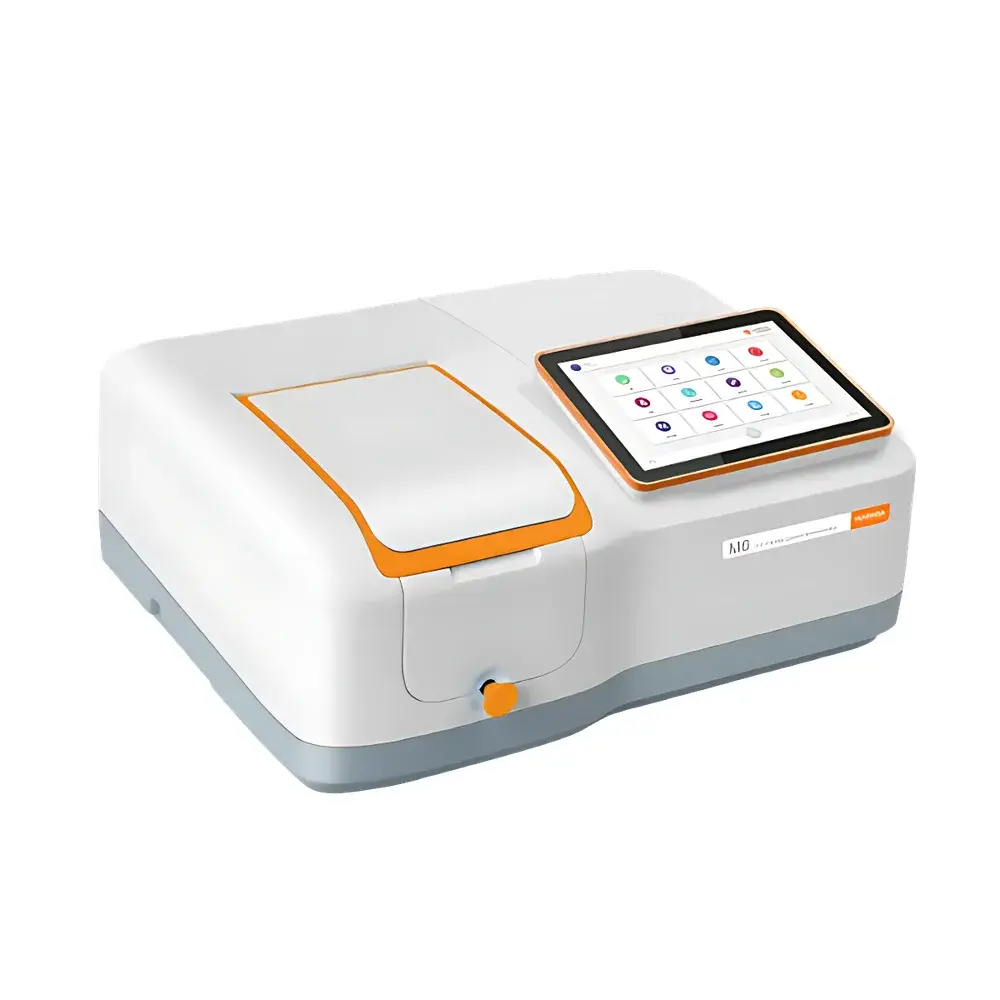
Mapada M6 Dual-Beam UV-Vis Spectrophotometer with Pulsed Xenon Lamp
| Brand | Mapada |
|---|---|
| Origin | Shanghai, China |
| Manufacturer Type | Direct Manufacturer |
| Instrument Architecture | Dual-Beam |
| Detector Type | Photocell |
| Wavelength Range | 190–1100 nm |
| Wavelength Accuracy | ±0.5 nm |
| Spectral Bandwidth | 2 nm |
| Wavelength Scanning Mode | Automatic |
| Housing Material | Reinforced Engineering Plastic with Aluminum Alloy Base Structure |
| Sample Compartment Design | Removable Front Panel, Damped Hinged Lid (0–120° Position Lock), Integrated Spill Drain Port |
Overview
The Mapada M6 is a dual-beam ultraviolet-visible (UV-Vis) spectrophotometer engineered for routine quantitative and qualitative analysis in academic laboratories, quality control environments, and industrial R&D settings. It employs a pulsed xenon lamp as its broadband light source—eliminating warm-up time, minimizing thermal drift, and extending source lifetime compared to traditional deuterium/tungsten halogen lamp combinations. The optical design follows the classic double-beam configuration, where incident light is split into sample and reference paths using a rotating mirror or beam splitter; real-time ratioing of intensities corrects for source fluctuation and detector drift, ensuring high photometric stability and measurement reproducibility. With a spectral range spanning 190–1100 nm, the M6 supports applications from nucleic acid quantification at 260 nm to near-infrared (NIR) absorbance measurements of organic solvents or polymers. Its 2 nm spectral bandwidth complies with ISO 9001 and ASTM E275 verification protocols for routine spectrophotometric performance assessment.
Key Features
- Dual-beam optical architecture with real-time reference correction for enhanced baseline stability and reduced photometric noise.
- Pulsed xenon lamp illumination: no warm-up required, <10⁶ shot lifetime, low heat generation, and uniform intensity across UV and visible regions.
- Sample compartment engineered with functional ergonomics: hinged lid equipped with hydraulic damping mechanism enabling precise positioning between 0° and 120°; integrated spill drain port prevents liquid accumulation and cross-contamination during cuvette handling.
- Modular front panel design allows rapid replacement of cuvette holders—including standard 10 mm pathlength, micro-volume, and multicell configurations—without tools or recalibration.
- Structural integrity optimized via aerospace-grade aluminum alloy base casting and high-impact engineering plastic housing, delivering mechanical rigidity essential for long-term wavelength repeatability and vibration resistance.
- Automatic wavelength scanning and peak detection algorithms support method-driven operation, including fixed-wavelength absorbance, kinetic assays, and spectral scanning with user-defined resolution steps.
Sample Compatibility & Compliance
The M6 accommodates standard quartz, glass, and plastic cuvettes (10 mm pathlength default), as well as specialized accessories such as temperature-controlled cells and fiber-optic probes (via optional adapters). Its optical alignment and stray light suppression (<0.05% at 220 nm) meet the performance criteria outlined in USP , ISO/IEC 17025, and CLSI EP10-A3 guidelines for analytical instrument validation. While not certified under FDA 21 CFR Part 11 out-of-the-box, the system supports audit-trail-enabled software upgrades compliant with GLP/GMP documentation requirements when deployed with validated third-party data acquisition platforms.
Software & Data Management
The M6 operates with Mapada’s proprietary SpectraSoft Suite—a Windows-based application supporting instrument control, spectral acquisition, quantitative analysis (including multi-point calibration curves, factor-based concentration calculation, and DNA/RNA purity ratios), and report export in CSV, PDF, and XML formats. Raw spectral data are stored with embedded metadata (date/time stamp, operator ID, instrument serial number, lamp usage hours). Software versioning, user-level access control, and electronic signature options are available through licensed enterprise modules aligned with ISO/IEC 17025 Clause 7.7 on result reporting integrity.
Applications
- Quantitative determination of pharmaceutical actives per USP and EP 2.2.25 methods.
- Enzyme kinetics monitoring (e.g., NADH/NADPH oxidation at 340 nm) under controlled temperature conditions.
- Water quality analysis: nitrate, phosphate, and heavy metal complexation assays per APHA Standard Methods.
- Material science: thin-film transmittance/absorbance profiling and bandgap estimation of semiconductor coatings.
- Educational use: demonstration of Beer-Lambert law, spectral interference studies, and comparative solvent polarity effects.
FAQ
Does the M6 require lamp alignment or manual wavelength calibration during routine operation?
No. The pulsed xenon lamp and fixed grating monochromator eliminate the need for periodic lamp centering or wavelength calibration checks. A single factory-set wavelength verification using holmium oxide or didymium filters satisfies ISO 6326-1 traceability requirements.
Is the spill drain port compatible with corrosive solvents such as concentrated acids or organic halides?
Yes—the drain channel and surrounding compartment surfaces are coated with chemically resistant epoxy-polyester hybrid finish, rated for intermittent exposure to pH 1–12 solutions and common organic solvents per ASTM D1308.
Can the M6 interface with LIMS or ERP systems?
Yes, via RS-232 or USB-to-serial emulation mode; raw data output conforms to ASTM E1382-95 standard ASCII format for direct ingestion into laboratory information management systems.
What is the recommended maintenance interval for the xenon lamp?
Lamp replacement is advised after 1×10⁶ pulses or 2,000 operating hours—whichever occurs first—as indicated by the built-in pulse counter and software diagnostic log.
Does the instrument support compliance with pharmacopeial validation protocols?
Yes. The M6 meets system suitability test (SST) criteria for resolution, absorbance accuracy, and photometric linearity per USP when used with certified reference materials and documented operational qualification (OQ) procedures.





