
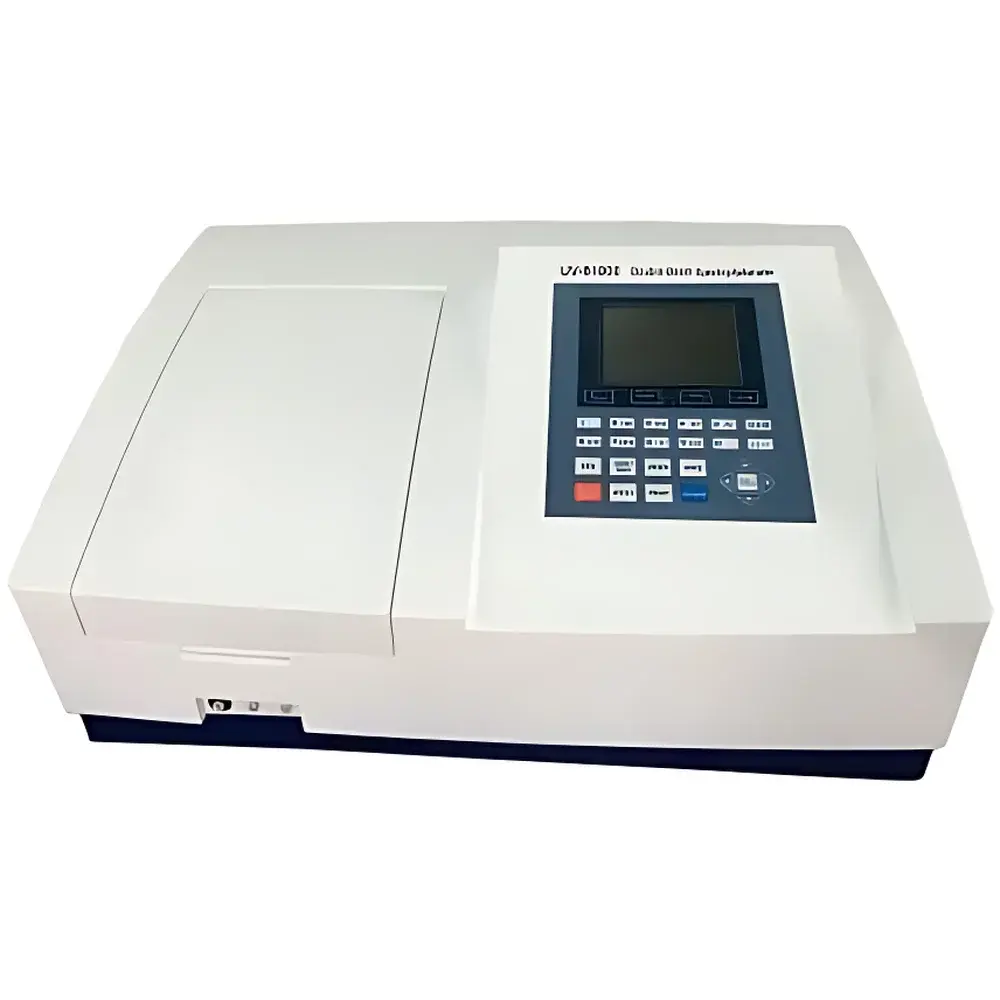
Mapada UV-6100B and UV-6100BS Dual-Beam Ultraviolet-Visible Spectrophotometers
| Brand | Mapada |
|---|---|
| Origin | Shanghai, China |
| Model | UV-6100B, UV-6100BS |
| Optical System | Dual-beam |
| Detector | Photodiode Array |
| Wavelength Range | 190–1100 nm |
| Spectral Bandwidth | 1.8 nm (UV-6100B), 0.5/1/2/4/5 nm (UV-6100BS) |
| Wavelength Accuracy | ±0.3 nm |
| Wavelength Repeatability | ≤0.1 nm |
| Stray Light | ≤0.03% T at 220 nm and 360 nm |
| Photometric Accuracy | 0.2% T (0–100% T), ±0.002 A (0–0.5 A), ±0.004 A (0.5–1 A) |
| Photometric Repeatability | ≤0.15% T (0–100% T), 0.001 A (0–0.5 A), 0.002 A (0.5–1 A) |
| Baseline Flatness | ±0.001 A |
| Drift | ±0.0003 A/h at 500 nm |
| Noise | ±0.0003 A |
| Scan Speed | Up to 3800 nm/min (high mode) |
| Display | 320 × 240 pixel, 5-inch LCD |
| Data Interface | USB port |
| Power Supply | AC 220 V/50 Hz or AC 110 V/60 Hz |
| Dimensions | 590 × 420 × 260 mm |
| Weight | 26 kg |
Overview
The Mapada UV-6100B and UV-6100BS are dual-beam ultraviolet-visible (UV-Vis) spectrophotometers engineered for high-precision quantitative and qualitative analysis across academic, pharmaceutical, environmental, and industrial laboratories. Based on the Beer–Lambert law, these instruments measure absorbance, transmittance, concentration, and kinetic response by comparing sample and reference beam intensities in real time—eliminating errors from source fluctuation and detector drift. The optical architecture integrates a high-efficiency 1200 lines/mm holographic grating with a dual-beam path design, enabling stable baseline performance and enhanced photometric reproducibility. Both models operate across a broad spectral range of 190–1100 nm, covering deep UV through near-infrared regions—critical for nucleic acid quantification, enzyme kinetics, dye characterization, and impurity profiling in raw materials.
Key Features
- Dual-beam optical configuration with real-time reference compensation ensures long-term measurement stability and minimizes baseline drift during extended scans.
- High-resolution 5-inch LCD display (320 × 240 pixels) supports intuitive navigation and direct visualization of absorption spectra, standard curves, time-based kinetics, and wavelength scanning plots—all in English-language interface.
- Optimized light source system featuring imported long-life deuterium and tungsten-halogen lamps; ozone-reduced deuterium lamp design improves lab safety and operational sustainability.
- Plug-and-play lamp module architecture eliminates post-replacement optical alignment—reducing downtime and technician dependency.
- Wide sample compartment accommodates cuvettes from 5 mm to 100 mm pathlength, supporting both microvolume and macro-scale measurements without accessory modification.
- Integrated GLP self-validation function enables on-demand verification of wavelength accuracy and photometric linearity per internal calibration protocols—generating traceable validation reports compliant with laboratory quality systems.
- Robust mechanical construction (26 kg mass, rigid aluminum alloy chassis) provides vibration resistance and thermal stability in shared instrumentation environments.
Sample Compatibility & Compliance
The UV-6100B and UV-6100BS accommodate standard quartz, glass, and plastic cuvettes (10 mm default), as well as specialized cells for turbid, viscous, or low-volume samples when used with optional accessories. Instrument performance aligns with key international standards including ISO 6425 (spectrophotometer performance testing), ASTM E275 (description of UV-Vis spectrophotometric terminology), and USP (Spectrophotometry and Light-Scattering). While not FDA 21 CFR Part 11–certified out-of-the-box, the systems support audit-trail-capable data export via Mapada’s professional scanning software—enabling integration into GxP-compliant workflows when paired with validated computer systems and procedural controls.
Software & Data Management
The included Mapada Professional Scanning Software (v3.x or later) provides full remote instrument control via USB interface. Functions include multi-wavelength quantitative analysis, spectrum overlay, derivative spectroscopy, peak identification, and kinetic method programming. All spectral data are saved in vendor-neutral CSV and ASCII formats, facilitating import into MATLAB, Origin, or Python-based analytical pipelines. Internal memory stores up to 500 spectra and 200 calibration curves; external storage is supported via USB flash drives. Print output is enabled through parallel port connectivity to legacy lab printers—ensuring compatibility with existing infrastructure without requiring network upgrades.
Applications
These spectrophotometers serve core analytical roles in QC/QA labs performing routine assays per pharmacopeial monographs (e.g., USP , EP 2.2.25), including assay of active pharmaceutical ingredients (APIs), excipient purity checks, and dissolution profile monitoring. In academic settings, they support teaching of fundamental spectroscopic principles and research in photochemistry, nanomaterial characterization (e.g., gold nanoparticle LSPR), and protein folding studies using intrinsic tryptophan absorbance. Environmental applications include COD determination, nitrate/nitrite quantification, and heavy metal complexation analysis via colorimetric reagents. The UV-6100BS variant—with its variable slit width (0.5–5 nm)—offers added flexibility for resolving narrow absorption bands in conjugated organic molecules or optimizing signal-to-noise ratio in low-concentration trace analysis.
FAQ
What is the difference between UV-6100B and UV-6100BS?
The UV-6100BS features a variable spectral bandwidth selector (0.5, 1, 2, 4, or 5 nm), while the UV-6100B maintains a fixed 1.8 nm bandwidth—making the BS model more suitable for high-resolution applications requiring optimized resolution versus sensitivity trade-offs.
Does the instrument support compliance with ISO/IEC 17025 requirements?
Yes—the built-in GLP self-check, wavelength and photometric accuracy verification routines, and traceable calibration reporting support documented instrument qualification per ISO/IEC 17025 Section 6.4 and Annex A.
Can the spectrophotometer be integrated into a LIMS environment?
Direct LIMS integration is not native, but ASCII/CSV data export and programmable scan methods enable middleware-based automation using standard scripting tools (e.g., Python pySerial, LabVIEW drivers).
Is a PC required for operation?
No—the standalone mode supports full functionality via front-panel controls and LCD display; however, advanced data processing, report generation, and method archiving require connection to a Windows PC running Mapada software.
What maintenance is recommended for optimal performance?
Biannual verification of wavelength accuracy and stray light using NIST-traceable holmium oxide and sodium nitrate filters is advised; lamp replacement intervals are tracked automatically and typically occur every 1,000–2,000 hours of operation.





