
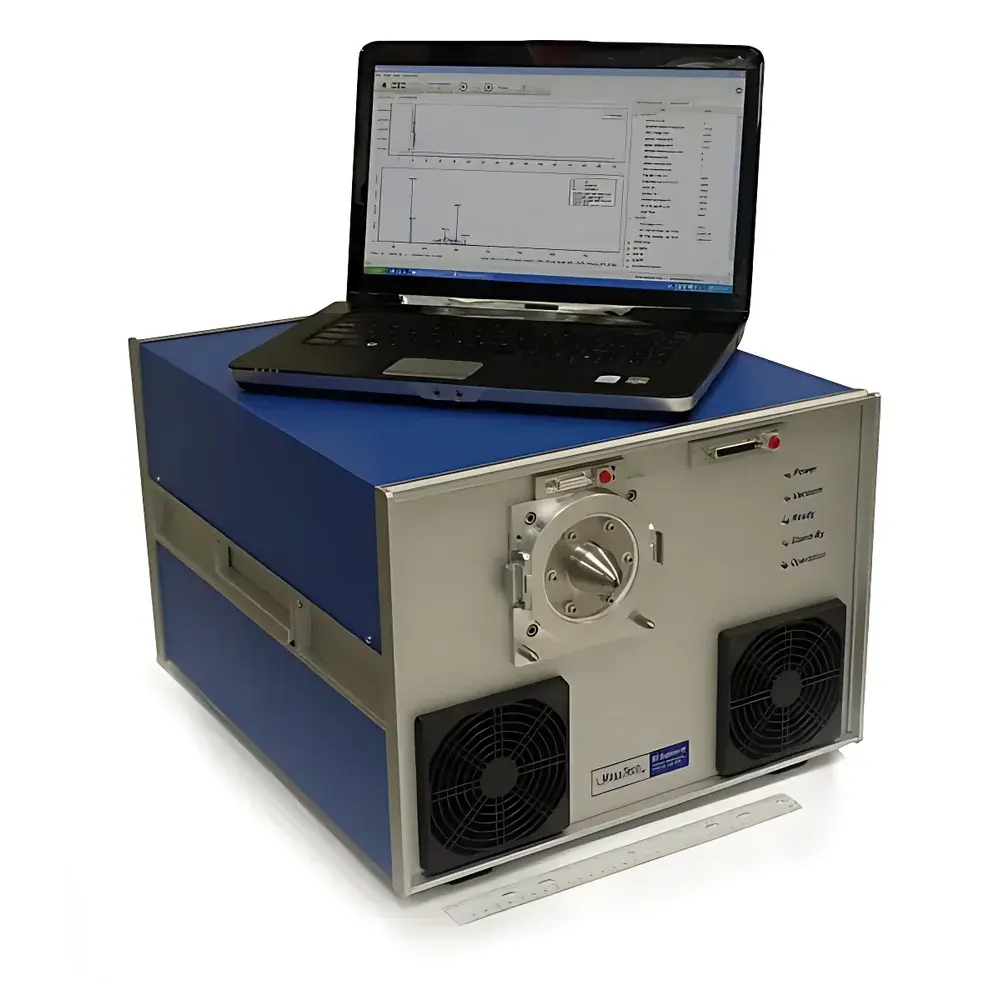
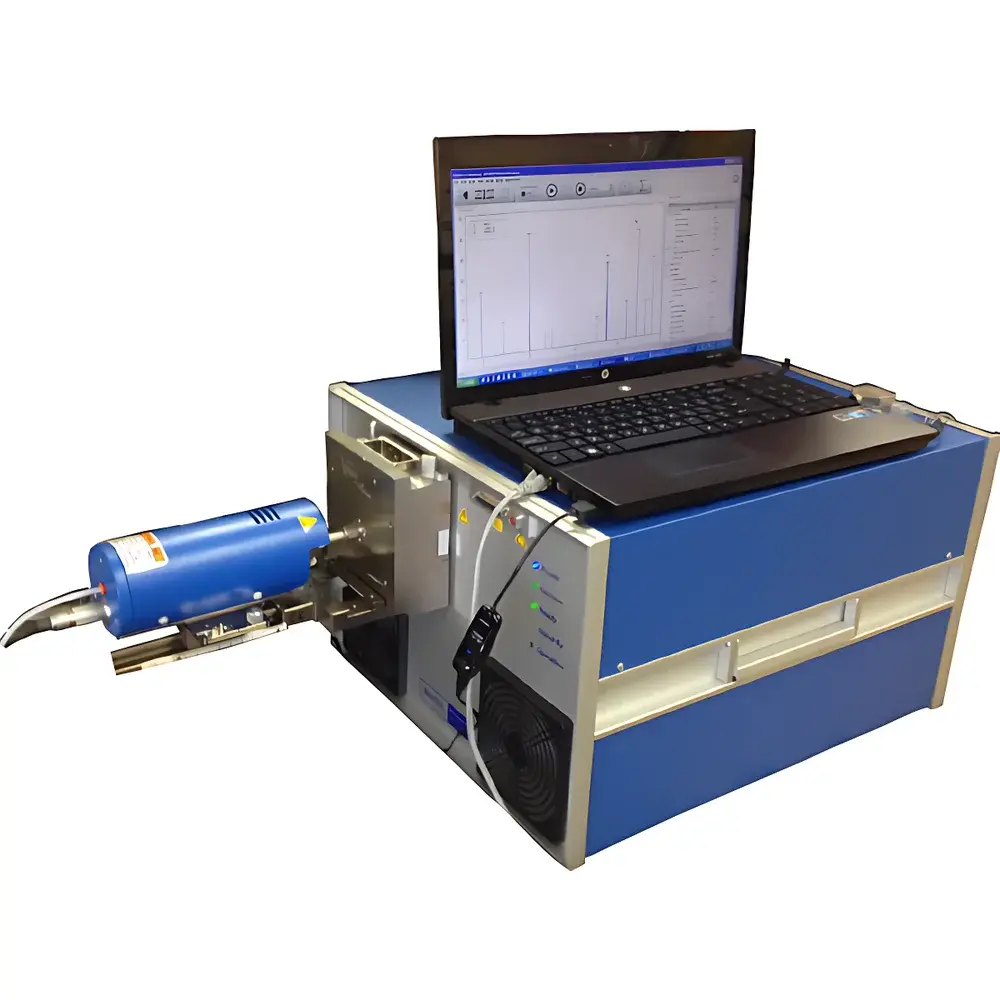
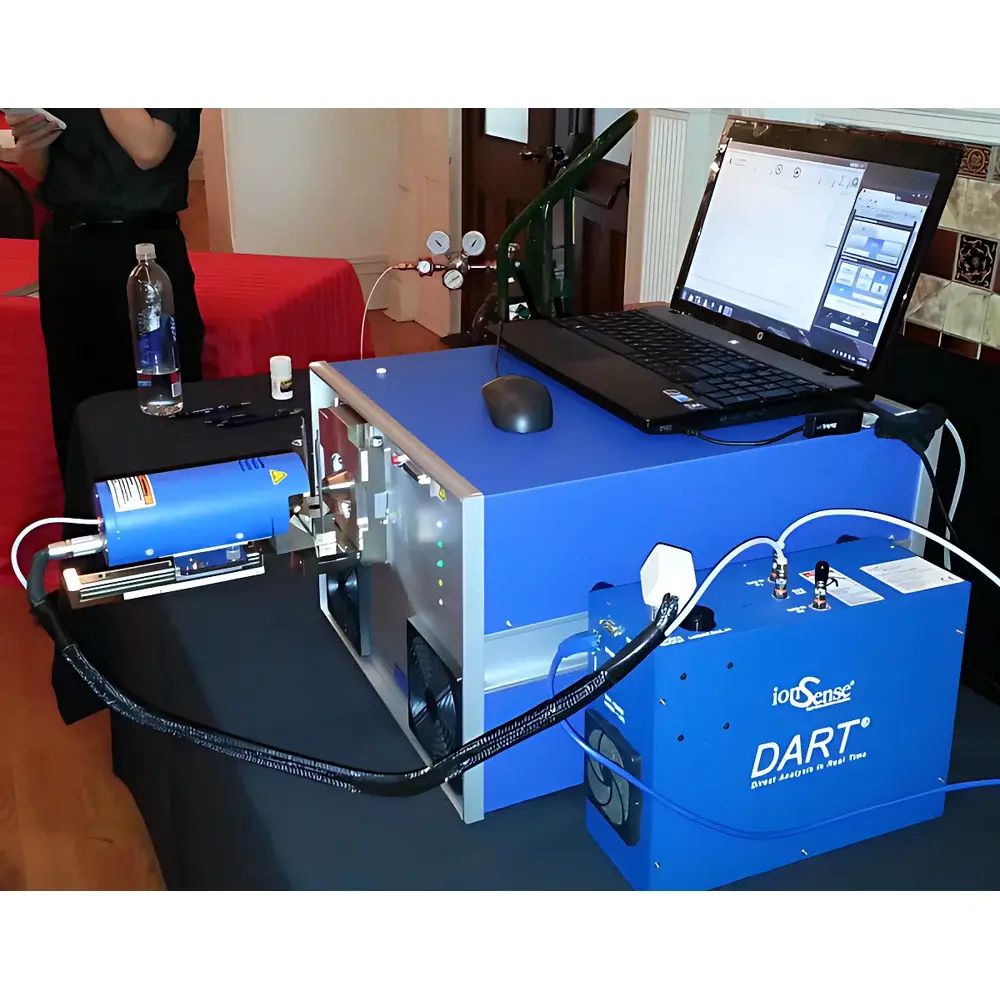
MassTech MT50 Portable 3D Ion Trap Mass Spectrometer
| Brand | MassTech (ASPEC as authorized distributor) |
|---|---|
| Origin | USA |
| Instrument Type | 3D Ion Trap Mass Spectrometer |
| Model | MT50 |
| Mass Range | 30–2500 amu |
| Sensitivity | 50 pg/µL reserpine, S/N ≥ 10:1 |
| Resolution | 6000 (FWHM at m/z 400) |
| Mass Accuracy | ±0.3 amu |
| Scan Speed | 1000–8000 amu/s or up to 5 spectra/sec |
| Ionization Compatibility | ESI, oESI, 2ndESI, APCI, DART, AP/MALDI |
| Power Input | 90–240 VAC, 50/60 Hz |
| Power Consumption | 250–300 W |
| Dimensions (L×W×H) | 51 × 43 × 30 cm |
| Weight | <35 kg |
| Operating Mode | MS¹ and MSⁿ (up to MS⁵) |
| Polarity | Positive/Negative Switchable |
| Gas Requirement | None (gas-free operation) |
| Transport | Shock-damped wheeled case |
Overview
The MassTech MT50 is a second-generation portable 3D ion trap mass spectrometer engineered for high-fidelity, on-site molecular analysis in resource-constrained or non-laboratory environments. Unlike conventional benchtop ion trap systems, the MT50 integrates a miniaturized, robust 3D quadrupole ion trap architecture—designed from decades of fundamental ion physics research—to deliver laboratory-grade spectral fidelity without requiring vacuum pumps, compressed gas supplies, or climate-controlled rooms. Its core measurement principle relies on RF/DC trapping, resonant ejection, and sequential isolation/collision-induced dissociation (CID) within a single compact trap volume, enabling true MSn capability (up to MS5) with high mass accuracy and reproducible fragmentation pathways. The system is purpose-built for field-deployable chemical identification and structural elucidation of small molecules, lipids, metabolites, peptides, glycans, and synthetic polymers—particularly where rapid decision-making is critical, such as food authenticity verification, environmental contaminant screening, forensic evidence triage, or pharmaceutical process monitoring.
Key Features
- True portable 3D ion trap platform: No external gas cylinders, no roughing pumps, no liquid nitrogen or cryogens required.
- Field-rugged mechanical design: Validated under NASA-relevant vibration, shock, and thermal cycling protocols; operational across –10 °C to +45 °C ambient range.
- Modular ion source compatibility: Native support for ESI, oESI, 2ndESI, APCI, DART, and AP/MALDI—enabling direct analysis of solids, liquids, gases, and irregular surfaces without sample preparation.
- High-duty-cycle MSn acquisition: Real-time precursor selection, isolation, and CID across up to five generations—critical for confident structural annotation and library matching.
- Integrated power management: Operates on AC mains (90–240 VAC) or DC input (e.g., vehicle battery via optional converter); average power draw remains stable between 250–300 W during full-scan and MSn sequences.
- Serviceable architecture: Tool-free ion source and trap access; field-replaceable RF electronics modules; calibration verified using internal lock-mass references (e.g., cesium iodide clusters).
Sample Compatibility & Compliance
The MT50 accommodates diverse sample physical states—including viscous oils, powders, plant tissues, polymer films, aqueous extracts, and volatile headspace vapors—through its multi-modal ionization interface. When coupled with DART, it enables ambient desorption/ionization of thermally labile compounds directly from packaging, skin, currency, or soil substrates. Regulatory alignment includes support for data integrity frameworks compliant with FDA 21 CFR Part 11 (audit trail, electronic signatures, user access control), ISO/IEC 17025 method validation documentation, and GLP/GMP-aligned instrument qualification packages (IQ/OQ/PQ). All firmware and acquisition software undergo annual cybersecurity patching per NIST SP 800-53 controls.
Software & Data Management
Acquisition and processing are managed via MassTech’s proprietary MT-Suite v4.x, a Windows-based application featuring real-time spectrum visualization, automated peak detection, isotopic pattern deconvolution, and embedded NIST/EPA/HRMS spectral libraries. Raw data files (.mt5) are stored in vendor-neutral HDF5 format with embedded metadata (instrument parameters, operator ID, GPS timestamp, environmental sensor logs). Batch processing supports quantitative workflows using internal standard normalization, with export options for CSV, mzML, and .mzXML—ensuring interoperability with third-party platforms including Skyline, XCMS Online, and OpenMS. Audit trails record all parameter changes, calibration events, and data exports with immutable timestamps.
Applications
- Food Fraud Detection: Species authentication (e.g., fish, meat, dairy) in <5 seconds via lipidomic fingerprinting; detection of adulterants (e.g., melamine, Sudan dyes) at sub-ppm levels.
- Environmental Field Screening: Rapid identification of PAHs, PCBs, pesticides, and microplastic additives in soil, water, or air filters—without solvent extraction.
- Forensic Chemistry: On-scene analysis of illicit drugs, explosives residues, and ignitable liquids on trace evidence (fabric, paper, glass).
- Pharmaceutical QA/QC: In-process monitoring of reaction intermediates, impurity profiling, and excipient compatibility testing during API synthesis.
- Clinical & Biopharma: Point-of-care lipidomics/metabolomics for biomarker discovery in serum, urine, or dried blood spots—compatible with CE-MS and LC-MS front-ends.
FAQ
Is the MT50 compliant with regulatory data integrity requirements?
Yes—the system supports 21 CFR Part 11-compliant audit trails, role-based user authentication, and electronic signature workflows when configured with validated MT-Suite settings.
Can the MT50 be used for quantitative analysis?
Yes—its linear dynamic range spans four orders of magnitude, and sensitivity meets USP and ICH Q2(R2) criteria for method validation when paired with appropriate internal standards and calibration curves.
Does the MT50 require routine maintenance by certified engineers?
No—field-serviceable components include the ion source assembly, RF driver module, and detector board; routine cleaning and recalibration can be performed by trained end users following documented SOPs.
What is the typical turnaround time from sample introduction to spectrum acquisition?
Under DART mode, signal acquisition begins within 1–2 seconds of sample exposure; full-scan MS¹ spectra are acquired every 200 ms, with MS² spectra generated within 1.5 seconds of precursor selection.
Is remote operation supported?
Yes—MT-Suite includes secure TLS-encrypted remote desktop access and RESTful API endpoints for integration into LIMS or automated sampling robotics.
Related Products





