
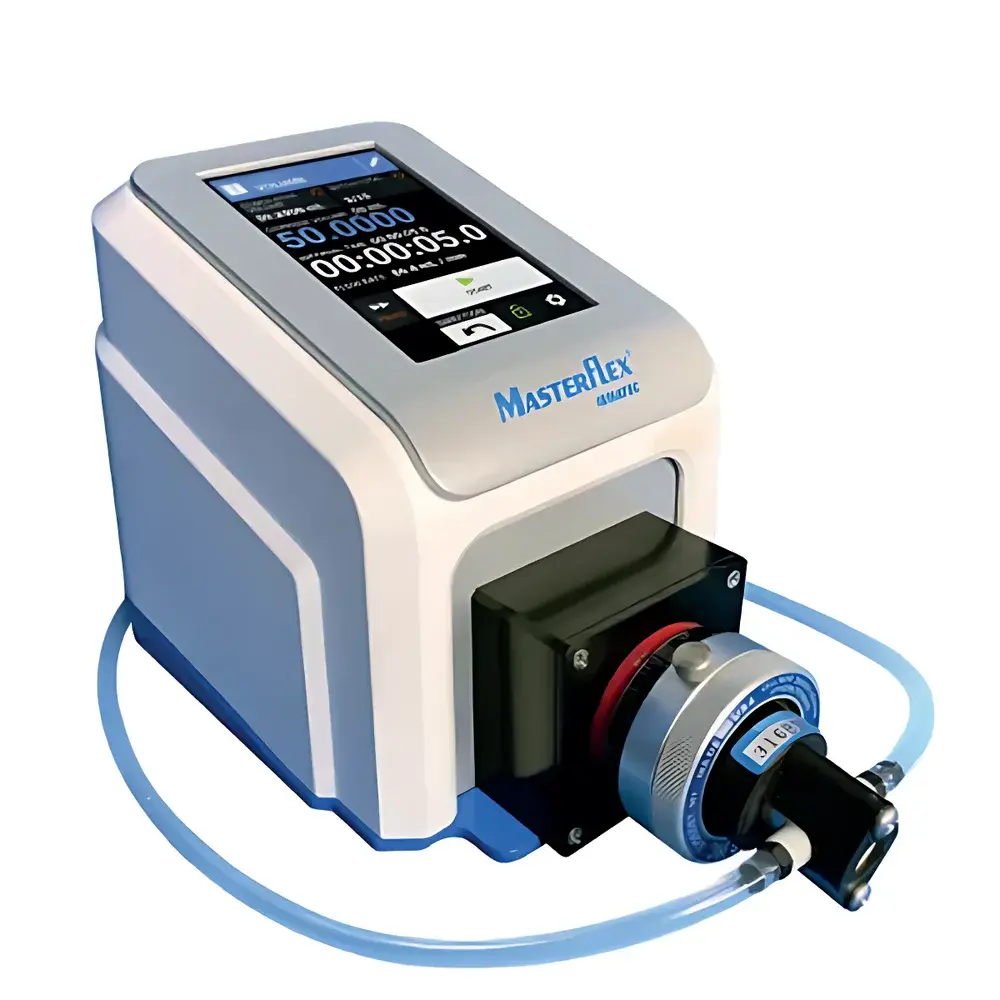
Masterflex® ISMATEC® Reglo Digital Miniflex 4-Channel 6-Roller Peristaltic Pump
| Brand | Masterflex |
|---|---|
| Origin | USA |
| Model | Reglo Digital Miniflex |
| Pump Type | Peristaltic Pump |
| Channel Count | 4 |
| Roller Count per Head | 6 |
| Display | 5" Capacitive TFT/RGB Touchscreen (12.7 cm) |
| Operating Modes | Continuous, Volume Dispensing, Timed Dispensing |
| Pump Head Compatibility | Miniflex Standard Tubing Cartridge System |
| User Access Levels | Three-Tier Authentication |
Overview
The Masterflex® ISMATEC® Reglo Digital Miniflex is a high-precision, multi-channel peristaltic pump engineered for laboratory-scale fluid handling where accuracy, repeatability, and operational flexibility are critical. Utilizing the well-established peristaltic principle—where rollers compress flexible tubing to generate positive displacement—the Reglo Digital Miniflex delivers contamination-free, pulse-dampened flow without exposing fluids to valves, seals, or wetted metal components. Its four independent channels operate simultaneously yet individually, each driven by a dedicated 6-roller pump head that ensures smooth occlusion, reduced tube fatigue, and extended tubing life. Designed for integration into analytical workflows, bioprocessing setups, and automated sampling systems, this pump meets the stringent demands of GLP-compliant laboratories and regulated QC environments requiring traceable, auditable operation.
Key Features
- Four fully independent peristaltic channels with synchronized or asynchronous control via intuitive 5-inch capacitive TFT/RGB touchscreen (12.7 cm diagonal), offering wide viewing angles and responsive haptic feedback.
- 6-roller pump heads optimized for low-pulse delivery and enhanced volumetric accuracy—particularly advantageous for shear-sensitive media such as cell suspensions, enzymes, or polymer solutions.
- Three operational modes: Continuous (constant RPM), Volume Dispensing (target volume with adjustable ramp-up/down and anti-drip logic), and Timed Dispensing (programmable on/off cycles with customizable interval and dwell times).
- Onboard program memory supports storage and recall of up to 32 user-defined dispensing protocols—including tube ID, speed, volume, timing parameters, and ramp profiles—enabling rapid reconfiguration between assays.
- Three-tier user access control (Operator, Supervisor, Administrator) enforces role-based permissions for parameter modification, program editing, and system configuration—supporting compliance with FDA 21 CFR Part 11 requirements when paired with validated software logging.
- Analog remote interface (0–10 V / 4–20 mA) allows seamless integration with PLCs, SCADA systems, or custom automation platforms for centralized process orchestration.
Sample Compatibility & Compliance
The Reglo Digital Miniflex accommodates standard ISMATEC-compatible tubing sizes (e.g., PharMed® BPT, Norprene®, Viton®) ranging from 0.5 mm to 4.8 mm inner diameter, supporting flow rates from 1,200 mL/min per channel depending on tubing selection and rotational speed (0.1–120 rpm). Its tubing-centric architecture eliminates cross-contamination risk and enables rapid changeover between incompatible chemistries or sterile/non-sterile applications. The pump complies with IEC 61000-6-2 (EMC immunity) and IEC 61000-6-4 (EMC emissions) standards. When deployed in pharmaceutical or clinical research settings, its programmable audit trail capabilities—when used with external data acquisition software meeting ALCOA+ principles—facilitate adherence to ISO 17025, USP , and GMP Annex 11 expectations.
Software & Data Management
While the Reglo Digital Miniflex operates autonomously via its embedded firmware, it supports bidirectional communication through RS-232 and USB-B interfaces. Optional ISMATEC PumpControl software (Windows-based) provides advanced scheduling, real-time flow monitoring, event logging with timestamps, and export of CSV-formatted operation records. All parameter changes, program executions, and user logins can be captured with digital signatures and time-stamped metadata—critical for regulatory submissions and internal quality audits. Firmware updates are delivered via signed binary packages to ensure integrity and version traceability.
Applications
- Automated reagent dispensing in ELISA, PCR setup, and microplate washing systems.
- Continuous perfusion in bioreactors and hollow-fiber cell culture modules.
- Calibration standard delivery in ICP-MS, HPLC, and ion chromatography sample introduction lines.
- Controlled nutrient or inhibitor infusion in neuroscience microdialysis or organ-on-chip platforms.
- Low-shear transfer of fragile biologics—including viral vectors and exosomes—during purification and formulation steps.
- Environmental water analysis: timed sampling from multiple source points into preservation vials or autosampler racks.
FAQ
What tubing sizes are compatible with the Miniflex 4-channel pump head?
The pump accepts ISMATEC-standard tubing cartridges with inner diameters from 0.5 mm to 4.8 mm; recommended part numbers include 96410-xx series for PharMed BPT and 96400-xx for Norprene.
Can the pump be integrated into a LabVIEW or Python-controlled automation system?
Yes—RS-232 and USB-B interfaces support ASCII command protocol; full command reference and example scripts (including PySerial implementations) are available in the technical documentation portal.
Does the device support electronic signature and audit trail functionality out-of-the-box?
The hardware logs user actions and execution events internally; full 21 CFR Part 11 compliance requires deployment with validated third-party data management software and documented procedural controls.
How is tubing life monitored or predicted?
No built-in wear sensor exists, but the firmware tracks cumulative runtime per channel and allows manual entry of tubing batch IDs and replacement dates—enabling preventive maintenance scheduling via external CMMS integration.
Is calibration required, and if so, how often?
Volumetric calibration is recommended before first use and after tubing replacement; periodic verification (e.g., gravimetric testing per ASTM D3231) should occur at intervals defined by risk assessment—typically every 3–6 months in regulated environments.



