
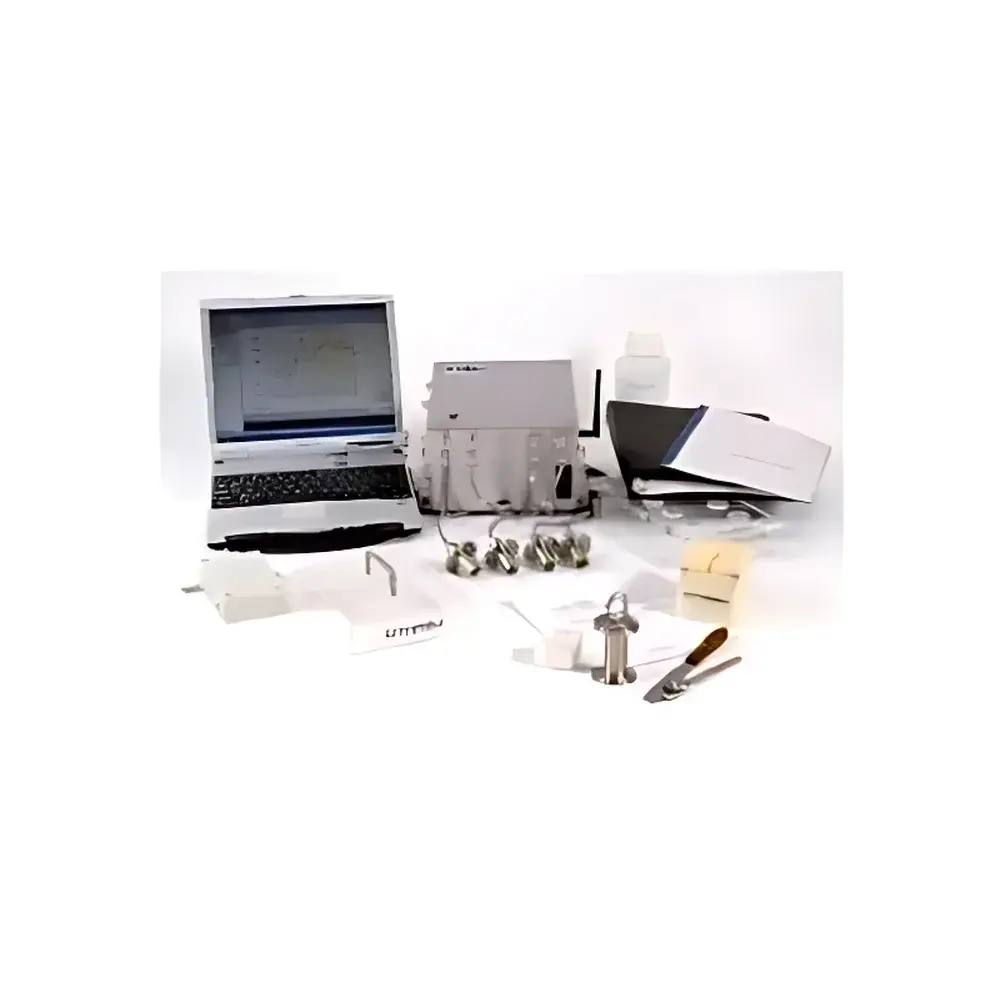
MATHIS ESP™ Pharmaceutical Blend Uniformity Monitoring System
| Brand | MATHIS |
|---|---|
| Origin | Canada |
| Model | ESP™ |
| Application Domain | In-line blend uniformity monitoring for solid dosage forms |
| Measurement Principle | Differential thermal sensing (calorimetric-based mixing signature analysis) |
| Sample Forms | Dry powders, granules, semi-solids, suspensions, waxy matrices |
| Compliance Context | Designed to support FDA Process Analytical Technology (PAT) initiative, aligned with ICH Q8(R2), Q9, and Q10 |
Overview
The MATHIS ESP™ Pharmaceutical Blend Uniformity Monitoring System is an engineered PAT (Process Analytical Technology) solution designed for real-time, non-invasive assessment of powder blend homogeneity during dry mixing operations in pharmaceutical manufacturing. Unlike traditional off-line assays—such as HPLC or UV spectrophotometry—that require sampling, sample preparation, and time-delayed analysis, the ESP™ system operates continuously in-line or at-line using differential thermal sensing technology. This principle relies on detecting subtle, transient thermal signatures generated when dissimilar particles interact under shear and compression within a mixer. Variations in heat flow reflect differences in composition distribution, enabling quantitative tracking of blend evolution from initial segregation to statistical homogeneity—and beyond, into over-mixing regimes. The system is specifically validated for use with high-potency actives, low-dose formulations, and complex multi-component blends where content uniformity (CU) is critical per USP <905> and Ph. Eur. 2.9.40.
Key Features
- In-line thermal signature acquisition with sub-second temporal resolution, enabling detection of blend state transitions without physical contact or material loss
- Calibration-free operation for qualitative trend monitoring; optional quantitative calibration against reference methods (e.g., NIR, Raman) for correlation to assay results
- Modular hardware architecture compatible with V-blenders, bin blenders, and high-shear mixers via standardized flange-mounted sensor ports
- Real-time visualization of blend trajectory via normalized thermal variance index (TVI), with configurable alarm thresholds for under- and over-mixing conditions
- IP65-rated enclosure with stainless-steel wetted parts compliant with ASME BPE surface finish standards (Ra ≤ 0.8 µm)
- Embedded temperature compensation algorithms to mitigate ambient and equipment thermal drift during extended batch runs
Sample Compatibility & Compliance
The ESP™ system accommodates a broad spectrum of pharmaceutical process streams: free-flowing and cohesive powders (including lactose, microcrystalline cellulose, and API blends), wet granulations, suspension-based intermediates, and thermally stable semi-solids (e.g., wax-based sustained-release matrices). It does not require optical transparency, electrical conductivity, or specific dielectric properties—making it broadly applicable where NIR or Raman face limitations due to opacity or fluorescence interference. From a regulatory standpoint, the system supports ALCOA+ data governance principles: attributable, legible, contemporaneous, original, and accurate records. Audit trail functionality complies with FDA 21 CFR Part 11 requirements when integrated with validated LIMS or MES platforms. System qualification follows IQ/OQ/PQ protocols aligned with ASTM E2500-13 and ISPE GAMP 5 guidance.
Software & Data Management
The ESP™ Control Suite is a Windows-based application supporting both local operator interface and centralized deployment via OPC UA connectivity. It provides synchronized time-series logging of thermal variance metrics, mixer RPM, torque, and ambient temperature—all timestamped to UTC with millisecond precision. Raw data exports are available in CSV and HDF5 formats for secondary analysis in MATLAB, Python (NumPy/Pandas), or JMP. Batch reports include statistical summaries (mean TVI, standard deviation, coefficient of variation), blend endpoint determination logic, and annotated event markers (e.g., “loading complete”, “discharge initiated”). All user actions—including parameter changes and report generation—are logged with electronic signatures traceable to individual operators.
Applications
- Determination of optimal blend time for new product introductions, reducing development cycle duration by up to 40% versus conventional trial-and-error approaches
- Batch release support through real-time confirmation of content uniformity acceptance criteria prior to compression or encapsulation
- Root cause analysis of content variability incidents—e.g., identifying inconsistent feed sequences, worn mixer paddles, or moisture-induced agglomeration
- Continuous process verification (CPV) programs required under ICH Q5E and FDA’s Quality Metrics Initiative
- Supporting quality-by-design (QbD) frameworks by establishing design space boundaries for mixing parameters (time, speed, fill level)
FAQ
Does the ESP™ system require method validation before use in GMP production?
Yes. While the thermal sensing principle is universal, site-specific operational qualification (OQ) and performance qualification (PQ) must be conducted per your internal SOPs and in alignment with ICH Q2(R2) for analytical procedure validation.
Can ESP™ replace off-line content uniformity testing entirely?
No. It serves as a real-time PAT tool to inform and reduce reliance on end-point testing—not to eliminate it. Regulatory submissions must still include validated off-line assays for registration batches.
Is the sensor affected by dust accumulation or coating during prolonged operation?
The sensor head incorporates self-cleaning thermal shielding and is rated for continuous duty in Class D cleanroom environments; routine inspection per manufacturer-recommended intervals is required.
What mixer types have been successfully interfaced with ESP™?
Documented integrations include Nara, Bohle, and Vector V-blenders; Diosna and Fielder high-shear granulators; and IBC-style bin blenders—with mechanical interface kits available for each.
Does ESP™ support 21 CFR Part 11 compliance out-of-the-box?
The embedded software includes role-based access control, electronic signatures, and audit trail generation—but full Part 11 compliance requires integration with a validated electronic record system and documented procedural controls.




