
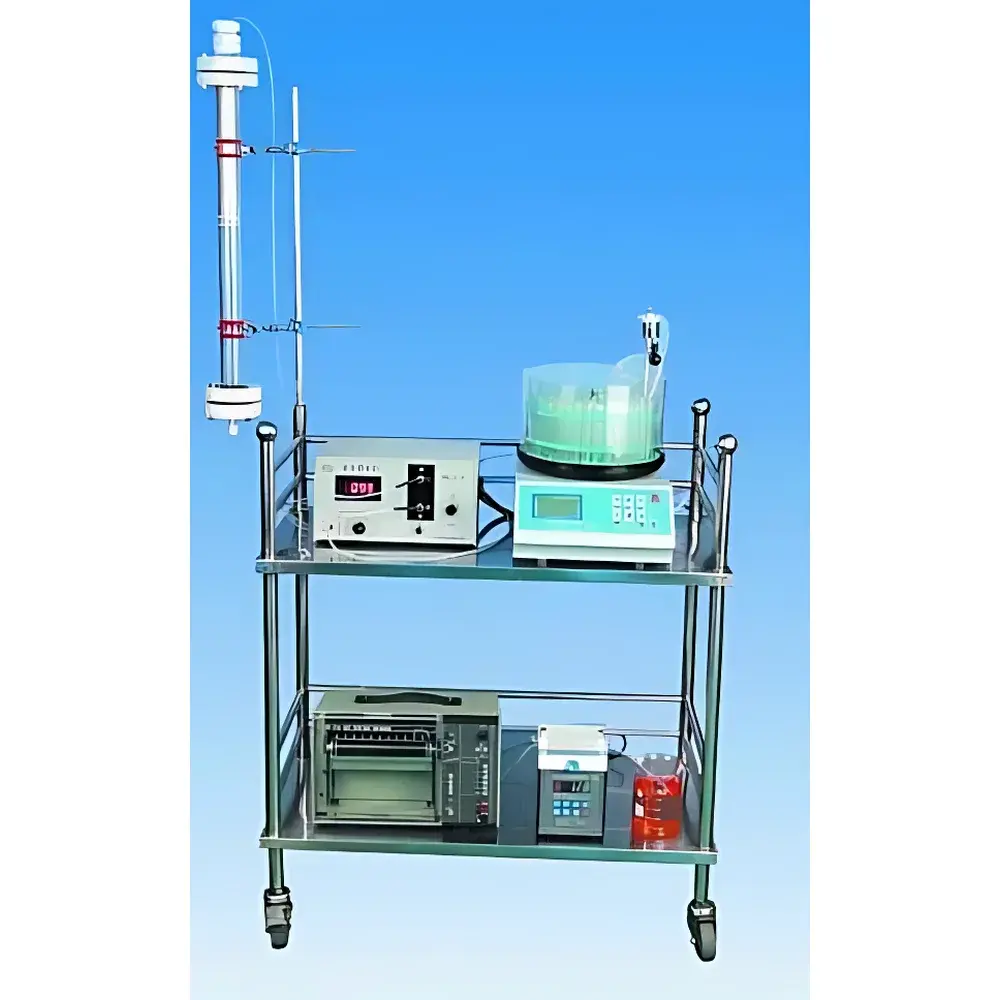
MB99-1 UV Detector for Liquid Chromatography Systems
| Origin | Shanghai, China |
|---|---|
| Manufacturer Type | Distributor |
| Origin Category | Domestic (China) |
| Model | MB99-1 |
| Price | USD 2,850 (FOB Shanghai) |
Overview
The MB99-1 UV Detector is a benchtop absorbance-based analytical module engineered for integration into low-pressure liquid chromatography (LC) systems used in academic research, biotechnology labs, and quality control environments. It operates on the principle of ultraviolet absorbance photometry, utilizing fixed-wavelength mercury-vapor lamps to monitor eluent absorbance at four discrete wavelengths—220 nm, 254 nm, 280 nm, and 340 nm—enabling selective detection of nucleic acids, aromatic amino acids, peptides, and other UV-active biomolecules. Designed as a core component of the MB99-series chromatography workstations, the MB99-1 interfaces with analog chart recorders (e.g., XWT-S) and supports real-time analog output of absorbance (A) and transmittance (%T) signals for offline spectral plotting and peak integration. Its optical path is optimized for flow cells compatible with standard analytical columns (Φ1.0 × 40 mm, Φ1.6 × 50 mm, Φ2.5 × 60 mm), ensuring stable baseline performance under continuous flow conditions ranging from 0.1 to 10 mL/min. The detector does not incorporate digital signal processing or USB/Ethernet connectivity; its architecture prioritizes mechanical robustness, thermal stability, and long-term calibration retention in non-GMP teaching and pilot-scale separation workflows.
Key Features
- Four fixed-wavelength UV detection channels (220 nm, 254 nm, 280 nm, 340 nm) using high-stability mercury lamp source
- Analog voltage output (0–100 mV full scale) compatible with strip-chart recorders and legacy data acquisition systems
- Optimized flow cell design supporting laminar flow across common column dimensions (Φ1.0–2.5 mm ID × 40–60 mm length)
- Integrated dual-channel signal conditioning for simultaneous A and %T output
- Front-panel wavelength selector switch with mechanical interlock to prevent accidental misalignment
- Calibration verification port for optional NIST-traceable reference filters (sold separately)
Sample Compatibility & Compliance
The MB99-1 is validated for use with aqueous and mildly organic mobile phases (≤30% acetonitrile or methanol), including Tris-glycine, SDS-PAGE, and TE buffers commonly employed in protein and nucleic acid purification. It complies with general laboratory safety standards per IEC 61010-1 for electrical equipment used in measurement, control, and laboratory applications. While not certified to ISO/IEC 17025 or FDA 21 CFR Part 11, its analog signal architecture ensures compatibility with GLP-compliant documentation practices when paired with calibrated chart recorders and manual audit trails. Column compatibility includes standard glass and PEEK-packed analytical columns up to 100 cm in length and ≤5 mm internal diameter. Solvent compatibility excludes strong oxidizers (e.g., perchloric acid), halogenated solvents, and high-pH mobile phases (>9.0) without prior flow cell cleaning protocols.
Software & Data Management
The MB99-1 operates exclusively in analog mode and does not include embedded firmware, touchscreen interface, or native software drivers. Data acquisition relies on external analog recording devices such as the XWT-S desktop strip-chart recorder, which provides permanent hardcopy output with time-stamped trace annotation. For digital archiving, users may digitize recorded charts via flatbed scanning and apply third-party peak analysis tools (e.g., ImageJ with Gel Analyzer plugin or commercial chromatography software like Chromeleon™ via analog-to-digital converter hardware). No proprietary file formats, cloud synchronization, or electronic signature functionality is supported. Audit trail generation requires manual logbook entries correlating run parameters (flow rate, collection timer settings, column lot numbers) with physical chart records.
Applications
- Preparative and analytical gel filtration chromatography of proteins and polysaccharides
- Ion-exchange purification of monoclonal antibodies and recombinant enzymes
- Educational LC system demonstrations in undergraduate biochemistry and pharmaceutical sciences curricula
- Fraction collection triggering in conjunction with BSZ-100 timed fraction collectors (1 min–24 h interval range)
- Monitoring elution profiles during desalting, buffer exchange, and size-exclusion cleanup steps
- Validation of column packing integrity and mobile phase consistency through baseline noise assessment
FAQ
Does the MB99-1 support wavelength scanning or variable bandwidth selection?
No. It is a fixed-wavelength detector with discrete 220 nm, 254 nm, 280 nm, and 340 nm channels; no continuous spectral scanning or bandwidth adjustment is available.
Can the MB99-1 be connected directly to a modern PC without additional hardware?
No. It outputs only analog voltage signals (0–100 mV). Direct PC connection requires an external analog-to-digital converter (ADC) with appropriate sampling rate and resolution (≥12-bit, ≥10 Hz).
Is the flow cell replaceable or user-serviceable?
Yes. The quartz flow cell is mechanically mounted and can be removed for cleaning or replacement using standard 2.5 mm hex key tools; spare cells are available as OEM part #HD-3-FC-QZ.
What is the typical baseline noise specification under standard operating conditions?
When operated with deionized water at 1 mL/min and 254 nm, baseline drift is ≤±0.002 AU/h and RMS noise is ≤±0.0005 AU (measured over 10 s, 0.5 s response time).
Does the MB99-1 meet requirements for regulated GMP manufacturing environments?
It is not designed for GMP production use. It lacks electronic audit trail, user access control, and 21 CFR Part 11 compliance features; it is intended for R&D, teaching, and non-critical QC applications.




