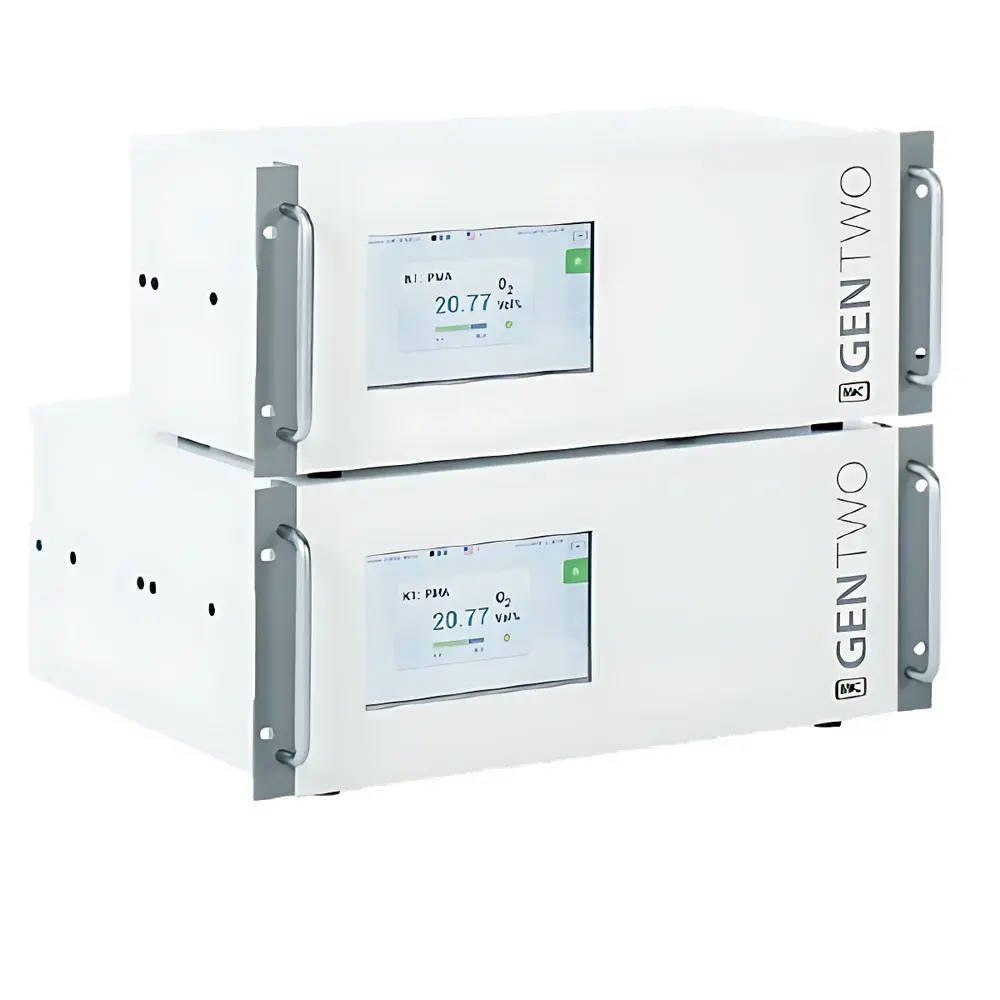
M&C PMA1000 Online Oxygen Analyzer
| Brand | ONUEE |
|---|---|
| Origin | Germany |
| Manufacturer Type | Authorized Distributor |
| Product Category | Imported Industrial Analyzer |
| Model | PMA1000 |
| Price | Upon Request |
Overview
The M&C PMA1000 Online Oxygen Analyzer is a high-precision, continuous-process oxygen measurement system engineered for industrial process control environments. It employs the paramagnetic property of molecular oxygen—a fundamental physical characteristic where O₂ molecules are uniquely attracted to magnetic fields—to deliver stable, interference-free quantification of oxygen concentration in gas streams. Unlike electrochemical or zirconia-based sensors, the paramagnetic principle ensures long-term stability, zero consumption of sensing elements, and immunity to background gas composition (e.g., CO₂, N₂, CH₄, H₂O vapor) when properly conditioned. With an exceptionally low dead volume of just 2 mL and T₉₀ response time under 3 seconds at 60 Nl/h flow rate, the PMA1000 supports real-time feedback for critical applications such as combustion optimization, inerting validation, bioreactor headspace monitoring, and environmental emissions compliance. Designed for non-hazardous (non-explosive) areas per IEC 60079-0, it operates reliably across ambient temperatures from 0 °C to 50 °C and sample gas temperatures up to 50 °C—provided the gas is dry, oil-free, and particle-free, with dew point strictly above operating temperature.
Key Features
- Paramagnetic oxygen detection with four selectable linear ranges: 0–1 vol%, 0–10 vol%, 0–30 vol%, and 0–100 vol% O₂
- Lowest detection limit (LOD) of 0.02 vol% O₂; repeatability better than ±0.01 vol% O₂
- Integrated 7-inch full-color capacitive touchscreen display with intuitive HMI navigation and onboard data logging capacity for ≥12 months of timestamped measurements
- Modular architecture supporting expansion with auxiliary sensors (e.g., pressure, temperature, flow) via standardized digital interfaces
- Automatic pressure compensation over absolute range 0.6–1.6 bar, minimizing span drift due to upstream pressure fluctuations
- Isolated analog outputs (0–20 mA / 4–20 mA, max. 500 Ω load) and configurable relay/digital I/O for direct integration into DCS, PLC, or SCADA systems
- Onboard auto-calibration function with programmable relay triggers for zero/span verification cycles, traceable to certified reference gases
- Native support for MODBUS TCP/IP and proprietary AK protocol over Ethernet; USB port for firmware updates and local data export
Sample Compatibility & Compliance
The PMA1000 is validated for use with clean, dry, non-corrosive gas matrices typical in combustion flue streams, nitrogen blanketing lines, fermentation off-gas, and ambient air quality monitoring. Sample conditioning is required prior to inlet: particulate filtration (≤0.3 µm), coalescing removal of aerosols/oil mist, and refrigerated or desiccant drying to maintain dew point at least 5 °C below minimum process temperature. Wet or acidic gases (e.g., untreated biogas, chlorine-containing streams) require external scrubbing. The analyzer complies with CE marking requirements under the EU Electromagnetic Compatibility Directive 2014/30/EU and Low Voltage Directive 2014/35/EU. While not intrinsically safe, its IP40-rated 19″ rack-mount enclosure meets mechanical protection standards for controlled indoor industrial environments. All wetted materials—including SS316, PVDF, PPS, FKM elastomers, borosilicate glass, and platinum components—are selected for chemical resistance and long-term dimensional stability per ISO 8502-3 and ASTM D4541 guidelines.
Software & Data Management
Firmware includes embedded audit-trail functionality compliant with GLP principles: every calibration event, parameter change, or output adjustment is time-stamped, user-tagged, and stored in non-volatile memory. Data export is supported via USB mass storage mode (CSV format) or Ethernet-based polling using MODBUS register mapping. Remote configuration and diagnostics are enabled through a secure web interface accessible via standard browsers—no proprietary software installation required. The system supports time-synchronized logging aligned to NTP servers when connected to corporate networks. For regulated industries (e.g., pharmaceutical manufacturing per FDA 21 CFR Part 11), optional configuration packages provide electronic signature enforcement and role-based access control (RBAC) for critical operations.
Applications
- Combustion efficiency optimization in boilers, furnaces, and thermal oxidizers via real-time O₂ trim control
- Inerting verification in chemical reactors, powder silos, and solvent recovery units to maintain <1 vol% O₂
- Bioprocess monitoring of aerobic fermentation tanks and cell culture bioreactors
- Environmental stack emission reporting per EN 14181 and EPA Method 3A
- Quality assurance in modified atmosphere packaging (MAP) gas mix verification
- Research-grade oxygen profiling in catalytic reaction studies and material aging tests
FAQ
What calibration gases are recommended for routine verification?
Certified zero gas (N₂ ≥99.999%) and span gas (O₂ in N₂ at 21.0% or application-specific concentration) traceable to NIST or equivalent national metrology institutes.
Can the PMA1000 operate continuously without manual intervention?
Yes—its auto-calibration cycle can be scheduled daily or weekly; however, initial commissioning and annual full verification require certified reference gases and documented procedures.
Is pressure compensation active during all measurement ranges?
Yes—pressure compensation is applied continuously across the full 0.6–1.6 bar abs. operating range and is factory-calibrated for each configured O₂ range.
How does the analyzer handle condensation in the sample line?
Condensation must be prevented upstream—the unit is not rated for liquid ingress. Use chiller-based or permeation dryers to ensure sample dew point remains ≥5 °C below ambient and sensor housing temperature.
What is the expected service life of the paramagnetic sensor module?
Under specified operating conditions and proper sample conditioning, the sensor exhibits no consumable wear; mean time between failures (MTBF) exceeds 10 years per IEC 61508 SIL-2 assessment.
Related Products