
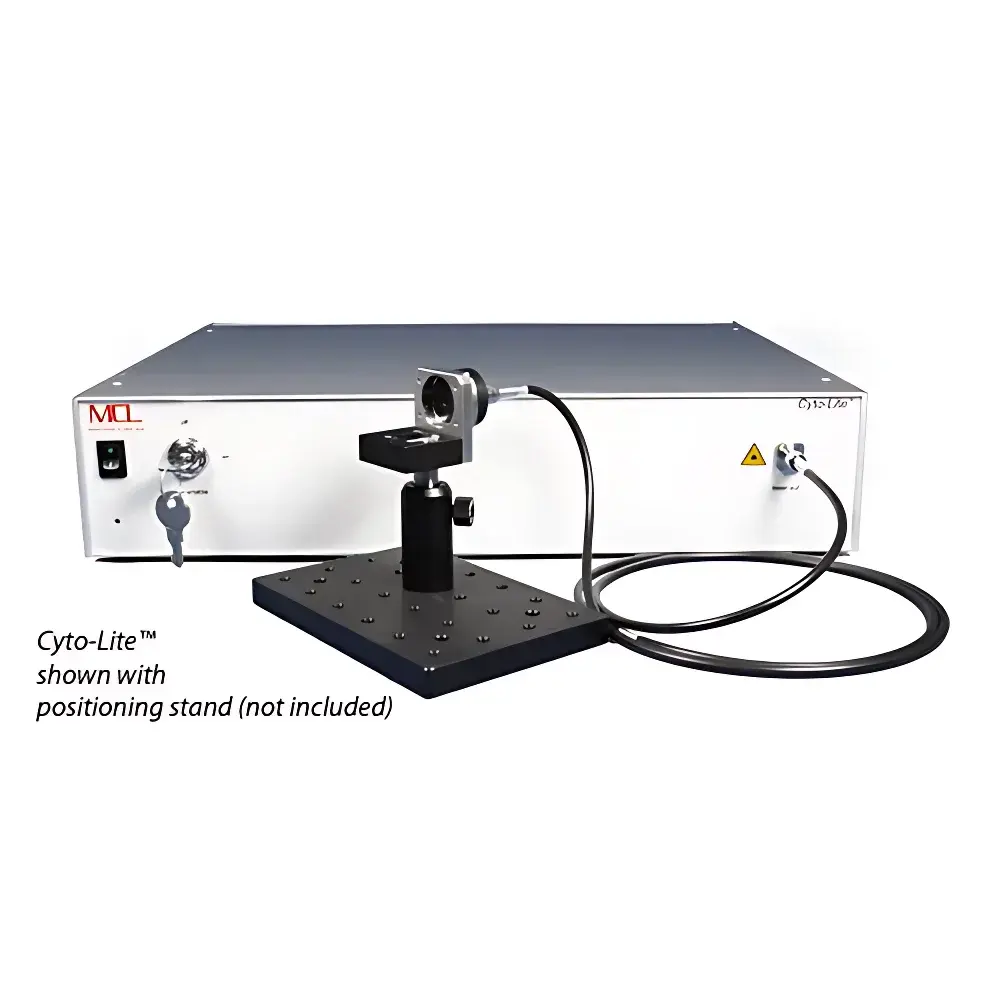
MCL Think Nano Cyto-Lite™ Multi-Wavelength Laser Engine
| Brand | MCL Think Nano |
|---|---|
| Origin | USA |
| Model | Cyto-Lite™ |
| Laser Wavelengths | 405 nm, 532 nm, 640 nm |
| Output Power | 10 mW (405 nm & 640 nm), 20 mW (532 nm) |
| Control Interface | USB 2.0 |
| Modulation | Onboard DDS sine-wave generator + 16-bit DAC per channel |
| Feedback Modes | Constant current or constant optical power |
| Power Supply | Three independent linear regulators |
| Protection Features | Overcurrent protection, watchdog circuitry, ESD protection per channel |
| Fiber Delivery | Single-mode PM fiber, collimated free-space output optional |
| Compliance | CE, RoHS, FDA 21 CFR Part 1040.10 (Laser Product Safety) |
Overview
The MCL Think Nano Cyto-Lite™ is a compact, integrated multi-wavelength laser engine engineered for precision single-molecule imaging, fluorescence microscopy, and optogenetic stimulation in demanding optical laboratory environments. Unlike conventional multi-laser setups requiring discrete sources, beam combiners, shutters, and alignment-intensive optical paths, the Cyto-Lite™ consolidates three spectrally distinct laser lines—405 nm (violet), 532 nm (green), and 640 nm (red)—into a single, polarization-maintaining (PM) single-mode fiber output. This architecture eliminates mechanical shutter dependency, reduces optical path complexity, and improves long-term alignment stability critical for quantitative time-lapse and co-localization experiments. Its core measurement principle relies on digitally synchronized, independently regulated diode laser emission, where each wavelength is thermally stabilized and driven via low-noise linear regulation to ensure shot-noise-limited intensity stability (<0.3% RMS over 8 hours). Designed for integration into custom-built or OEM microscope platforms—including MCL’s own RM21™ Microscope Platform and Nano-View® series—the Cyto-Lite™ serves as a turnkey excitation source for confocal, TIRF, STORM, and light-sheet modalities requiring rapid, reproducible spectral switching.
Key Features
- Triple-wavelength integration (405 nm, 532 nm, 640 nm) with single-fiber output—enabling simplified coupling into epifluorescence, scanning, or fiber-coupled illumination paths
- Fully software-controlled operation via USB 2.0 interface and native Cyto-Lite™ control suite; no external controllers or analog I/O modules required
- Independent, real-time control of each laser line in either constant current or closed-loop constant optical power mode—ensuring photostability across varying environmental conditions
- Onboard direct digital synthesis (DDS) sine-wave generator and 16-bit DAC per channel—supporting analog modulation up to 1 MHz with <10 ns jitter for pulsed illumination, FRAP, or optogenetic stimulation protocols
- Ultra-low electronic noise achieved through triple isolated linear regulator power supplies and per-channel RF filtering—critical for high-sensitivity detection in EMCCD or sCMOS-based single-molecule assays
- Comprehensive hardware safety architecture: per-channel overcurrent protection, microcontroller-monitored watchdog circuitry, and ESD-hardened input/output stages compliant with IEC 61000-4-2 Level 4
Sample Compatibility & Compliance
The Cyto-Lite™ is compatible with standard fluorophores used in super-resolution and single-molecule localization microscopy (SMLM), including DAPI (405 nm), Alexa Fluor 488/EGFP (532 nm), and Cy5/Alexa Fluor 647 (640 nm). Its stable, low-drift output enables reliable quantification in applications governed by ISO/IEC 17025-compliant calibration workflows. The system meets CE marking requirements under the EU Electromagnetic Compatibility Directive 2014/30/EU and the Low Voltage Directive 2014/35/EU. Laser safety classification complies with IEC 60825-1:2014 and FDA 21 CFR Part 1040.10, certified as Class 3B for all three wavelengths when operated at maximum specified power. Firmware supports audit-trail logging for GLP/GMP-aligned laboratories, with timestamped parameter changes exportable in CSV format.
Software & Data Management
The Cyto-Lite™ ships with a cross-platform (Windows/macOS/Linux) native application built on Qt and libusb, providing intuitive GUI-based control of intensity, modulation waveform, feedback mode, and interlock status. All parameters are accessible via a documented ASCII command protocol over USB CDC ACM, enabling seamless integration into Python (PySerial), MATLAB, or LabVIEW automation frameworks. Software supports automated power ramping, TTL-triggered burst modes, and synchronized multi-channel modulation profiles. Internal non-volatile memory retains user-defined default settings across power cycles. Data logs—including real-time optical power readings, temperature telemetry, and fault event timestamps—are stored locally and exportable for traceability in regulated environments. No cloud connectivity or telemetry transmission is performed; all data remains on the host system.
Applications
- Single-molecule fluorescence imaging (smFRET, co-localization, dwell-time analysis)
- Structured illumination microscopy (SIM) and stochastic optical reconstruction microscopy (STORM)
- Live-cell optogenetics using ChR2 (470 nm approximated by 405 nm activation + 532 nm readout) and C1V1 (640 nm activation)
- Quantitative fluorescence correlation spectroscopy (FCS) requiring stable, low-noise excitation
- OEM integration into automated slide scanners, microfluidic cytometers, and compact benchtop analyzers
- Calibration reference source for photodetector linearity testing and quantum yield measurements
FAQ
Is the Cyto-Lite™ compatible with third-party microscope control software such as Micro-Manager or NIS-Elements?
Yes—via its open ASCII command protocol over USB CDC ACM, the Cyto-Lite™ integrates with Micro-Manager (through custom device adapter), NIS-Elements (using TTL or serial plugin), and other platforms supporting generic serial instrumentation.
Can the 405 nm and 640 nm outputs be used simultaneously without crosstalk or thermal drift?
Yes—each laser diode operates on an independent thermal and current control loop; spectral isolation is maintained by internal bandpass filtering, and thermal cross-talk is minimized by physical separation and active heat sinking.
Does the system support analog voltage modulation inputs in addition to USB software control?
No—modulation is exclusively digital via the onboard DDS/DAC; however, arbitrary waveforms can be preloaded and triggered externally via TTL sync input.
What is the typical warm-up time to achieve ±0.5% optical power stability?
Under ambient lab conditions (22–25°C), full thermal equilibrium and power stability are achieved within 15 minutes of cold start.
Is fiber coupling mandatory, or can free-space collimated output be configured?
Both configurations are supported: the standard delivery is PM fiber (FC/APC), but optional free-space collimated output (with adjustable focus and kinematic mount) is available upon request.




