
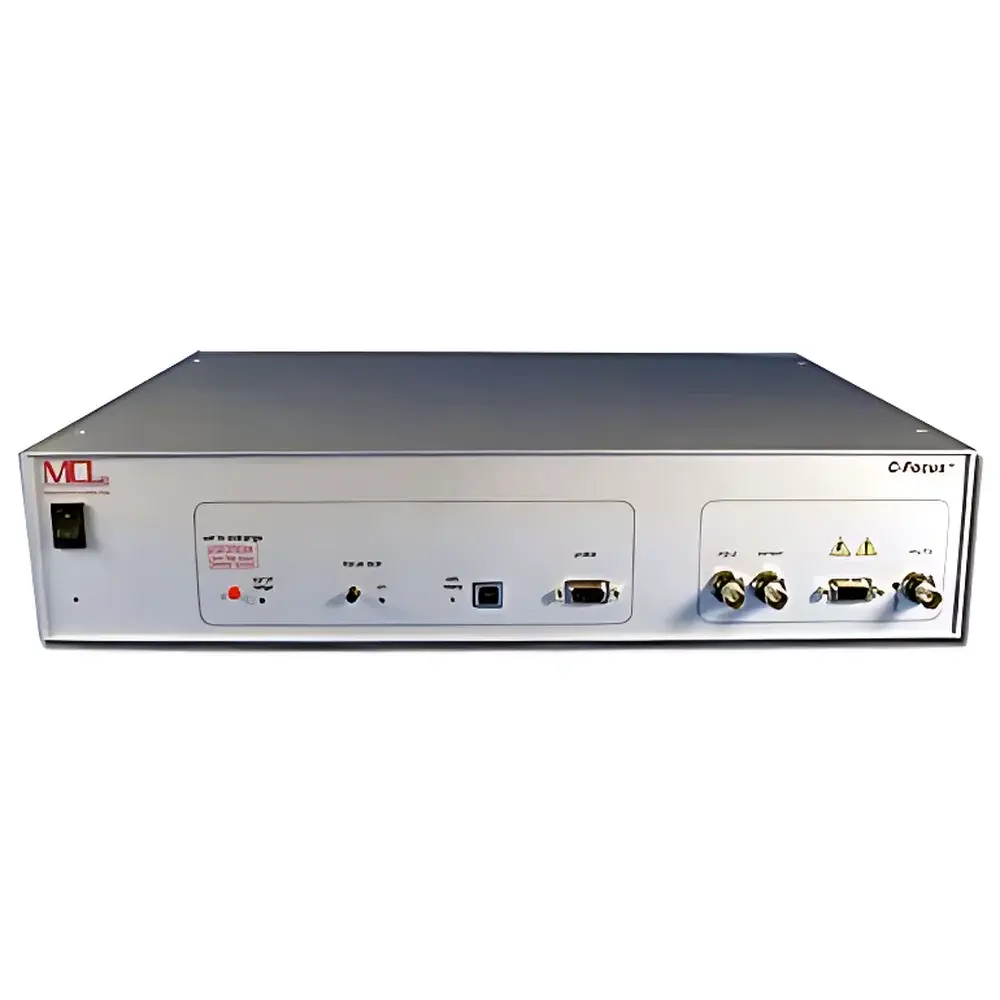
MCL Think Nano C-Focus™ Automated Microscope Focus Stabilization System
| Brand | MCL Think Nano |
|---|---|
| Origin | USA |
| Manufacturer Type | Authorized Distributor |
| Product Category | Imported |
| Model | C-Focus™ System |
| Product Type | Motorized Precision Translation Stage for Objective Lens Positioning |
| Motion Range | 100 µm |
| Resolution | 0.2 nm |
| Resonant Frequency | 500 Hz ±20% |
| Stiffness | 1.0 N/µm |
| Max Recommended Load | 0.5 kg |
| Sensor Technology | Proprietary PicoQ® capacitive position sensing |
| Control Interface | 16-bit USB digital interface (included) |
| Closed-Loop Architecture | Yes |
| Compatibility | Universal retrofit for all upright and inverted microscopes via standard threaded adapters |
| Actuation Method | Piezo-driven lens positioner (Nano-F100S) |
| Sub-nanometer Positioning Capability | Yes |
Overview
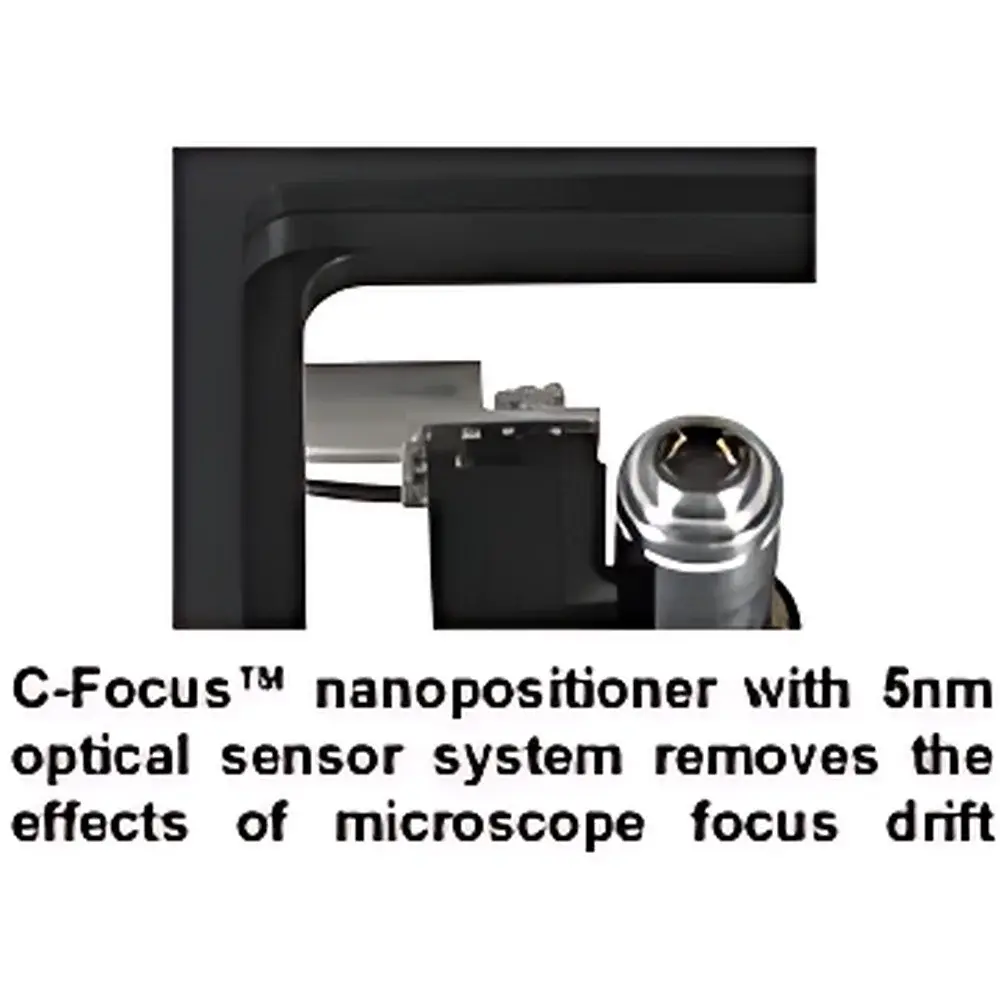
The MCL Think Nano C-Focus™ Automated Microscope Focus Stabilization System is an engineered solution for eliminating focus drift in long-duration, high-resolution optical microscopy. It operates on a direct physical measurement principle—using a proprietary PicoQ® capacitive displacement sensor to monitor real-time objective-to-sample distance with sub-nanometer resolution—and actively corrects deviations via closed-loop control of the objective lens position. Unlike video-based or laser-reflection autofocus systems that infer focus from image contrast or beam reflection intensity, the C-Focus™ system measures mechanical spacing directly, ensuring stability independent of sample optical properties, illumination uniformity, or fluorophore photophysics. This architecture delivers robust performance in demanding modalities including TIRF, confocal, STORM, PALM, and single-molecule fluorescence imaging—particularly where prolonged acquisition (>10–60 min), environmental thermal fluctuation, or mechanical creep would otherwise degrade axial resolution.
Key Features
- Sub-0.2 nm closed-loop positioning resolution enabled by integrated PicoQ® capacitive sensors
- 100 µm total travel range with 500 Hz resonant bandwidth for rapid correction of thermal and mechanical drift
- Modular, non-invasive retrofit design compatible with all major microscope platforms (Olympus IX, Nikon Eclipse, Zeiss Axio, Leica DM series) using standardized M27×0.75 or M32×0.75 threaded adapters
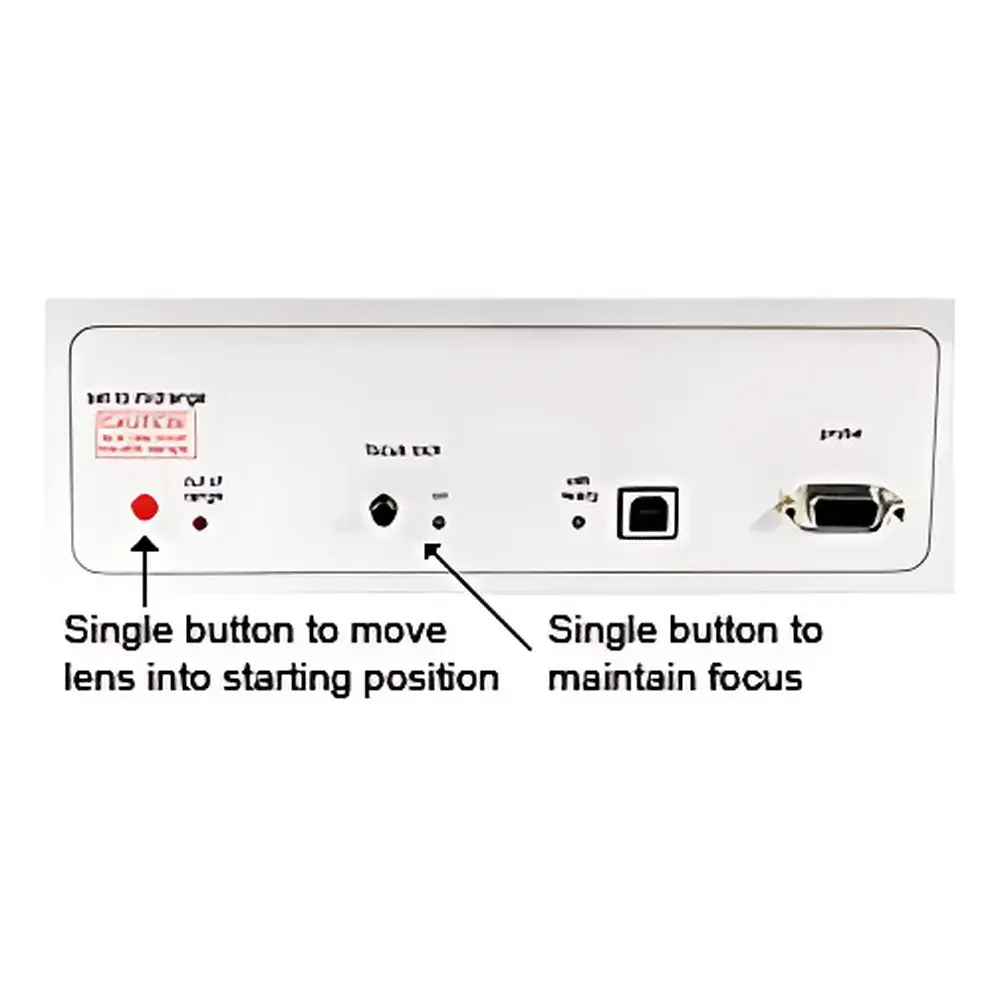
- Dual-mode operation: “Focus Lock” button initiates autonomous drift compensation; optional analog (±10 V) or 16-bit USB digital command enables external synchronization with acquisition hardware (e.g., EMCCD shutter triggers, galvo scanners)
- Zero interference with manual focusing—mechanical coarse/fine focus remains fully functional during C-Focus™ operation
- Stiffness of 1.0 N/µm ensures minimal hysteresis and high positional repeatability under dynamic load conditions
- Controller firmware supports programmable correction thresholds, dwell time, and PID tuning parameters via MCL’s NanoDrive® software suite
Sample Compatibility & Compliance
The C-Focus™ system imposes no restrictions on sample type, mounting medium, or immersion configuration (air, water, oil, glycerol). Its mechanical sensing approach eliminates reliance on signal-to-noise ratio or contrast gradients, making it suitable for label-free phase contrast, DIC, and low-signal single-molecule experiments. The system complies with ISO 9001-certified manufacturing protocols and meets CE marking requirements for laboratory equipment. While not a medical device, its closed-loop architecture and deterministic response support GLP-compliant workflows requiring audit-trail-capable instrumentation. All electronic components conform to FCC Part 15 Class B and IEC 61326-1 electromagnetic compatibility standards.
Software & Data Management
The included NanoDrive® software provides native integration with Windows-based acquisition platforms (Micro-Manager, MetaMorph, NIS-Elements via COM/ActiveX). Real-time sensor data logging (timestamped, 1 kHz sampling) is exportable in CSV and HDF5 formats for post-acquisition drift quantification. Firmware updates and parameter configuration are performed over USB without hardware modification. For regulated environments, optional FDA 21 CFR Part 11-compliant audit trail modules—including user authentication, electronic signatures, and immutable log archiving—are available upon request. Remote scripting via Python API (pyMCL) enables integration into automated imaging pipelines and custom analysis workflows.
Applications
- Sustained single-molecule tracking and co-localization studies (e.g., MutS-DNA interactions imaged under oxygen-scavenging conditions)
- High-speed confocal z-stacks with <10 nm axial reproducibility across multi-hour time courses
- TIRF microscopy requiring stable evanescent field depth (<100 nm) over extended durations
- Correlative light-electron microscopy (CLEM) sample navigation where precise z-reproducibility between modalities is critical
- Quantitative FRET and FLIM experiments sensitive to axial chromatic shift or defocus-induced intensity decay
- Automated screening platforms integrating focus stabilization with motorized stage and filter wheel control
FAQ
Can the C-Focus™ be installed on a custom-built or non-standard microscope?
Yes—provided the objective nosepiece or turret accepts standard M27×0.75 or M32×0.75 threads, or a custom adapter can be machined. Engineering consultation is recommended for unconventional optical paths.
Does the system require recalibration after installation or temperature change?
No. The PicoQ® sensor is thermally compensated and factory-calibrated; zero-point drift is <0.5 nm/°C over 20–30 °C ambient range.
Is the Nano-F100S lens positioner compatible with oil-immersion objectives?
Yes—mechanical coupling occurs above the objective barrel; immersion medium does not contact any C-Focus™ components.
Can multiple C-Focus™ units be synchronized across different objectives or microscopes?
Yes—via TTL trigger input/output ports and shared clock signals through the controller’s auxiliary I/O interface.
What maintenance is required?
None beyond periodic inspection of adapter thread integrity and dust protection of sensor aperture; no consumables or alignment procedures are needed.




