
MCL Think Nano Mad-Deck™ 3-Axis Integrated Precision Micro-Positioning Platform
| Brand | MCL Think Nano |
|---|---|
| Origin | USA |
| Manufacturer Type | Authorized Distributor |
| Product Category | Imported Optical Translation Stage |
| Model | Mad-Deck™ |
| Drive Type | Motorized (Stepper-Based) |
| Motion Axes | X, Y, Z (All Motorized) |
| Linear Encoder Resolution (Optional) | 50 nm |
| Micropositioning Step Size | 95 nm |
| Max. Speed | 1.5 mm/sec |
| Native Accuracy | 1.0 µm |
| Native Repeatability | < 100 nm |
| Body Material | Aluminum |
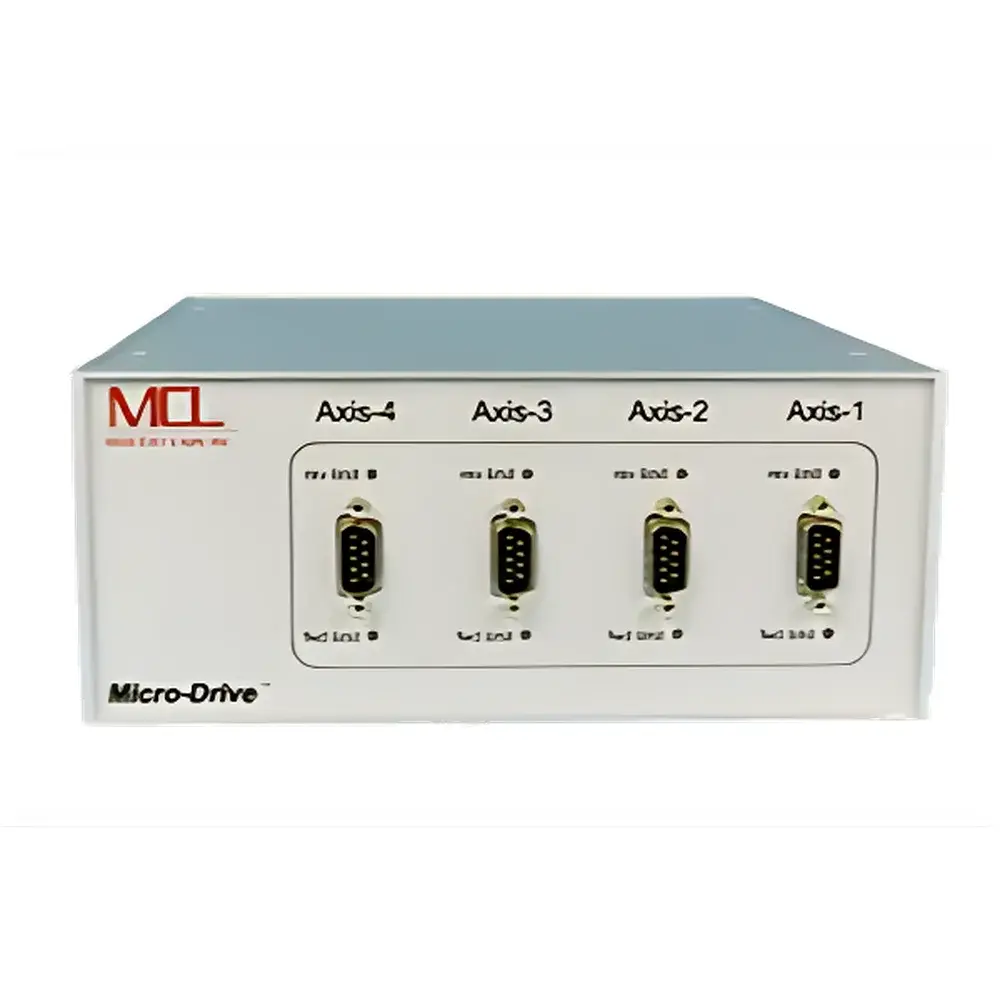
| Controller | Micro-Drive™ |
| Interface | Bidirectional USB |
| Software Compatibility | LabVIEW-based GUI, Custom VI Development, Third-Party Integration |
Overview
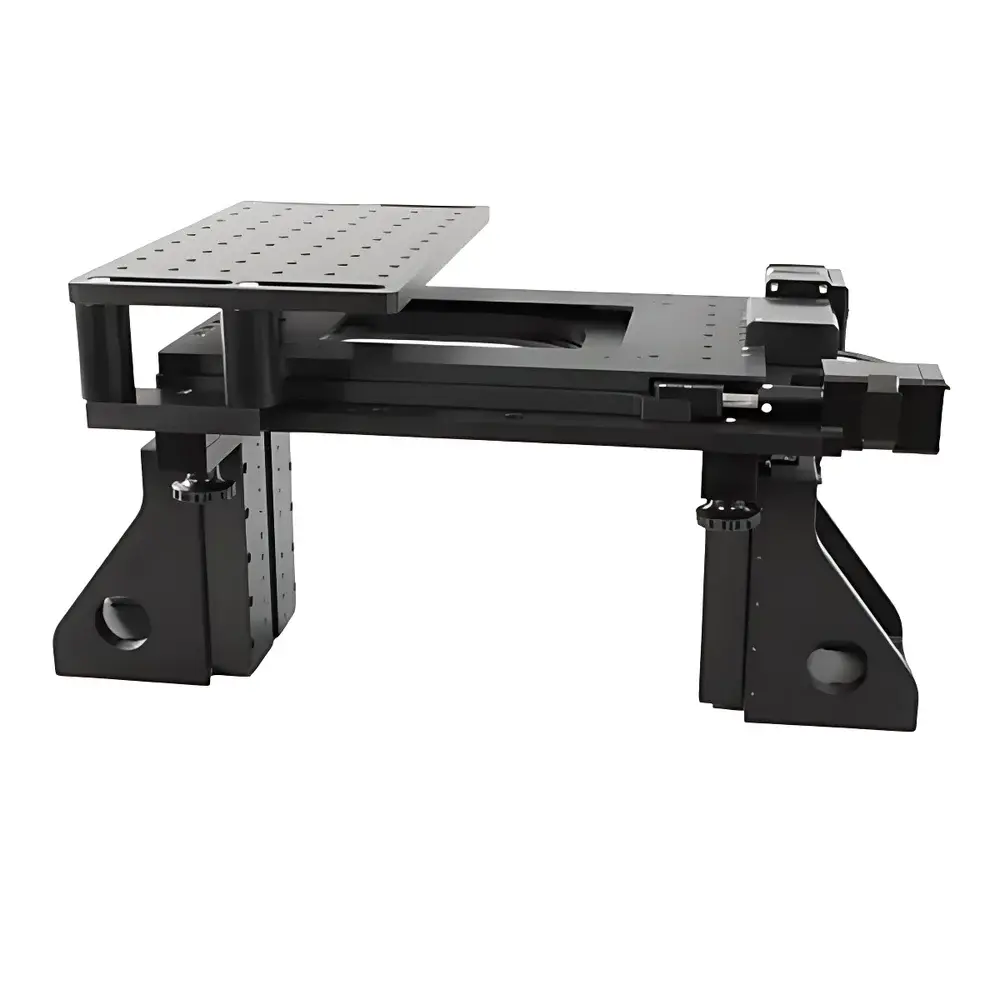
The MCL Think Nano Mad-Deck™ is a modular, three-axis (X-Y-Z) motorized micro-positioning platform engineered for high-stability, high-reproducibility sample manipulation in advanced optical microscopy and nanoscale experimental setups. Unlike conventional stacked or gimbal-style translation stages, the Mad-Deck™ integrates all three axes into a single monolithic aluminum chassis with planar Z-axis architecture—ensuring orthogonal motion without parasitic tilt or wobble during vertical translation. Its core actuation relies on high-torque, low-backlash stepper motors coupled with proprietary intelligent control firmware that dynamically compensates for thermal drift, load-induced hysteresis, and mechanical compliance. This architecture enables deterministic sub-micron positioning over extended travel ranges while maintaining optical access above and below the sample plane—a critical requirement for inverted microscopy, interferometric scattering (iSCAT), scanning NV magnetometry, and multi-photon excitation geometries.
Key Features
- Integrated XYZ motion in a single compact platform with no external couplings or alignment dependencies
- Planar Z-axis design ensuring minimal axial runout (< 50 nm) and preserved focus plane integrity during vertical scanning
- Proprietary intelligent control algorithm enabling real-time step correction, stall detection, and adaptive acceleration profiling
- Native repeatability of < 100 nm and absolute accuracy of ±1.0 µm (unencoded); optional high-resolution linear encoders (50 nm resolution) available for closed-loop operation
- Modular expansion capability: compatible with MCL’s nanopositioners (e.g., MadPLL®), piezo-driven fine-stage overlays, and custom breadboard/riser plinth interfaces
- Micro-Drive™ controller with bidirectional USB 2.0 interface, supporting both command-line protocols (ASCII over USB) and standardized SCPI-like syntax for integration into automated workflows
Sample Compatibility & Compliance
The Mad-Deck™ accommodates standard microscope slide formats (25 × 75 mm), custom sample holders (including vacuum-compatible and cryogenic variants), and multi-well plates via interchangeable mounting plates. Its low-profile footprint (≤42 mm height, depending on model) ensures compatibility with objective lenses down to 2 mm working distance. All models conform to RoHS Directive 2011/65/EU and CE marking requirements for laboratory equipment. The Micro-Drive™ controller supports audit-trail logging and user-accessible firmware update logs—facilitating GLP/GMP-aligned instrument qualification when paired with documented calibration procedures per ISO/IEC 17025. While not FDA-cleared as a medical device, its performance characteristics meet ASTM E2561–20 standards for positional metrology in optical instrumentation.
Software & Data Management
The platform ships with MCL’s native LabVIEW-based control suite, offering intuitive graphical interfaces for trajectory planning, multi-point sequencing, and synchronized acquisition triggering (TTL/USB). All motion parameters—including velocity profiles, acceleration ramps, dwell times, and encoder feedback thresholds—are programmable via exposed VIs or direct ASCII command strings. The Micro-Drive™ controller maintains persistent non-volatile memory for up to 128 user-defined coordinate sets and supports time-stamped position logging at ≥1 kHz sampling rate (when streaming via USB). For enterprise environments, the controller exposes a COM-port-emulated interface compatible with Python (pySerial), MATLAB Instrument Control Toolbox, and National Instruments TestStand. Full API documentation and driver packages are provided under a perpetual commercial license, with no runtime royalties or dongle dependencies.
Applications
- Single-molecule fluorescence tracking requiring long-duration XYZ stabilization with minimal photobleaching-induced drift
- Electrophysiology patch-clamp rigs demanding precise electrode approach trajectories with force-feedback synchronization
- Multi-photon microscopy where Z-stack acquisition must preserve lateral registration across >100 µm depth ranges
- Interferometric scattering (iSCAT) and dark-field imaging systems requiring simultaneous focus-plane maintenance and lateral scanning
- Scanning nitrogen-vacancy (NV) magnetometry platforms integrating diamond anvil cells or cryostat-mounted samples
- Automated wafer-level optical inspection systems leveraging repeatable stage homing and programmable grid navigation
FAQ
Is the Mad-Deck™ compatible with vacuum or inert-gas environments?
Yes—select models (e.g., Mad-Deck™/Z-VAC) are available with stainless-steel fasteners, vacuum-rated lubricants, and feedthrough-compatible cabling; custom vacuum flange adapters can be supplied upon request.
Can I retrofit my existing Mad-Deck™ with linear encoders after purchase?
Encoder retrofits are supported only on units manufactured after Q3 2022; earlier models require chassis replacement due to mechanical interface constraints.
Does the Micro-Drive™ controller support Ethernet or RS-232 connectivity?
No—only USB 2.0 (full-speed) is natively supported; however, USB-to-Ethernet bridge devices compliant with CDC ACM class drivers have been validated in customer installations.
What is the maximum payload capacity for dynamic vs. static loading?
Dynamic payload limit is 1.2 kg at full speed (1.5 mm/sec); static load capacity is 4.5 kg with ≤0.5 µrad angular deviation over full travel.
Are firmware updates provided free of charge throughout the product lifecycle?
Yes—MCL Think Nano provides lifetime firmware updates at no cost, including security patches, protocol extensions, and backward-compatible feature enhancements.




