
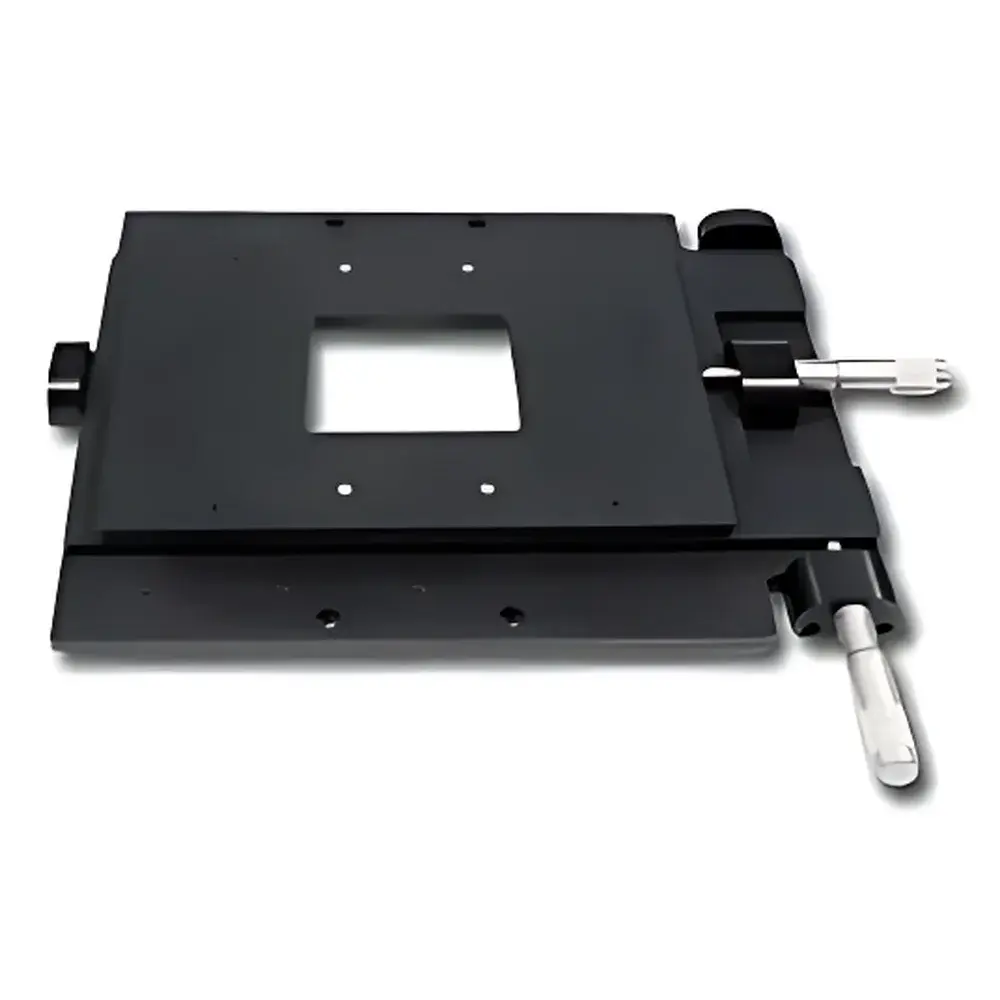
MCL Think Nano Manual MicroStage Series XY Translation Stage
| Brand | MCL Think Nano |
|---|---|
| Origin | USA |
| Manufacturer Type | Authorized Distributor |
| Product Category | Imported Instrument |
| Model | Manual MicroStage Series |
| Product Type | Manual Translation Stage |
| Travel Range (X/Y) | 25 mm |
| Graduation | 10 µm |
| Vernier Resolution | 1 µm |
| Body Material | Aluminum |
| Locking Mechanism | Integrated Continuous Pre-Loaded Position Lock (10 N per axis) |
| Compatibility | Olympus IX/IX2, Nikon TE2000/Ti, Leica DMI, Zeiss Axiovert/Axio Observer inverted microscopes |
| Optional Mounting | Breadboard base with 1/4"-20 (1" grid) or M6 (25 mm grid) threaded holes |
Overview
The MCL Think Nano Manual MicroStage Series is a high-precision, low-profile XY translation stage engineered for stable coarse positioning in demanding optical microscopy and nanoscale experimental configurations. Built upon a rigid aluminum monocoque architecture, it operates on precision-ground linear motion guides and utilizes fine-pitch micrometer drives to deliver deterministic mechanical displacement without backlash or hysteresis. Its core function is to serve as a foundational positioning platform—specifically designed to interface with high-resolution nanopositioning systems (e.g., piezoelectric or voice-coil opositioners) mounted atop the stage surface. Unlike conventional microscope stages lacking mechanical locking, the Manual MicroStage integrates a continuously active pre-load mechanism (10 N per axis) that eliminates positional drift induced by inertial forces during high-speed scanning sequences. This ensures spatial fidelity across multi-frame imaging, time-lapse acquisition, and raster-scan alignment—critical for quantitative fluorescence microscopy, confocal sectioning, and correlative light-electron microscopy (CLEM) workflows.
Key Features
- Precision XY travel of 25 mm per axis with dual-axis orthogonality maintained within ±5 arc-seconds
- Micrometer-driven adjustment with coarse graduation at 10 µm and vernier-enhanced resolution of 1 µm
- Integrated continuous position locking via internal spring-preloaded friction interface—no manual clamping required
- Low-profile design (≤25 mm height) optimized for compatibility with inverted microscope nosepiece clearance constraints
- Aluminum body machined to <±3 µm flatness over full travel; anodized for corrosion resistance and ESD control
- Modular mounting options including OEM flange patterns for Olympus IX/IX2, Nikon TE2000/Ti, Leica DMI, and Zeiss Axiovert platforms
Sample Compatibility & Compliance
The Manual MicroStage is validated for use with standard inverted optical microscopes across major OEM platforms, including Olympus IX/IX2 Series, Nikon TE2000 and Ti Series, Leica DMI Series, and Zeiss Axiovert and Axio Observer systems. It supports direct integration into ISO-standard optical tables (via optional breadboard accessory with 1/4″-20 or M6 threaded hole patterns) and accommodates custom mechanical interfaces for non-microscope applications such as laser alignment benches or fiber coupling stations. While not a regulated medical device, its mechanical stability and repeatability align with GLP-aligned laboratory practices. The stage conforms to RoHS Directive 2011/65/EU and meets CE marking requirements for mechanical equipment under the Machinery Directive 2006/42/EC. No electrical safety certification is applicable, as the device is fully passive and manually operated.
Software & Data Management
As a purely mechanical, non-motorized stage, the Manual MicroStage does not require firmware, drivers, or software integration. All positional data are recorded manually using the engraved vernier scale or external metrology tools (e.g., digital calipers, laser interferometers). For laboratories operating under FDA 21 CFR Part 11 or ISO/IEC 17025 compliance frameworks, users may document stage settings in electronic lab notebooks (ELNs) with audit-trail-enabled timestamping. The absence of embedded electronics eliminates electromagnetic interference concerns in sensitive electrophysiology or single-molecule fluorescence setups. Technical drawings, dimensional tolerances, and mounting templates are provided in STEP and PDF formats for CAD-based system integration planning.
Applications
- Coarse sample positioning prior to fine nanopositioning with piezo-driven stages (e.g., MCL-MOTNZ, Nano-Z series)
- Stable platform for multi-well plate scanning in automated fluorescence imaging
- Alignment reference base for optical trap calibration and holographic tweezers
- Mounting substrate for microfluidic chip integration in live-cell imaging rigs
- Replacement stage for legacy inverted microscopes requiring drift-free operation during long-duration acquisitions
- Base layer in hybrid AFM-optical microscopy systems where mechanical isolation and repeatable XY referencing are essential
FAQ
Is the Manual MicroStage compatible with upright microscopes?
Yes—the Manual MicroStage-BX variant is specifically engineered for Olympus BX-series upright microscopes and maintains full compatibility with Mad City Labs’ nanopositioning controllers.
Can the stage be modified for vacuum or cleanroom use?
Standard units are not vacuum-rated; however, custom versions with vacuum-compatible lubricants, stainless steel hardware, and outgassing-certified anodization are available upon request and subject to NDA.
What is the maximum load capacity while maintaining 1 µm vernier accuracy?
The stage is rated for static loads up to 2 kg with ≤0.5 µm positional deviation under 10 N pre-load; dynamic load limits depend on acceleration profiles of attached opositioners and must be evaluated case-by-case.
Do you offer calibration certificates traceable to NIST standards?
NIST-traceable calibration reports for travel linearity and orthogonality are available as a value-added service—contact technical support for lead time and documentation scope.
Is thermal expansion compensated in the design?
No active compensation is implemented; however, the aluminum structure exhibits predictable CTE (~23 ppm/°C), and dimensional stability is maintained within ±1 µm over typical lab temperature fluctuations (20–25 °C).





