
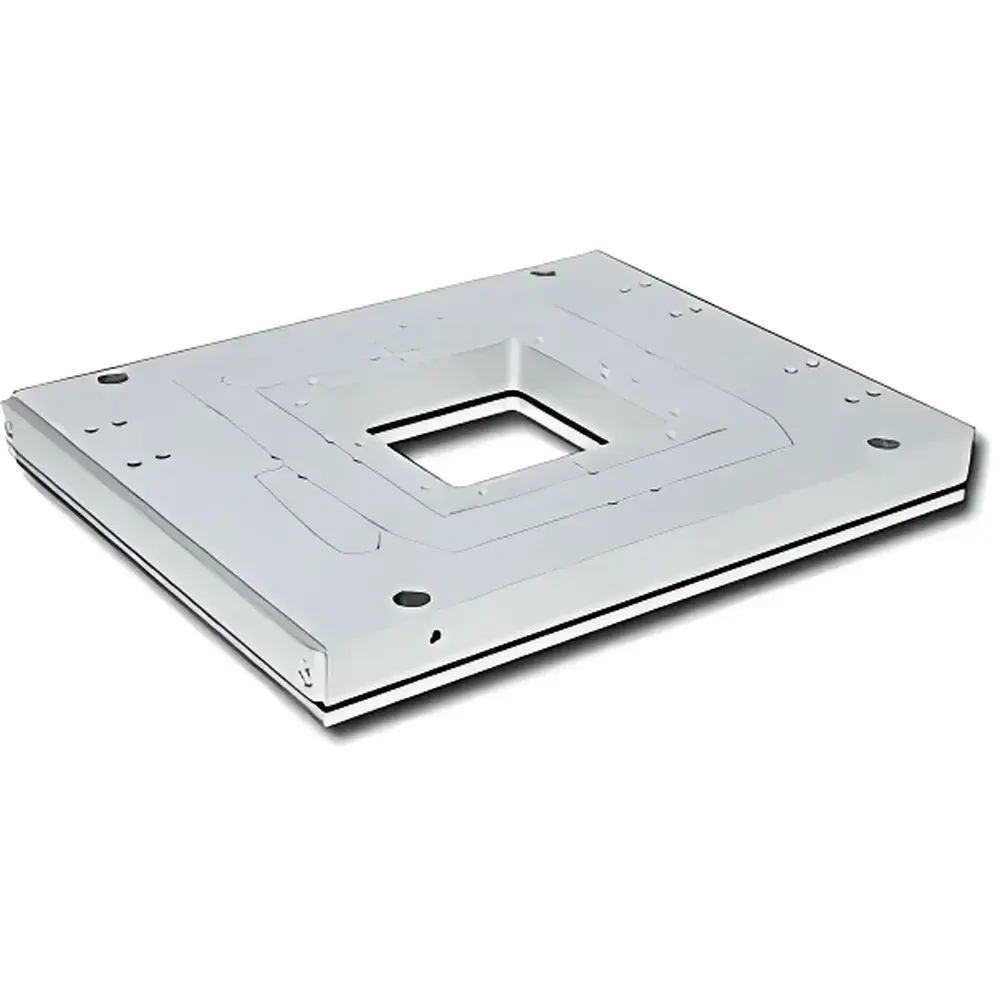
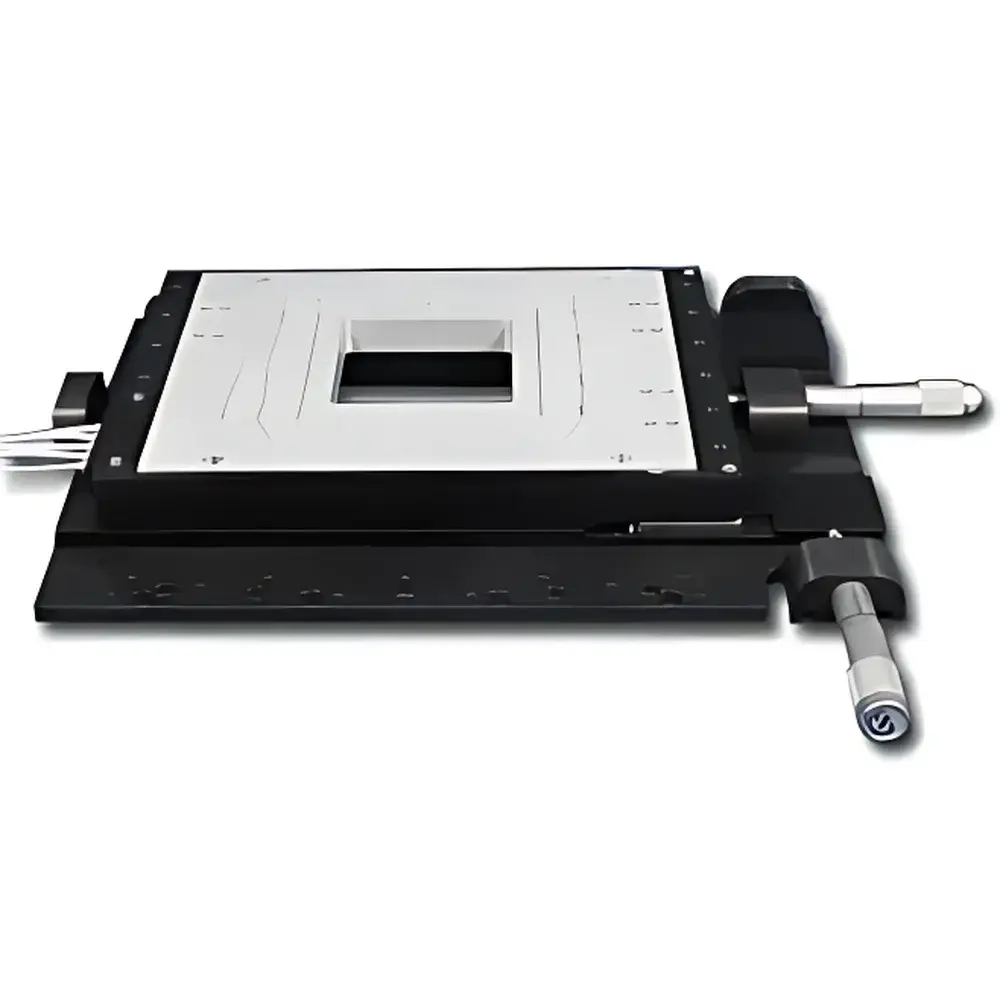
MCL Think Nano Nano-Align5 Series Five-Axis Precision Tip-Tilt-Translation Nanopositioning Stage
| Brand | MCL Think Nano |
|---|---|
| Origin | USA |
| Model | Nano-Align5 Series |
| Type | Motorized 5-Axis Nanopositioning Stage (XYZ + θX + θY) |
| Travel Range (XYZ) | 100/200/300 µm |
| Angular Range (θX/θY) | up to 3.3/4.5 mrad |
| Resolution (XYZ) | 0.2–0.6 nm |
| Resolution (θX/θY) | 2.2–9.0 nrad |
| Center Aperture | 66 mm × 66 mm |
| Body Material | Aluminum (standard), optional Invar or Titanium |
| Resonant Frequency | 250–450 Hz |
| Stiffness | 1.0 N/µm |
| Max Load (horizontal) | 0.5 kg |
| Max Load (vertical) | 0.2 kg |
| Controller | Nano-Drive® |
Overview
The MCL Think Nano Nano-Align5 Series is a high-precision, five-axis nanopositioning stage engineered for demanding optical alignment, nanofabrication, and metrology applications requiring simultaneous linear (X, Y, Z) and angular (θX, θY) degrees of freedom. Unlike conventional stacked or gimbal-based architectures, the Nano-Align5 employs a monolithic, low-profile flexure design with integrated piezoelectric actuators and proprietary PicoQ® capacitive sensing technology. This architecture enables true parallel kinematics—ensuring minimal crosstalk, high mechanical stability, and sub-nanometer repeatability under closed-loop operation. Its large 66 mm × 66 mm central aperture provides unobstructed optical access for confocal microscopy, laser interferometry, near-field probe integration, and in-situ SEM/TEM sample manipulation. Designed and manufactured in the United States, the stage meets stringent requirements for vacuum compatibility (optional), thermal stability, and long-term drift performance—making it suitable for ISO 17025-accredited calibration labs and GLP-compliant nanometrology workflows.
Key Features
- Five-degree-of-freedom motion: independent, synchronized control of X, Y, Z, tip (θX), and tilt (θY) axes
- Three standard travel variants: Nano-Align5-100 (100 µm XYZ / 1.1–1.5 mrad θ), Nano-Align5-200 (200 µm XYZ / 2.3–3.0 mrad θ), and Nano-Align5-300 (300 µm XYZ / 3.3–4.5 mrad θ)
- PicoQ® absolute position sensing with picometer-level resolution in translation (0.2–0.6 nm) and nanoradian resolution in rotation (2.2–9.0 nrad)
- Monolithic aluminum body (Invar or titanium available for 100/200 µm models) ensuring high stiffness (1.0 N/µm) and thermal drift < 50 nm/°C over operational range
- Resonant frequencies from 250 Hz (Z-axis, 300 µm model) to 450 Hz (X-axis, 100 µm model), enabling high-bandwidth servo control and dynamic step-and-settle performance
- Compact low-profile form factor (< 32 mm height) optimized for integration into multi-stage systems, optical breadboards, and confined vacuum chambers
Sample Compatibility & Compliance
The Nano-Align5 supports diverse sample and tooling configurations via standardized M4 and M6 threaded mounting holes on its top plate and base. Its open-center geometry accommodates objective lenses with NA > 0.9, fiber-coupled photonic probes, AFM cantilevers, and MEMS test fixtures without mechanical interference. All models comply with RoHS 2011/65/EU and CE marking directives for electromagnetic compatibility (EMC Directive 2014/30/EU) and low-voltage safety (LVD Directive 2014/35/EU). Optional vacuum-rated versions (10−7 Torr) are available with bakeable materials and non-outgassing adhesives. For regulated environments, the Nano-Drive® controller supports audit-trail logging and user-access controls aligned with FDA 21 CFR Part 11 principles when configured with timestamped data export and role-based authentication.
Software & Data Management
Control is delivered through the Nano-Drive® software suite (Windows/Linux), providing native support for LabVIEW™, MATLAB®, Python (via PyVISA), and C/C++ SDKs. Real-time position streaming at up to 10 kHz enables synchronization with external triggers (TTL/USB), lock-in amplifiers, or camera acquisition systems. The software implements full PID tuning per axis, hysteresis compensation using factory-calibrated look-up tables, and programmable trajectory generation (linear, sinusoidal, Lissajous). All position data—including sensor raw output, actuator voltage, and thermal drift correction values—are logged in HDF5 format with embedded metadata (timestamp, user ID, configuration hash), facilitating traceability in ISO/IEC 17025 documentation packages.
Applications
- Active alignment of photonic integrated circuits (PICs), fiber arrays, and VCSEL modules in telecom and quantum photonics packaging
- In-situ nanolithography beam steering and maskless patterning using electron or ion beams
- High-resolution interferometric surface profiling and aspheric lens null testing
- Atomic force microscopy (AFM) coarse/fine positioning cascades with MicroStage integration
- MEMS device characterization under optical or electrical stimulation, including resonant frequency mapping and modal analysis
- Calibration of coordinate measuring machines (CMMs) and laser trackers using artifact-free reference motion
FAQ
What is the difference between Nano-Align5 and Nano-Align3 or Nano-Align6?
The Nano-Align5 provides five-axis motion (XYZ + θX + θY) with balanced performance across travel, resolution, and stiffness. Nano-Align3 omits θY for cost-sensitive tip-only applications; Nano-Align6 adds θZ for full six-axis control but increases height and reduces aperture size.
Can the Nano-Align5 operate in ultra-high vacuum (UHV)?
Standard units are compatible with high vacuum (10−6 Torr); UHV-compatible variants (10−10 Torr) are available with modified materials, ceramic actuators, and vacuum-rated cabling upon engineering consultation.
Is external vibration isolation required?
While the stage’s high resonant frequency and stiff design provide inherent immunity to low-frequency floor noise, optimal sub-nanometer stability requires passive or active isolation platforms—particularly for interferometric or single-molecule imaging applications.
How is thermal drift compensated during long-duration experiments?
Nano-Drive® firmware applies real-time temperature-dependent offset correction using internal thermistors and pre-characterized drift coefficients stored in each unit’s calibration profile.
Does the system support third-party motion controllers?
Yes—open analog I/O (±10 V), digital trigger lines, and RS-485/USB-C interfaces enable integration with National Instruments, Thorlabs Kinesis, or custom FPGA-based control systems.



