
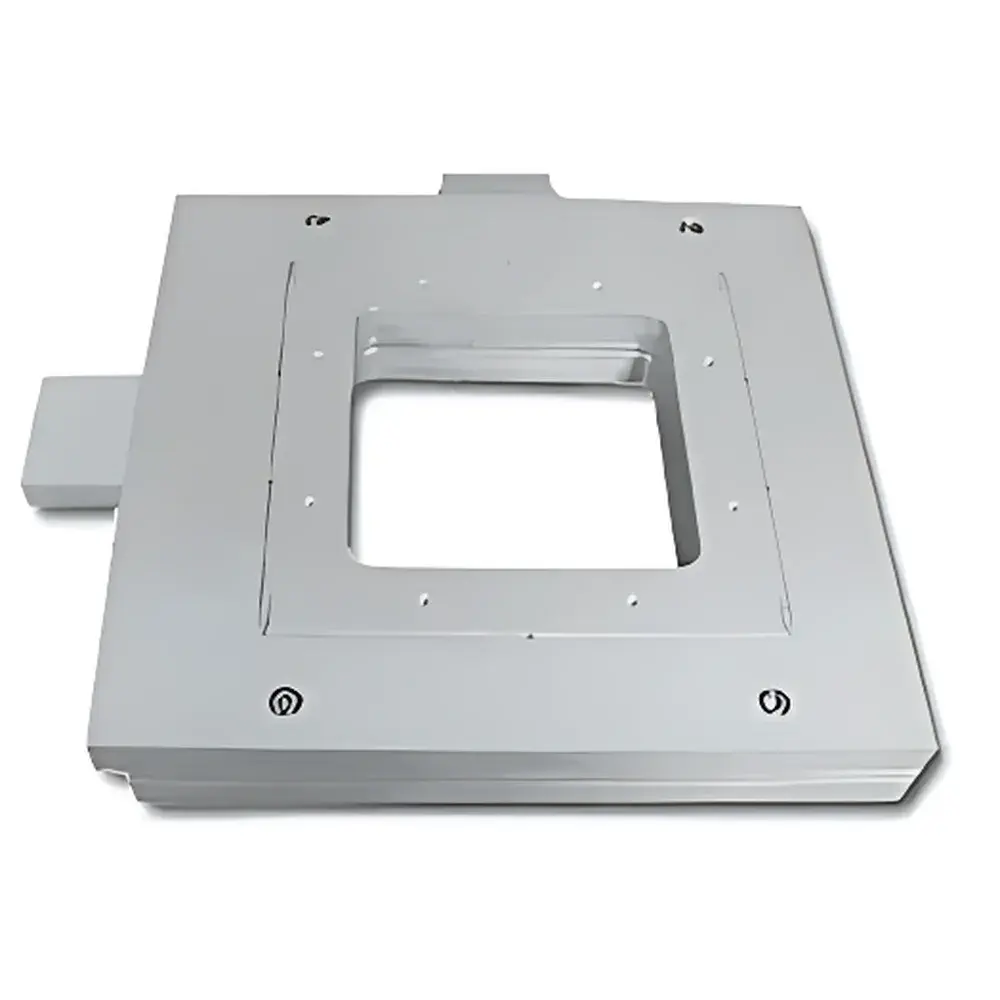
MCL Think Nano Nano-Max50 Dual-Axis Piezoelectric Nanopositioning Stage
| Brand | MCL Think Nano |
|---|---|
| Origin | USA |
| Model | Nano-Max50 |
| Motion Range (X/Y) | 50 μm × 50 μm |
| Resolution | 0.1 nm |
| Resonant Frequency (X) | 1.5 kHz ±20% |
| Resonant Frequency (Y) | 1.0 kHz ±20% |
| Stiffness | 5.0 N/μm |
| Angular Deviation (Roll/Pitch) | ≤1 μrad |
| Angular Deviation (Yaw) | ≤3 μrad |
| Max Horizontal Load Capacity | 5 kg |
| Control | Closed-loop with PicoQ® absolute position sensing |
| Controller | Nano-Drive® or Nano-Drive®85 |
| Body Material | Aluminum |
Overview
The MCL Think Nano Nano-Max50 is a high-performance, dual-axis piezoelectric nanopositioning stage engineered for sub-nanometer precision in demanding optical and cryogenic research environments. Built upon a monolithic aluminum architecture, it employs proprietary PicoQ® capacitive position sensing technology to deliver true absolute positioning feedback without homing or referencing—enabling deterministic, drift-free operation essential for long-duration experiments. Unlike open-loop piezo stages, the Nano-Max50 operates under closed-loop control, ensuring repeatable positioning accuracy of ±0.1 nm over its full 50 μm × 50 μm travel range. Its low-profile mechanical design and extra-large central aperture (≥Ø38 mm) facilitate seamless integration into inverted and upright optical microscopes, confocal systems, and custom-built cryostat mounts. The stage is specifically optimized for applications requiring both high static load support (up to 5 kg horizontally) and dynamic stability—making it suitable for coupling with heavy objective lenses, fiber couplers, quantum emitters, or multi-channel detector arrays.
Key Features
- Two-axis orthogonal nanopositioning with independent X- and Y-axis actuation and sensing
- 50 μm × 50 μm closed-loop travel range, scalable via custom configurations beyond standard limits
- 0.1 nm resolution and <±1 nm repeatability across full range, verified per ISO 230-2 Annex B protocols
- PicoQ® integrated capacitive sensors providing absolute position measurement—no power-loss recalibration required
- High mechanical stiffness (5.0 N/μm) and minimal parasitic motion: roll/pitch ≤1 μrad, yaw ≤3 μrad
- Resonant frequencies of 1.5 kHz (X) and 1.0 kHz (Y), enabling stable scanning at up to 100 Hz with <0.5% tracking error
- Aluminum body with precision-machined kinematic flexure guides—designed for thermal stability and vacuum compatibility (UHV-ready upon request)
- Compatible with MCL’s Nano-Drive® and Nano-Drive®85 controllers, supporting analog voltage input (±10 V), digital USB/Ethernet command interface, and real-time waveform streaming
Sample Compatibility & Compliance
The Nano-Max50 is routinely deployed in ISO Class 5 cleanroom-compatible optical benches and certified cryogenic setups operating down to 4 K. Its non-magnetic aluminum construction and absence of ferromagnetic components ensure compatibility with superconducting magnets and SQUID-based detection systems. The stage meets mechanical safety requirements outlined in IEC 61000-6-2 (immunity) and IEC 61000-6-4 (emission), and supports GLP-compliant experiment logging when paired with Nano-Drive®85 firmware v3.2+, which includes audit-trail-enabled parameter recording and user-access-controlled configuration locking. While not intrinsically rated for hazardous locations, it complies with UL 61010-1 for laboratory equipment safety when used within specified environmental limits (5–40 °C, <80% RH non-condensing).
Software & Data Management
Control and data acquisition are managed via MCL’s Nano-Control Suite—a cross-platform application supporting Windows, Linux, and macOS. The suite provides scripting interfaces (Python, MATLAB, LabVIEW) for automated raster scanning, hysteresis compensation, and real-time trajectory generation using user-defined Lissajous or spiral patterns. All position data is timestamped with microsecond resolution and exportable in HDF5 or CSV format, preserving metadata such as controller firmware version, sensor calibration ID, and thermal drift compensation status. Nano-Drive®85 firmware implements secure authentication and encrypted configuration storage, satisfying documentation traceability requirements under FDA 21 CFR Part 11 when configured with electronic signature workflows.
Applications
- Precision alignment of optical components in interferometric cavities and cavity-enhanced spectroscopy setups
- Cryostat-integrated sample positioning for low-temperature photoluminescence mapping of quantum dots and 2D materials
- Active stabilization of single-photon source coupling efficiency in quantum optics testbeds
- Sub-diffraction registration of multi-modal imaging channels (e.g., STED + FLIM + Raman)
- In situ nanomechanical probing in combined AFM-optical microscope configurations
- Calibration reference stage for metrology-grade optical encoders and laser Doppler vibrometers
FAQ
What is the maximum recommended load for vertical orientation?
The Nano-Max50 is rated for 5 kg in horizontal mounting. For vertical use, contact MCL engineering to evaluate gravitational loading effects on piezo stack lifetime and positional hysteresis.
Can the Nano-Max50 operate in ultra-high vacuum (UHV) environments?
Standard units are UHV-compatible with optional bake-out preparation (≤150 °C); outgassing rates meet ASTM E595 specifications when equipped with low-outgassing cabling and connector options.
Is PicoQ® sensor calibration traceable to NIST standards?
Yes—each PicoQ® sensor undergoes factory calibration against NIST-traceable interferometric references; calibration certificates are supplied with every unit.
How does closed-loop performance change at cryogenic temperatures?
Closed-loop operation remains fully functional down to 4 K; however, resonant frequency increases by ~12% and stiffness rises by ~18%—parameters are pre-compensated in Nano-Drive®85 firmware v3.4+.
Do you offer OEM integration support for custom optical enclosures?
MCL provides mechanical CAD models (STEP, IGES), API documentation, and joint design reviews for system integrators embedding the Nano-Max50 into turnkey instruments.




