MCL Think Nano Nano-MET Series Ultra-Low-Noise Multi-Axis Piezoelectric Translation Stages

| Brand | MCL Think Nano |
|---|---|
| Origin | USA |
| Model | Nano-MET Series |
| Type | Motorized Piezoelectric Translation Stage |
| Motion Axes | 2-Axis (XY), 3-Axis (XYZ) |
| Control | Closed-Loop |
| Positioning Resolution | XY: 0.15 nm, Z: 0.005 nm |
| Position Noise | XY: <4 pm/√Hz, Z: <400 fm/√Hz |
| Resonant Frequency | XY: 1.0–1.4 kHz, Z: 13.5 kHz |
| Travel Range | XY: 75 µm, Z: 5 µm |
| Max Load | 100 g (horizontal/vertical) |
| Body Material | Aluminum |
| Controller | Nano-Drive® |
Ask about pricing, availability and specifications.
Overview
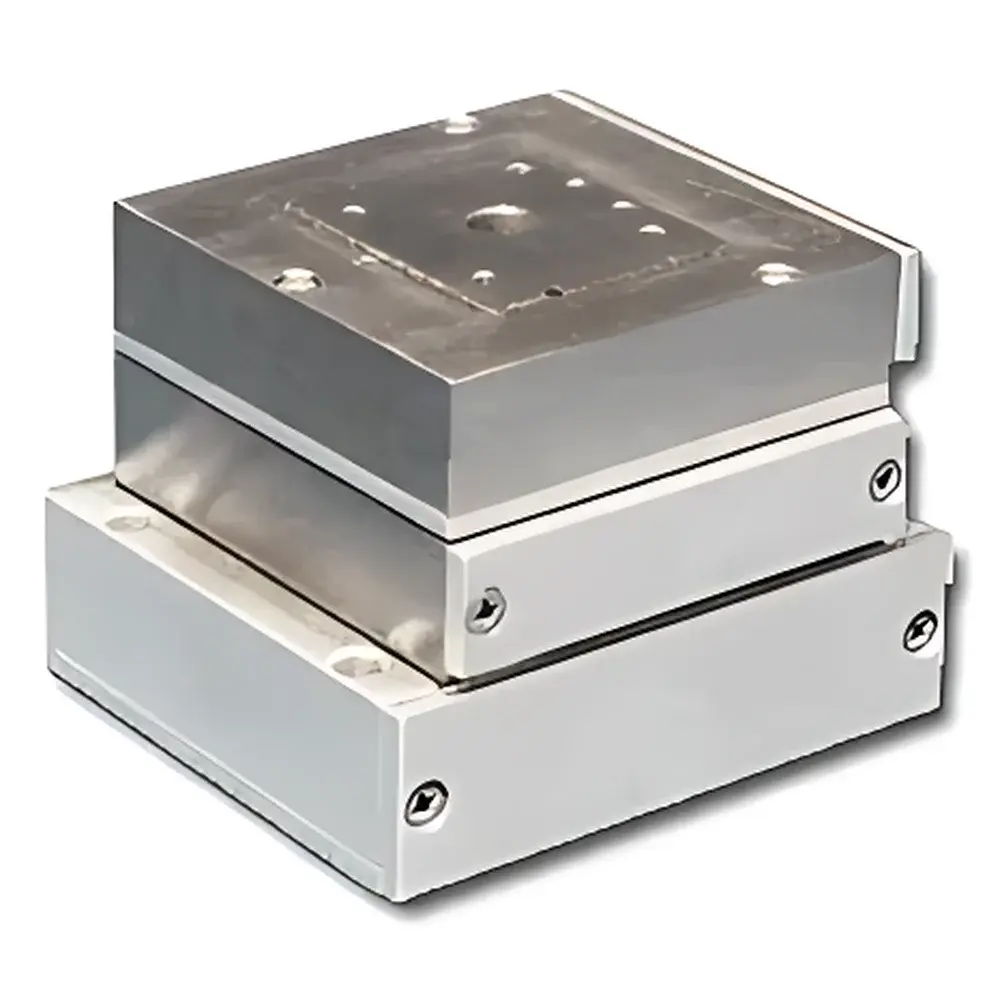
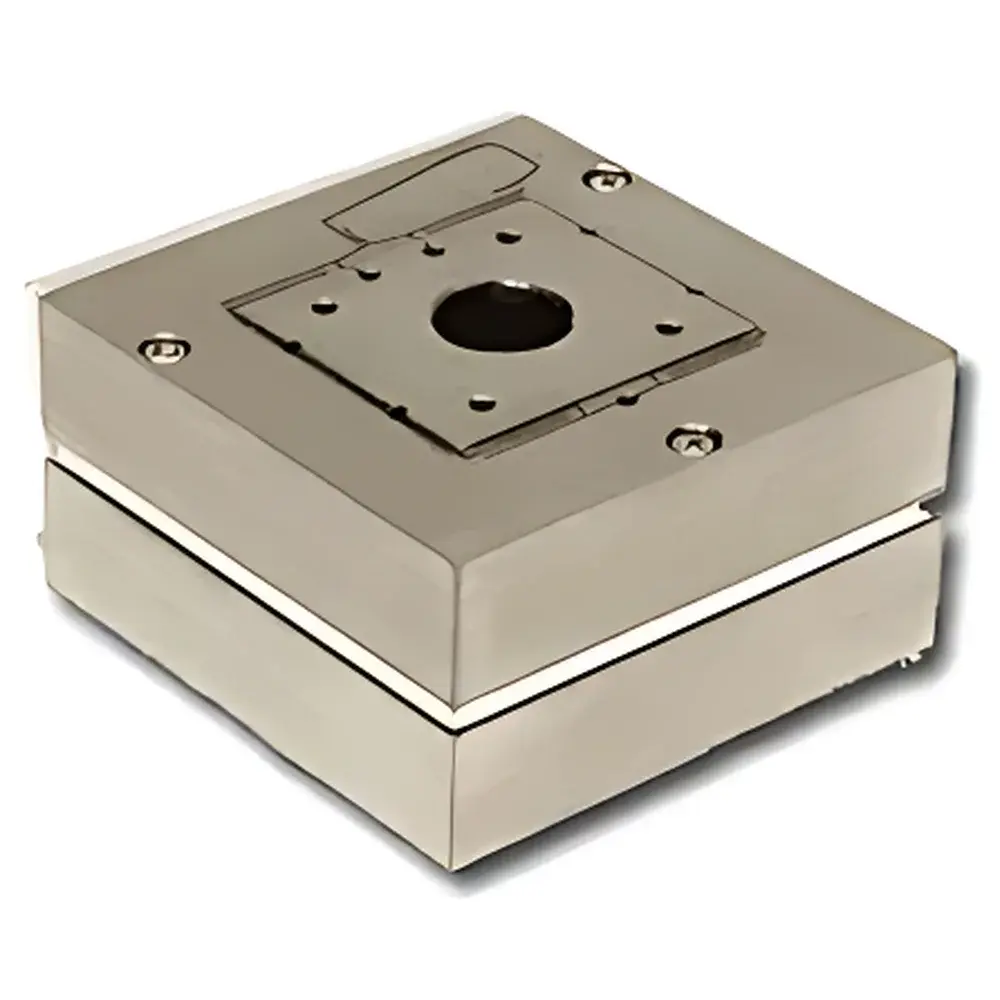
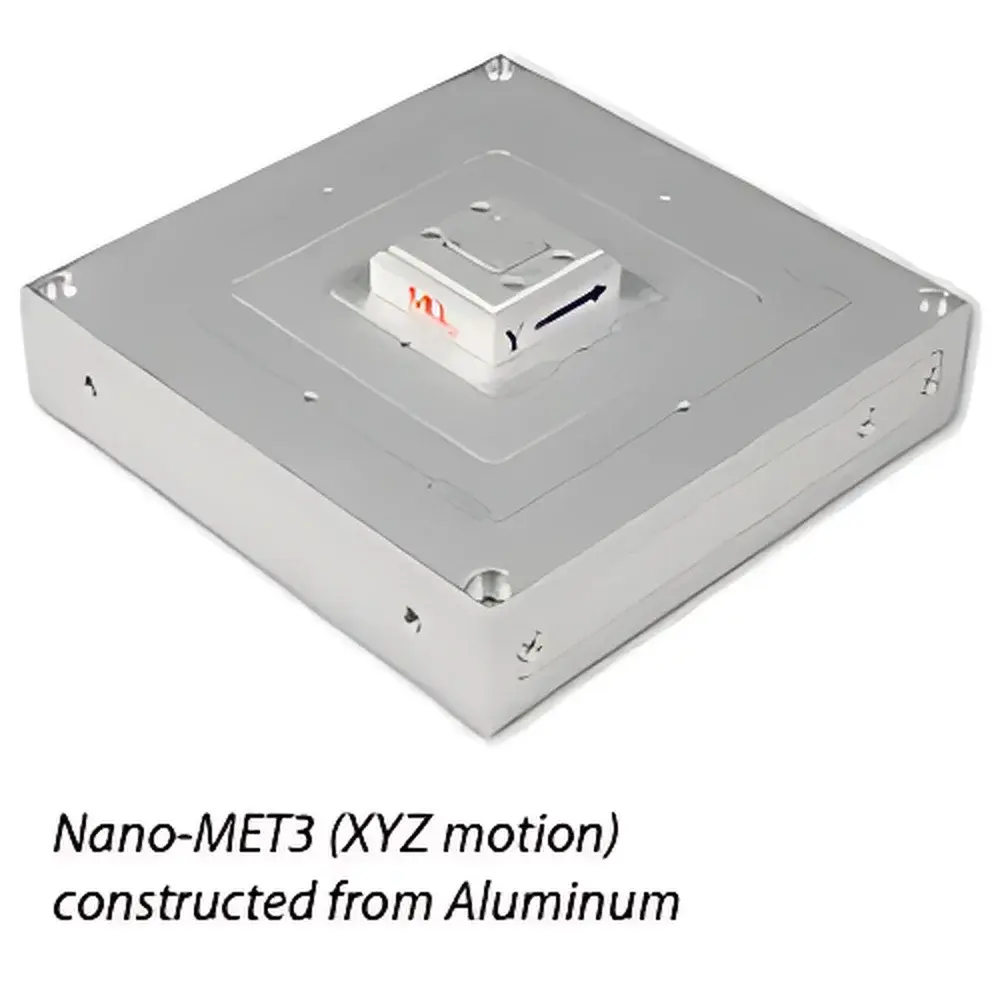
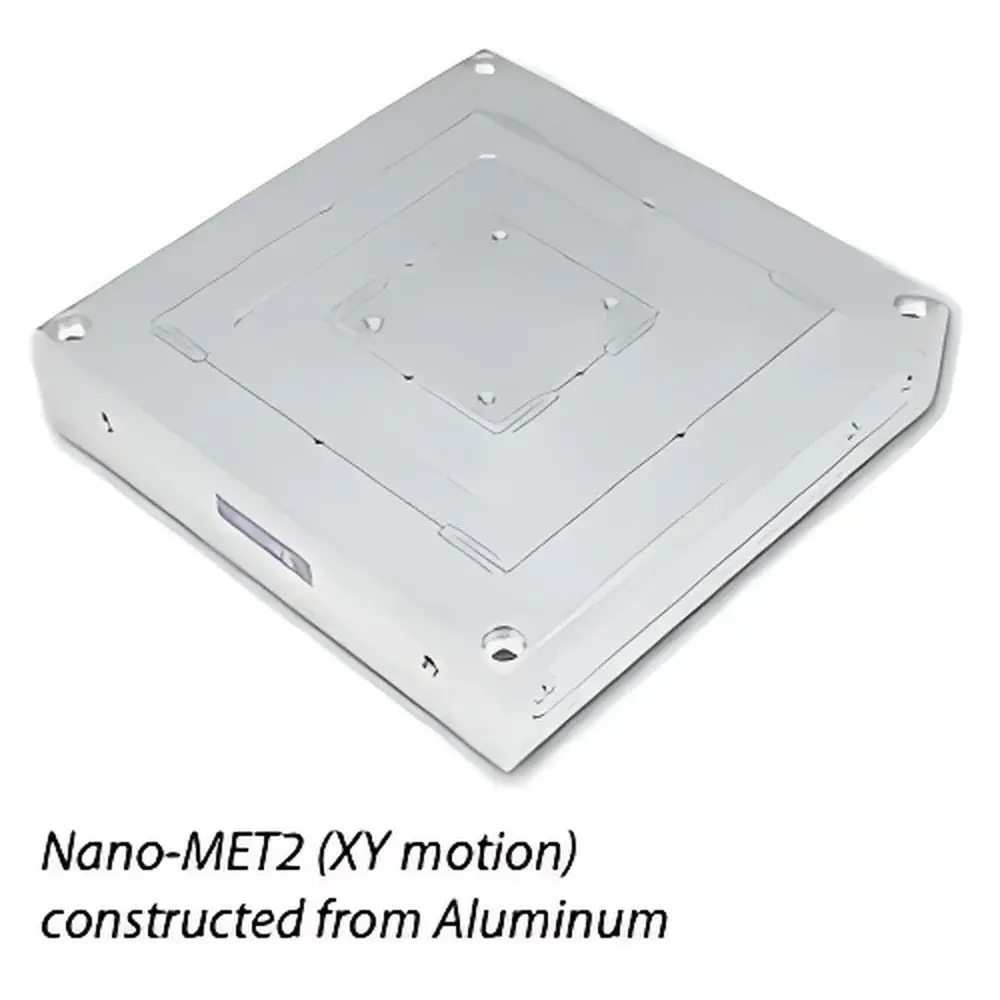
The MCL Think Nano Nano-MET Series comprises high-precision, closed-loop piezoelectric translation stages engineered for ultra-stable, sub-nanometer positioning in demanding optical and metrological environments. Based on proprietary PicoQ® capacitive sensing technology, these stages deliver absolute, drift-free position feedback without reliance on external interferometers or encoders. The Nano-MET2 (XY) and Nano-MET3 (XYZ) variants operate on a monolithic aluminum structure optimized for thermal stability, mechanical rigidity, and minimal hysteresis—critical for applications requiring long-term repeatability and spatial fidelity. Unlike stepper-motor or voice-coil-based platforms, the Nano-MET Series leverages direct piezoelectric actuation with integrated capacitive sensors, enabling true picometer-level resolution while maintaining bandwidths up to 13.5 kHz on the Z-axis—making it uniquely suited for dynamic scanning modalities such as high-speed atomic force microscopy (AFM), scanning probe microscopy (SPM), and interferometric alignment in adaptive optics systems.
Key Features
- True closed-loop operation with PicoQ® capacitive position sensors providing absolute, non-contact, and drift-compensated measurement
- Picometer-scale positioning resolution: 0.15 nm in XY, 0.005 nm in Z—validated under ambient laboratory conditions without vacuum or active temperature stabilization
- Ultra-low intrinsic position noise: <4 pm/√Hz (X/Y) and <400 fm/√Hz (Z), measured at 1 Hz bandwidth, enabling sub-Angstrom stability in time-domain experiments
- High resonant frequencies: 1.0–1.4 kHz (XY plane), 13.5 kHz (Z-axis on Nano-MET3), supporting rapid step-and-settle and resonant scanning protocols
- Monolithic aluminum construction ensures low thermal expansion coefficient (~23 ppm/K), high stiffness (>1.5 N/µm), and compatibility with UHV and cleanroom environments
- Integrated Nano-Drive® controller support for analog voltage input (±10 V), digital USB/Ethernet communication, and real-time waveform generation (sine, sawtooth, arbitrary)
Sample Compatibility & Compliance
The Nano-MET Series is designed for integration into OEM instrumentation and research-grade optical tables where mechanical isolation, electromagnetic compatibility (EMC), and material outgassing are critical. Its aluminum body meets ASTM B209 specifications for 6061-T6 alloy, ensuring consistent machinability and surface finish. The stages comply with RoHS Directive 2011/65/EU and are certified for CE marking under EMC Directive 2014/30/EU and Low Voltage Directive 2014/35/EU. For regulated environments—including ISO/IEC 17025-accredited calibration labs—the Nano-Drive® controller supports audit-ready logging, timestamped position traces, and user-accessible firmware revision tracking. While not inherently FDA 21 CFR Part 11 compliant, full electronic record integrity can be achieved when deployed with validated third-party data acquisition software meeting GLP/GMP documentation requirements.
Software & Data Management
The Nano-MET Series is fully supported by the cross-platform Nano-Drive® software suite (Windows/macOS/Linux), offering intuitive GUI control, scriptable Python API (via PyNanoDrive), and MATLAB Instrument Control Toolbox compatibility. All position data—including sensor readouts, drive voltages, and error signals—are streamed at up to 100 kHz with hardware-timestamped synchronization. Raw datasets export to HDF5 or CSV formats with embedded metadata (timestamp, gain settings, sensor calibration coefficients). The controller firmware implements cyclic redundancy checks (CRC-32) on all command packets and maintains an internal event log of initialization sequences, limit triggers, and overtemperature warnings—accessible via CLI or RESTful HTTP interface. Optional LabVIEW drivers and NI-DAQmx integration enable seamless incorporation into existing test automation frameworks.
Applications
- Atomic Force Microscopy (AFM): High-bandwidth Z-scanning for contact/resonant-mode imaging; XY stage synchronization with laser Doppler vibrometry
- Interferometric Metrology: Sub-wavelength alignment of retroreflectors, beam splitters, and cavity mirrors in gravitational wave detector prototype setups
- Nanoscale Lithography: Precision mask alignment and substrate stepping in electron-beam and near-field optical lithography tools
- Quantum Optics: Active stabilization of cavity length in ultrahigh-finesse Fabry–Pérot resonators used for cavity QED experiments
- Biophotonics: Nanopositioning of microfluidic chips during confocal fluorescence correlation spectroscopy (FCS) or single-molecule Förster resonance energy transfer (smFRET) assays
FAQ
What is the difference between Nano-MET2 and Nano-MET3?
The Nano-MET2 provides two-axis (X and Y) motion with independent closed-loop control; the Nano-MET3 adds a third axis (Z) with higher resonant frequency (13.5 kHz) and finer resolution (0.005 nm), optimized for fast vertical scanning in AFM and SPM.
Can the Nano-MET Series be operated in vacuum?
Yes—standard models are compatible with pressures down to 10⁻⁶ Torr; optional UHV-compatible versions with stainless-steel fasteners and low-outgassing adhesives are available upon engineering consultation.
Is thermal drift compensated in real time?
No active thermal compensation is built-in; however, the aluminum body’s low thermal time constant (<30 s) and inherent stability reduce drift to <0.5 nm over 1 hour at constant ambient temperature (23 ± 0.1 °C).
What maximum payload can be mounted without degrading performance?
The specified 100 g load rating assumes rigid mounting and center-of-mass alignment within ±0.5 mm of the stage’s geometric center; loads exceeding this require custom stiffness modeling and may impact resonant frequency and noise floor.
Does the Nano-Drive® controller support third-party synchronization protocols?
Yes—it provides TTL-compatible trigger I/O (input and output), IEEE-1588 precision time protocol (PTP) support, and programmable delay lines for deterministic multi-device coordination in distributed measurement systems.