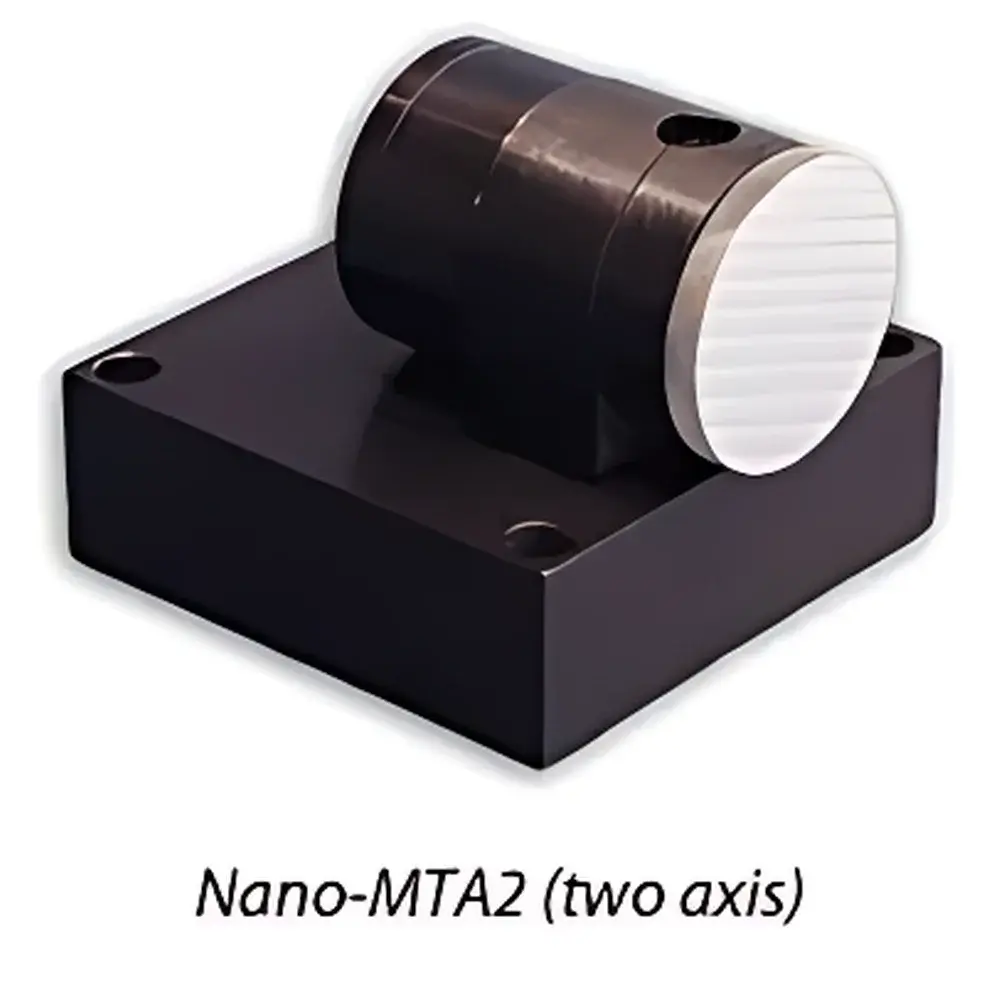
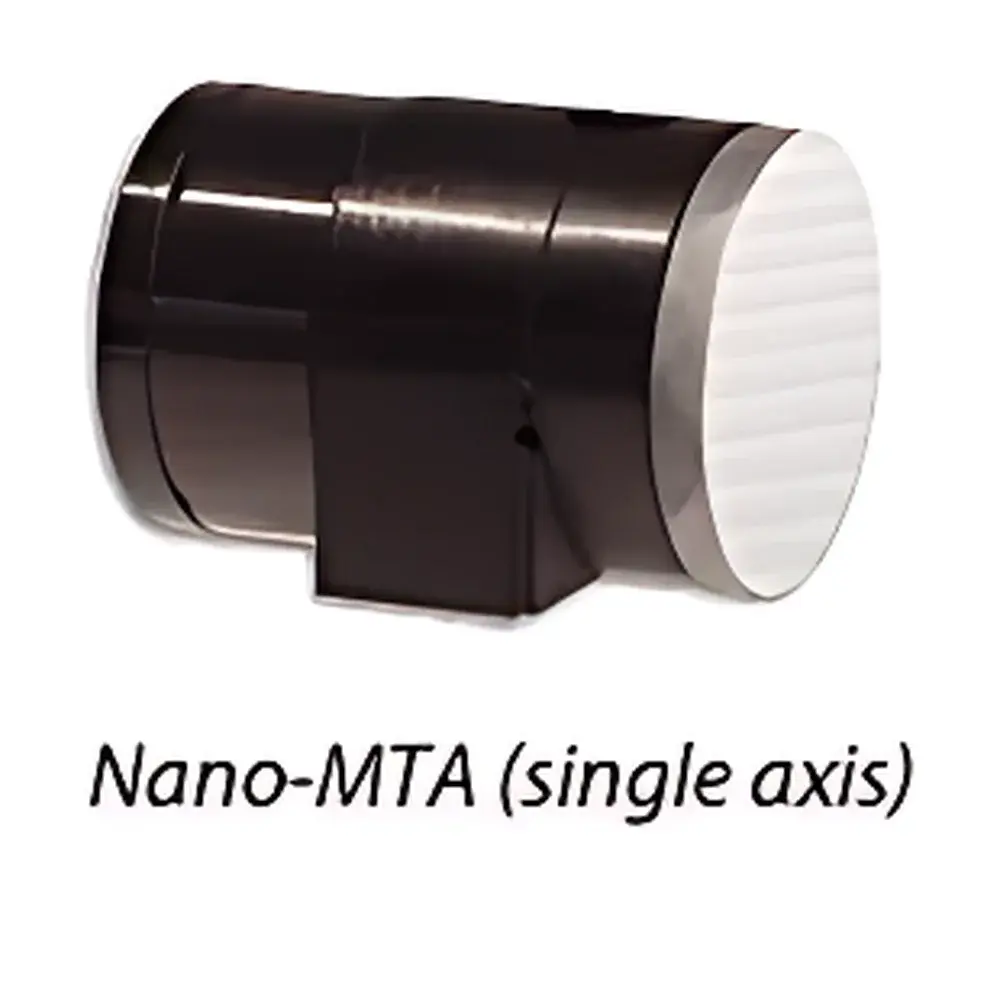
MCL Think Nano Nano-MTA Series Piezoelectric Tip/Tilt Mirror Mount

| Brand | MCL Think Nano |
|---|---|
| Origin | USA |
| Model | Nano-MTA Series |
| Type | Piezoelectric Single- and Dual-Axis Tip/Tilt Actuator |
| Motion Axes | 1 or 2 |
| Max Scan Frequency | 400 Hz |
| Tip/Tilt Range (standard) | ±2 mrad per axis |
| Tip/Tilt Range (extended) | ±5 mrad per axis |
| Resolution (standard) | 4 nm rad⁻¹ |
| Resolution (extended) | 10 nm rad⁻¹ |
| Resonant Frequency (X-axis, loaded) | 3.2 kHz (±2 mrad) / 2.8 kHz (±5 mrad) |
| Resonant Frequency (Y-axis, loaded) | 1.25 kHz (±2 mrad) / 800 Hz (±5 mrad) |
| Step Response Time | ≤2 ms |
| Controller Compatibility | Nano-Drive® or Nano-Drive®85 |
| Closed-Loop Position Sensing | Integrated PicoQ® capacitive sensor |
| Mirror Mounting Diameter | 25 mm |
| Body Materials | Aluminum, Invar, or Titanium |
| Compliance | Designed for ISO/IEC 17025-aligned optical alignment workflows and GLP/GMP-relevant active optics integration |
Ask about pricing, availability and specifications.
Overview
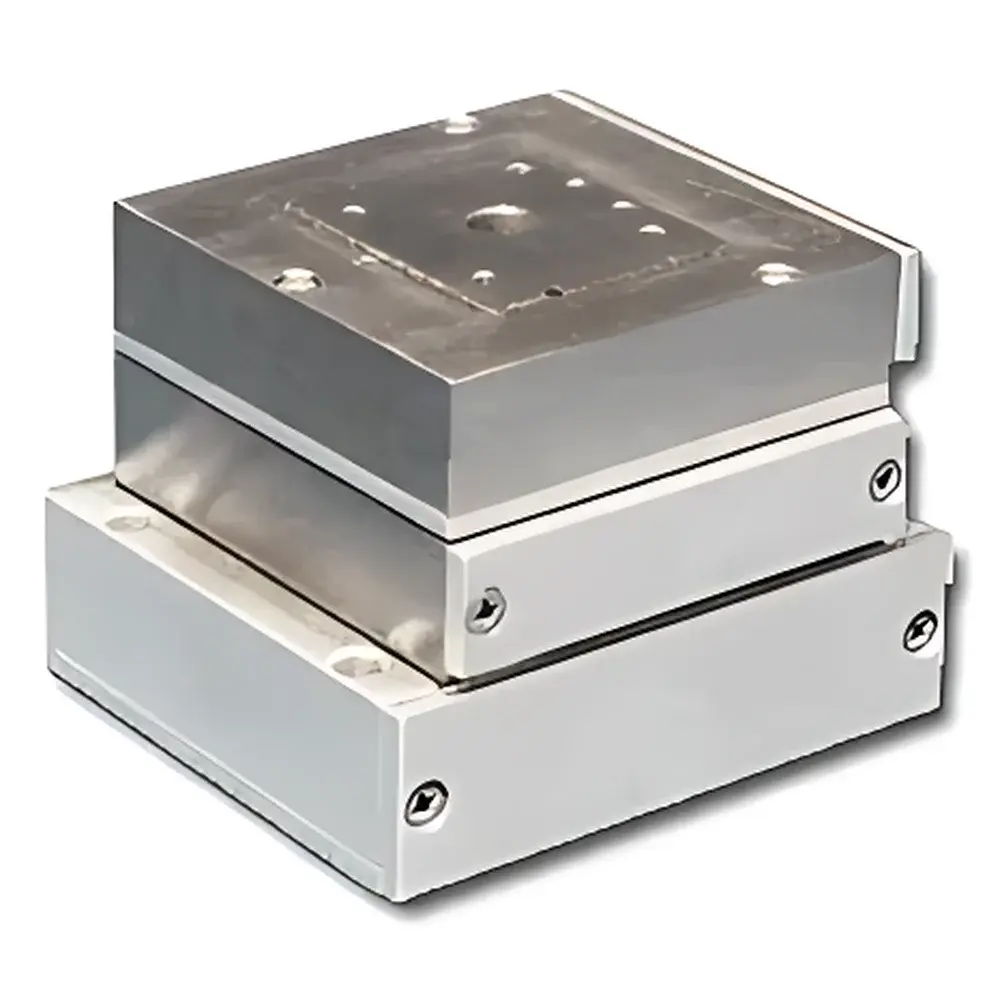
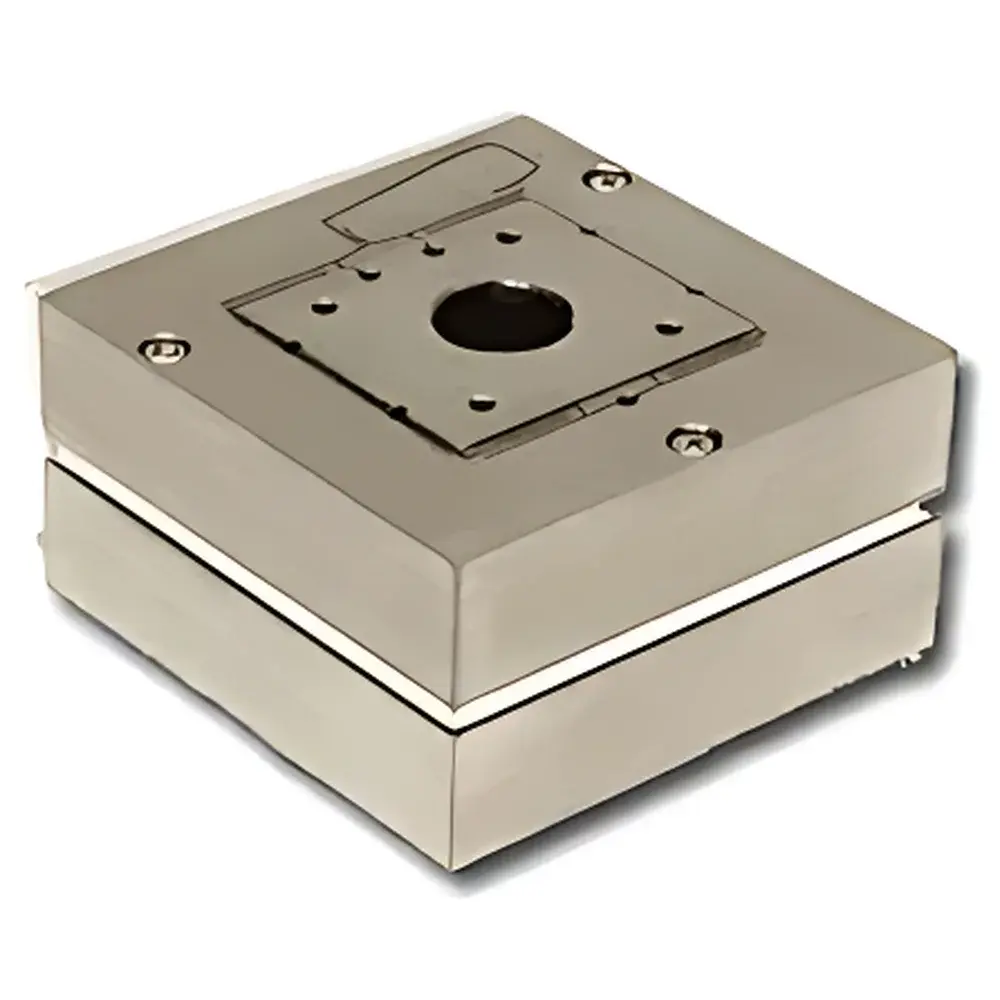
The MCL Think Nano Nano-MTA Series is a high-performance piezoelectric tip/tilt mirror mount engineered for sub-microradian beam steering and dynamic optical alignment in precision photonics systems. Operating on the principle of electrostrictive actuation within monolithic piezoceramic flexure mechanisms, the Nano-MTA delivers nanoradian-resolution angular displacement with exceptional mechanical stability and minimal hysteresis. Its design eliminates backlash and stiction—common limitations of motorized or voice-coil-based stages—making it suitable for applications demanding high repeatability, low positional noise, and deterministic response under closed-loop control. The series supports both single-axis (Nano-MTA1) and dual-axis (Nano-MTA2) configurations, enabling independent or coupled control of pitch and yaw motion. Each axis integrates proprietary PicoQ® capacitive position sensing, delivering absolute, drift-free angular measurement without external encoders or homing routines. This architecture ensures long-term calibration integrity and supports traceable metrology in environments aligned with ISO/IEC 17025 laboratory practices.
Key Features
- Piezo-driven tip/tilt motion with ±2 mrad or ±5 mrad full-scale range per axis, selectable via mechanical configuration
- Nanoradian resolution: 4 nrad (standard range) or 10 nrad (extended range), referenced to optical axis deviation
- Closed-loop operation enabled by integrated PicoQ® capacitive sensors—no recalibration required over temperature or time
- High dynamic bandwidth: up to 400 Hz sinusoidal scanning; step response ≤2 ms (10–90%) with Nano-Drive®85 controller
- Resonant frequencies exceeding 3 kHz (X-axis) and 1.2 kHz (Y-axis) when loaded with standard 25 mm Ø × 3 mm glass mirrors
- Orientation-agnostic mounting: compatible with horizontal, vertical, or inverted installation without performance degradation
- Thermally stable structural materials: optional Invar or titanium bodies minimize thermal drift in interferometric or vacuum-compatible setups
Sample Compatibility & Compliance
The Nano-MTA Series accommodates standard optical mirrors up to 25 mm in diameter and 3 mm thick, secured via Milbond®-compatible adhesive bonding (e.g., Edmund Optics NT53-288). Mirror substrates may include fused silica, BK7, or low-expansion ceramics—provided surface flatness remains within λ/10 PV to preserve wavefront fidelity. The device meets mechanical and electrical safety requirements per IEC 61010-1 for laboratory equipment. While not certified to FDA 21 CFR Part 11, its closed-loop data logging capability—when paired with Nano-Drive®85’s onboard timestamped trajectory buffers—supports audit-ready documentation for GLP and GMP-aligned optical manufacturing processes, including FBG inscription and optical disk mastering. All units are manufactured and tested in the United States under controlled cleanroom conditions compliant with AS9100D aerospace-grade quality protocols.
Software & Data Management
Control is implemented through either the Nano-Drive® (standard) or Nano-Drive®85 (high-power) controller, both integrating analog/digital I/O, proportional-integral (PI) feedback loops, and 150 V piezo amplifiers. The Nano-Drive®85 adds real-time waveform generation (arbitrary, sine, sawtooth), synchronized multi-channel triggering, and USB/Ethernet interfaces supporting SCPI command sets. Data acquisition includes position readback at up to 10 kHz sampling rate, with built-in RMS noise floor <0.15 nrad/√Hz (measured at 100 Hz). Third-party integration is supported via LabVIEW™ drivers, MATLAB® Instrument Control Toolbox, and Python APIs using standard VISA or TCP/IP protocols. Audit trails—including setpoint history, sensor output timestamps, and amplifier voltage logs—are exportable in CSV or HDF5 format for regulatory review.
Applications
- High-speed laser beam steering in adaptive optics systems for astronomy and free-space optical communications
- Fiber Bragg grating (FBG) writing via interferometric phase control during UV exposure
- Dynamic null testing and cavity alignment in gravitational-wave detector prototype interferometers
- Real-time aberration correction in multiphoton microscopy and confocal scanning platforms
- Precision track-following in optical disc mastering tools operating at rotational speeds >10,000 RPM
- Active stabilization of resonant cavities in quantum optics experiments requiring sub-100 nrad pointing stability
FAQ
What mirror mounting options are supported?
Standard mounting uses Milbond®-type epoxy (e.g., Edmund Optics NT53-288) on the 25 mm diameter kinematic surface. Custom kinematic bases or vacuum-compatible variants are available upon request.
Is vacuum compatibility available?
Yes—Invar- and titanium-body variants are rated for UHV environments (<10⁻⁹ Torr) when configured with bake-out compatible adhesives and non-outgassing cabling.
Can the Nano-MTA2 operate in open-loop mode?
Open-loop operation is technically possible but not recommended; absence of PicoQ® feedback compromises repeatability and introduces hysteresis-dependent positioning error beyond ±50 nrad.
How is thermal drift managed across ambient temperature fluctuations?
Invar and titanium versions exhibit CTE <1.5 ppm/°C; aluminum variants include embedded temperature compensation coefficients in Nano-Drive® firmware to correct for gain drift below ±0.02 %/°C.
What is the maximum safe mirror mass for 400 Hz scanning?
For sustained 400 Hz operation, mirror mass must remain ≤1.2 g (e.g., 25 mm Ø × 3 mm fused silica). Higher masses reduce resonant frequency and increase settling time proportionally.