
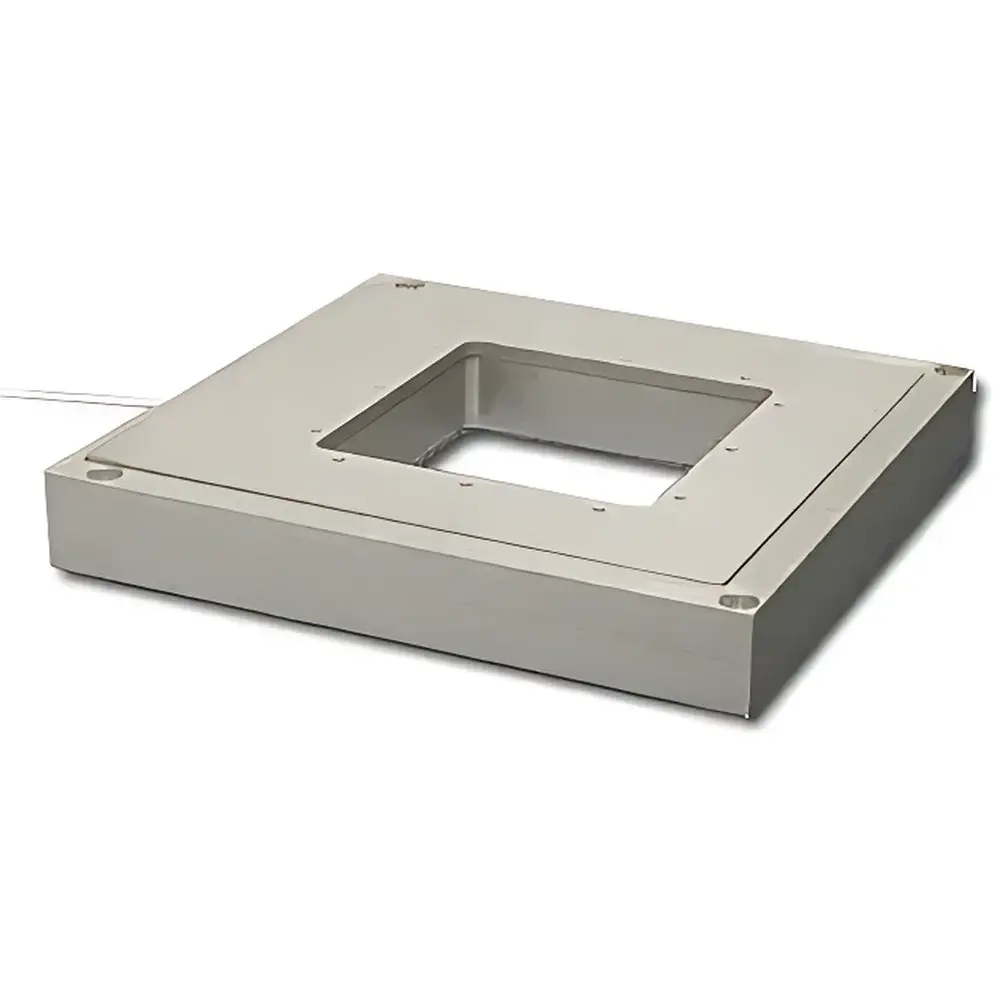
MCL Think Nano Nano-Z Series Piezo-Driven Z-Axis Translation Stage
| Brand | MCL Think Nano |
|---|---|
| Origin | USA |
| Manufacturer Type | Authorized Distributor |
| Product Category | Imported |
| Model | Nano-Z Series |
| Product Type | Motorized Precision Translation Stage |
| Motion Axis | Single-Axis (Z) |
| Travel Range | 100 µm or 200 µm |
| Resolution | 0.2 nm (Nano-Z100) / 0.4 nm (Nano-Z200) |
| Resonant Frequency | 600 Hz ±20% (100 µm) / 450 Hz ±20% (200 µm) |
| Stiffness | 1.0 N/µm |
| Max Recommended Load (Horizontal) | 0.5 kg |
| Body Material | Aluminum or Invar |
| Control Mode | Closed-Loop with Integrated PicoQ® Position Sensing |
| Step Response Time | ≤4 ms (with Nano-Drive®85) |
| Aperture | 2.6" × 2.6" |
| Height | 0.8" |
| Software Compatibility | Nano-Control Suite, Third-Party LabVIEW/Python API Support |
Overview
The MCL Think Nano Nano-Z Series is a high-performance, single-axis piezoelectric translation stage engineered specifically for precision vertical (Z-axis) positioning in optical microscopy and photonics instrumentation. Utilizing direct-drive piezoelectric actuation combined with proprietary PicoQ® capacitive position sensing, the Nano-Z Series delivers sub-nanometer resolution, picometer-level repeatability, and closed-loop stability under dynamic loading conditions. Its ultra-low profile (0.8″) and large central aperture (2.6″ × 2.6″) enable seamless integration into space-constrained microscope frames—including inverted, upright, and light-sheet platforms—without obstructing optical paths or objective clearance. Designed for retrofit compatibility, the Nano-Z Series eliminates the need for custom mechanical redesign while maintaining full alignment integrity across OEM and research-grade systems.
Key Features
- Ultra-low-profile mechanical architecture (20.3 mm height) optimized for microscope integration without compromising optical access.
- Two standard travel options: Nano-Z100 (100 µm) and Nano-Z200 (200 µm), both supporting closed-loop operation with absolute position feedback.
- PicoQ® integrated capacitive sensors provide real-time, drift-free position measurement with <0.2 nm noise floor and <10 pm long-term repeatability.
- High resonant frequency (up to 600 Hz) ensures rapid step response (<4 ms with Nano-Drive®85 controller), critical for high-speed autofocus, confocal line scanning, and adaptive optics synchronization.
- Stiffness of 1.0 N/µm enables stable performance under inertial loads typical in resonant scanning and multi-axis coupling scenarios.
- Modular body construction in either anodized aluminum (thermal expansion coefficient: 23 ppm/K) or low-expansion Invar (1.2 ppm/K), selectable per application thermal stability requirements.
- Fully compatible with industry-standard mounting interfaces (e.g., M4/M6 tapped holes, kinematic dowel pin patterns) and supports custom footprint adaptation for OEM integration.
Sample Compatibility & Compliance
The Nano-Z Series is designed for use with standard optical components including objectives (up to 100× oil immersion), filter cubes, dichroic mirrors, and detector modules. It complies with RoHS 3 and REACH directives for material safety. While not certified as medical device hardware, its closed-loop architecture, deterministic motion behavior, and traceable calibration protocols support GLP-compliant workflows in academic and industrial R&D laboratories. The system meets electromagnetic compatibility (EMC) Class B requirements per FCC Part 15 and CE EN 61326-1 standards. When paired with Nano-Drive®85 controllers, it supports audit-trail-enabled operation per FDA 21 CFR Part 11 when used within validated software environments (e.g., custom Python-based acquisition frameworks with timestamped metadata logging).
Software & Data Management
Native control is provided through the Nano-Control Suite—a cross-platform application supporting Windows, macOS, and Linux. The suite includes real-time position monitoring, waveform generation (sine, triangle, arbitrary), and scriptable motion sequences with sub-millisecond timing resolution. Low-level access is available via DLLs, shared libraries, and TCP/IP APIs for integration into MATLAB, Python (PyVISA, NumPy), LabVIEW, and Micro-Manager. All position data streams include synchronized timestamps and sensor confidence flags. Raw position noise spectra (e.g., Nano-Z100 Position Noise Spectrum) are exportable in HDF5 and CSV formats for spectral analysis and compliance reporting. Firmware updates maintain backward compatibility and introduce new motion profiles aligned with ISO 10360-8 metrology guidelines for coordinate measuring instruments.
Applications
- High-speed confocal and multiphoton microscopy requiring sub-millisecond Z-scanning and autofocus correction.
- Structured illumination microscopy (SIM) and lattice light-sheet imaging where axial sectioning demands nanometer-level slice reproducibility.
- Super-resolution modalities including STED, PALM, and STORM, where precise Z-localization and drift compensation are essential.
- OEM integration into automated slide scanners, wafer inspection tools, and fiber alignment stations requiring compact, high-bandwidth vertical actuation.
- Quantitative phase imaging (QPI) and digital holographic microscopy (DHM), where Z-piezo stages serve as reference path modulators.
- In situ mechanical testing rigs interfaced with optical coherence tomography (OCT) or laser Doppler vibrometry systems.
FAQ
What is the difference between open-loop and closed-loop operation on the Nano-Z Series?
Closed-loop mode uses the integrated PicoQ® sensor for real-time position verification and error correction, delivering guaranteed repeatability and linearity. Open-loop operation (available via firmware toggle) bypasses feedback for maximum bandwidth but sacrifices absolute accuracy and thermal drift compensation.
Can the Nano-Z Series be used in vacuum or cleanroom environments?
Standard units are rated for ambient laboratory use (ISO Class 8). Vacuum-compatible versions (UHV-rated to 10⁻⁷ Torr) and cleanroom-certified variants (Class 100/ISO 5 compliant housings) are available upon request with modified materials and outgassing testing reports.
Is thermal drift compensated during extended acquisitions?
Yes—the PicoQ® sensor provides continuous position readout independent of piezo hysteresis or temperature-induced expansion. For long-duration experiments (>1 hr), optional external temperature monitoring can feed forward corrections via the Nano-Control Suite’s scripting interface.
How is calibration traceability established for metrology applications?
Each stage undergoes factory calibration against NIST-traceable interferometric standards. Calibration certificates include linearity deviation plots, hysteresis envelopes, and noise spectral density measurements—all archived in the unit’s onboard EEPROM and accessible via API.
What maintenance is required over the operational lifetime?
No scheduled maintenance is required. The monolithic piezo design and solid-state position sensing eliminate wear mechanisms. Lifetime expectancy exceeds 10¹² cycles at full stroke under recommended load conditions.





