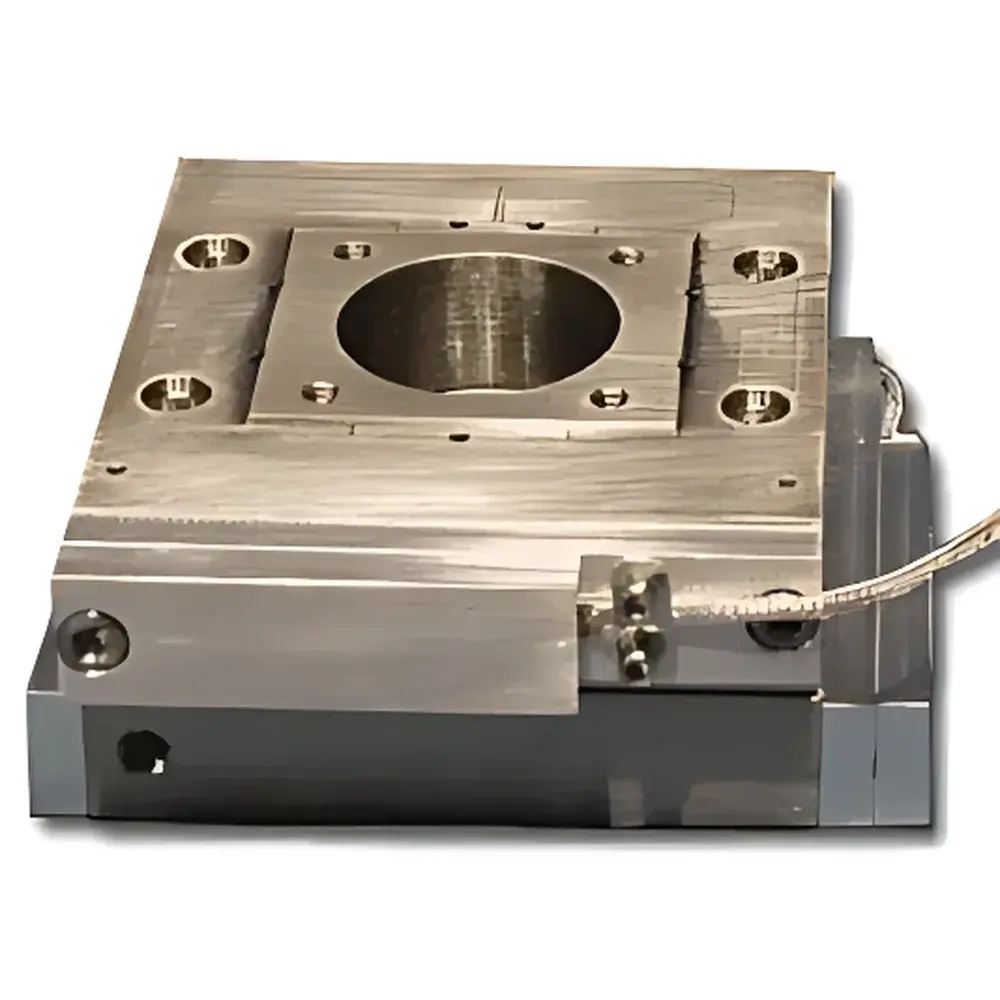
MCL Think Nano Nano-UHV50 Ultra-High Vacuum Compatible Dual-Axis Piezoelectric Nanopositioning Stage

| Brand | MCL Think Nano |
|---|---|
| Origin | USA |
| Model | Nano-UHV50 |
| Motion Range (X/Y) | 50 µm × 50 µm |
| Resolution (XY) | 0.1 nm |
| Resonant Frequency (X) | 500 Hz ±20% |
| Resonant Frequency (Y) | 250 Hz ±20% |
| Stiffness | 0.5 N/µm |
| Angular Deviation (Roll/Pitch) | ≤1 µrad |
| Angular Deviation (Yaw) | ≤3 µrad |
| Max. Horizontal Load | 0.5 kg |
| Max. Vertical Load | 0.2 kg |
| Body Material | Invar or Titanium |
| Bakeout Temperature | 100 °C |
| UHV Compatibility | ≤1×10⁻¹⁰ Torr |
| Aperture | 25 mm (1 inch) |
| Position Sensing | PicoQ® closed-loop absolute sensing |
| Controller | Nano-Drive® |
Ask about pricing, availability and specifications.
Overview
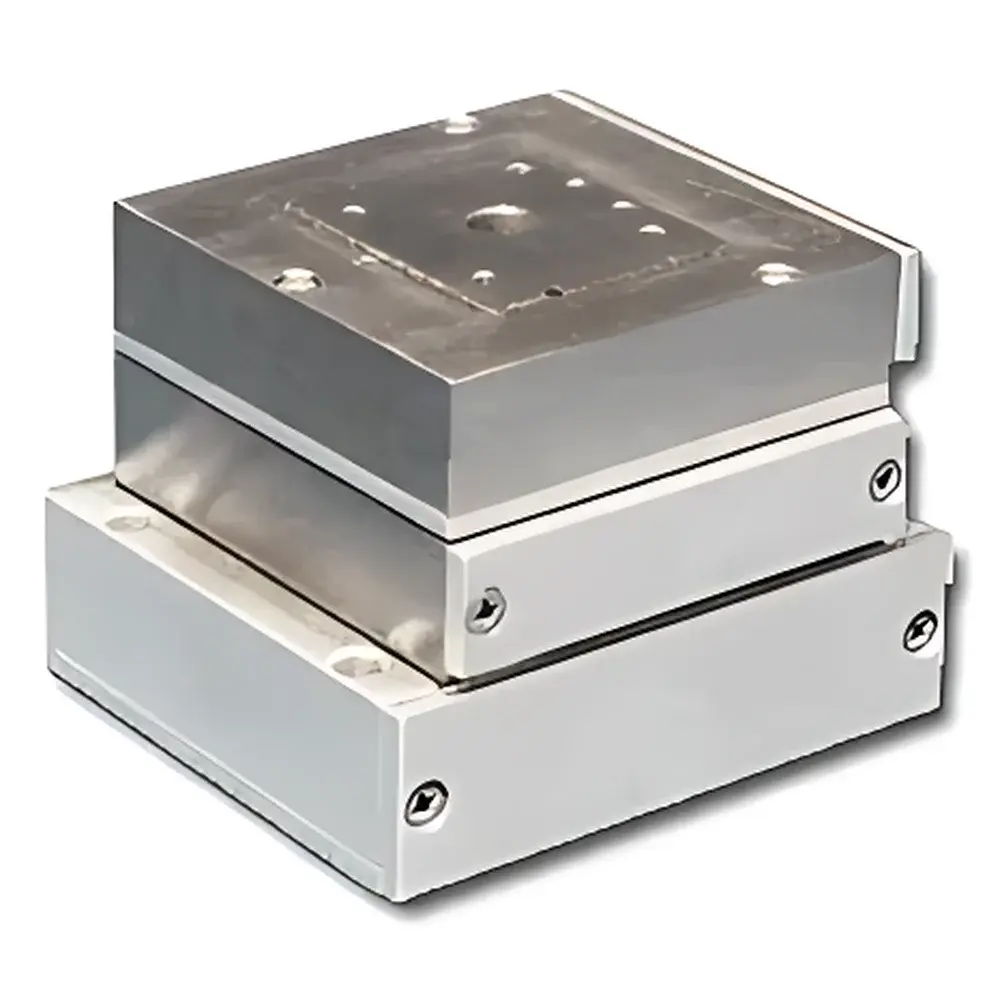
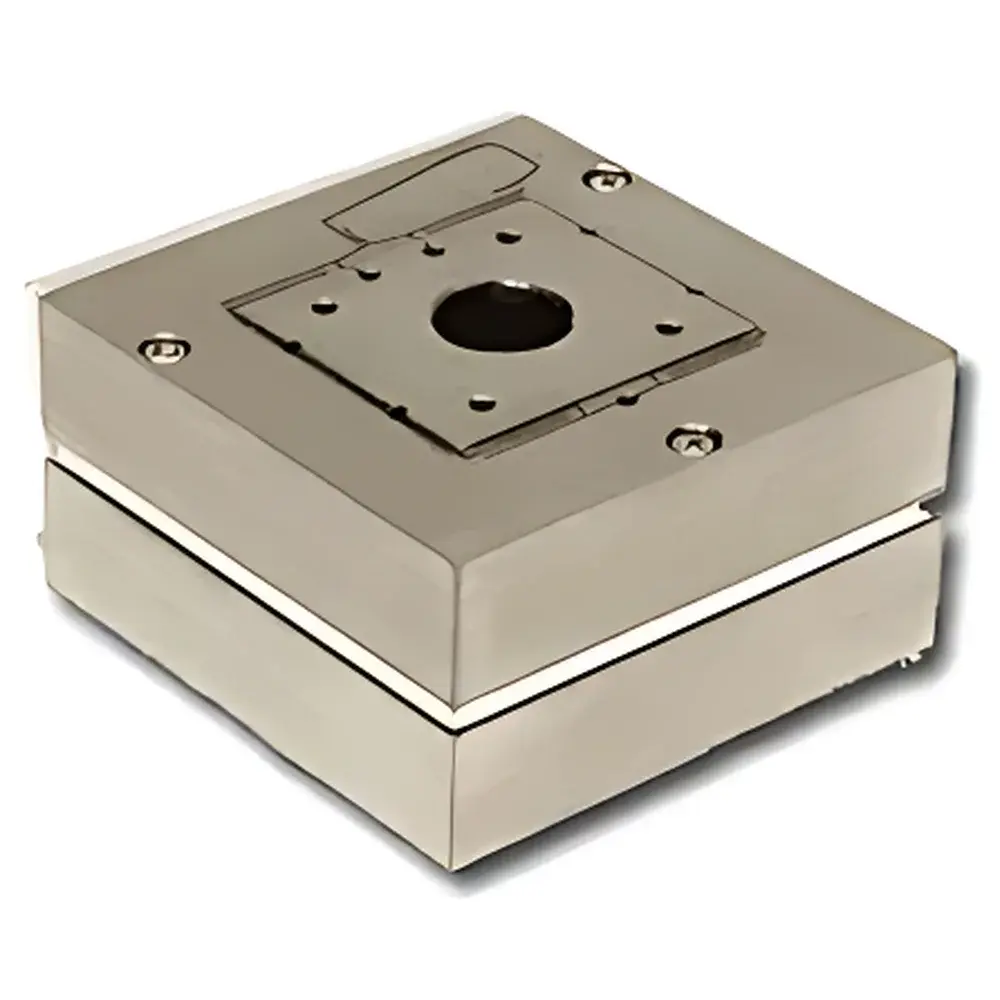
The MCL Think Nano Nano-UHV50 is a dual-axis (XY), ultra-high vacuum (UHV)-compatible nanopositioning stage engineered for sub-nanometer motion control in extreme vacuum environments. Designed around piezoelectric actuation and integrated PicoQ® capacitive position sensing, the stage operates on the principle of electrostrictive displacement with real-time closed-loop feedback—ensuring traceable, hysteresis-compensated positioning in demanding synchrotron, surface science, and atomic-scale imaging applications. Its all-metal construction—using either low-thermal-expansion Invar or non-magnetic, UHV-bakeable titanium—eliminates outgassing risks and maintains dimensional stability during thermal cycling up to 100 °C. The stage is rated for operation in base pressures down to 1×10⁻¹⁰ Torr, making it suitable for UHV scanning probe microscopy (SPM), X-ray nanodiffraction, vacuum ultraviolet (VUV) spectroscopy, and in-situ electron microscopy sample manipulation.
Key Features
- True UHV-compliant architecture: All structural components, adhesives, and internal cabling meet ASTM E595 total mass loss (TML) & collected volatile condensable materials (CVCM) specifications for vacuum service.
- Dual-axis XY motion with independent, synchronous control: 50 µm travel per axis, with <0.1 nm closed-loop resolution and repeatability verified per ISO 230-2 Annex B protocols.
- PicoQ® absolute position sensing: Monolithic capacitive sensors embedded within the moving platform deliver picometer-level linearity and zero drift over time—no homing or referencing required.
- Bakeable to 100 °C without disassembly: Compatible with standard UHV chamber bakeout procedures; flange-mounting interfaces conform to CF (ConFlat) or KF standards per customer specification.
- Optical access via centered 25 mm aperture: Enables coaxial beam path alignment, laser interferometry integration, or direct mounting of miniature sample holders.
- Modular electrical interface: Pre-terminated cables with customizable lengths and pinouts; designed for seamless integration with Accu-Glass® electrical feedthroughs (CF-35, CF-63), with optional compatibility for Lesker, VAT, or custom flange types.
Sample Compatibility & Compliance
The Nano-UHV50 is routinely deployed in laboratories adhering to ISO/IEC 17025-accredited calibration workflows and GLP-compliant surface characterization studies. Its material selection and surface finish (Ra < 0.2 µm, passivated titanium or electropolished Invar) comply with ASTM F86 and ASTM B689 for vacuum-compatible metallic components. The stage meets mechanical requirements outlined in ISO 14644-1 Class 1 cleanroom handling and supports traceable metrology under USP Analytical Instrument Qualification frameworks. When paired with the Nano-Drive® controller, full audit trail logging—including timestamped position commands, sensor readbacks, and error states—is maintained in accordance with FDA 21 CFR Part 11 requirements for electronic records and signatures.
Software & Data Management
Control is executed via the Nano-Drive® software suite (Windows/Linux), supporting native integration with LabVIEW™, MATLAB®, Python (via PyVISA), and EPICS IOC environments. The API provides low-latency command access to trajectory generation (point-to-point, raster, Lissajous), real-time streaming of position data at up to 10 kHz, and programmable safety limits (force, velocity, range). All position logs are stored in HDF5 format with embedded metadata (UTC timestamps, sensor calibration IDs, environmental temperature readings from optional thermistor inputs), enabling reproducible experiment reconstruction and third-party analysis in tools such as Igor Pro or OriginLab. Firmware updates are delivered via signed binary packages with SHA-256 verification.
Applications
- UHV scanning tunneling microscopy (STM) and atomic force microscopy (AFM) coarse/fine approach stages
- In-situ X-ray reflectivity (XRR) and grazing-incidence small-angle X-ray scattering (GISAXS) sample alignment
- Vacuum ultraviolet (VUV) monochromator mirror positioning and beamline optics stabilization
- Quantum device fabrication: cryogenic-compatible positioning of nanoprobes in dilution refrigerator insert stages
- Surface science reaction chambers: precise translation of catalytic substrates during temperature-programmed desorption (TPD)
- Coherent diffractive imaging (CDI) sample rastering with sub-pixel registration accuracy
FAQ
Is the Nano-UHV50 compatible with cryogenic environments?
The standard Nano-UHV50 is rated for ambient to 100 °C bakeout; cryogenic variants (down to 4 K) are available upon engineering review and require modified piezo stack formulations and thermal anchoring provisions.
Can I integrate this stage into an existing UHV system using non-Accu-Glass feedthroughs?
Yes—custom cable harnesses and mating connectors (e.g., SHV, Sub-D, LEMO) can be supplied to match Lesker, MDC, or VAT feedthrough configurations; lead times increase by 2–3 weeks for qualification testing.
What level of positional stability is achieved after thermal soak at 100 °C?
Post-bake positional drift remains below ±0.5 nm over 24 hours at constant temperature, measured via external heterodyne interferometer referenced to a fixed fiducial mark.
Does the Nano-Drive® controller support multi-axis synchronization with external triggers?
Yes—the controller features TTL input/output ports for hardware-triggered motion start/stop, encoder index pulse capture, and synchronized data acquisition with external DAQ systems at jitter <100 ns.
Are calibration certificates provided with each unit?
Each Nano-UHV50 ships with a factory-issued calibration report (NIST-traceable interferometric verification of range, linearity, and bidirectional repeatability), valid for 12 months under normal operating conditions.