
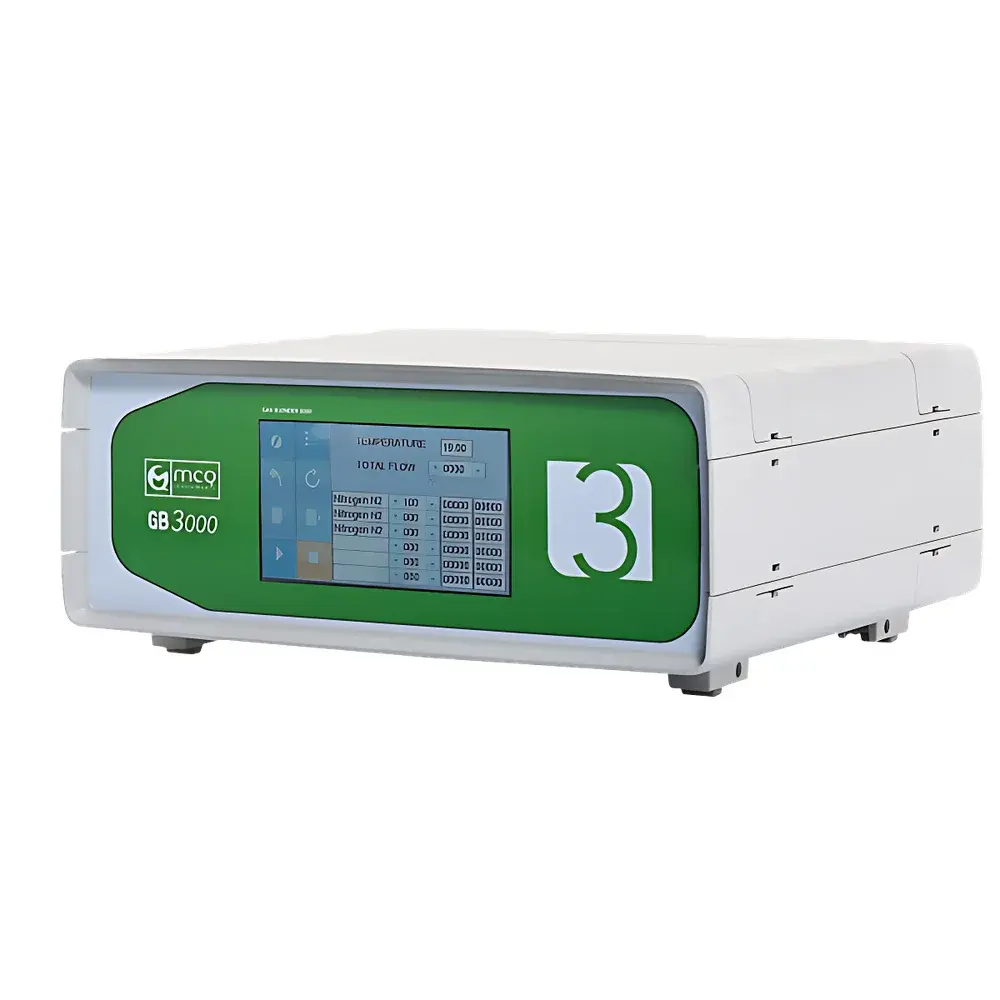
MCQ GB3000 Dynamic Gas Dilution System
| Brand | MCQ |
|---|---|
| Model | GB3000 |
| Origin | Italy |
| Configuration | 3-inlet / 1-outlet |
| Max Flow per Channel | 0–5000 mL/min |
| Dilution Ratio Range | 1:1 to 1:1000 |
| Gas Compatibility | N₂, O₂, CO₂, CH₄, Air, NO, CO, Ar, C₂H₄, C₂H₆, SF₆, C₃H₈, C₄H₁₀, H₂, He, DME (C₂H₆O), N₂O, SO₂, etc. |
| Third-Party Software Integration | Yes |
| Regulatory Compliance | Designed for ISO/IEC 17025-compliant calibration labs and EPA/EN-certified environmental testing environments |
Overview
The MCQ GB3000 Dynamic Gas Dilution System is an engineered solution for precise, real-time generation of certified reference gas mixtures in laboratory, calibration, and industrial process monitoring environments. Based on the principle of mass flow-controlled dynamic dilution—where high-purity source gases are metered via calibrated thermal mass flow controllers (MFCs) and mixed with a primary carrier (e.g., zero air or nitrogen) under laminar flow conditions—the GB3000 delivers traceable, stable, and reproducible gas concentrations across wide dynamic ranges. Unlike static blending or permeation-based methods, this system enables continuous, on-demand generation of target analyte concentrations from parts-per-trillion (ppt) to percent-level, supporting both single-point calibration and multi-level gradient protocols required by regulatory gas analysis workflows.
Key Features
- Triple independent inlet architecture (3-in/1-out) with individually calibrated thermal mass flow controllers, each rated for 0–5000 mL/min full-scale flow with ±0.8% reading accuracy and <0.2% repeatability.
- Dilution ratio programmability from 1:1 (undiluted) to 1:1000 (1000×), enabling sub-ppm to %v/v concentration synthesis without manual cylinder switching.
- Full RS-485 Modbus RTU and Ethernet TCP/IP communication interfaces for seamless integration into SCADA, LIMS, and third-party automation platforms (e.g., LabVIEW, MATLAB, Siemens PCS7).
- Integrated pressure-compensated flow control with automatic temperature and barometric correction, ensuring volumetric consistency across ambient variations (15–35°C, 70–106 kPa).
- Gas compatibility validated for reactive, inert, and flammable species—including H₂, CO, NO, SO₂, and hydrocarbons—via chemically inert stainless-steel wetted path and electropolished internal surfaces meeting ASTM F86 surface finish standards.
- Front-panel touchscreen interface with password-protected user levels (Operator, Technician, Administrator) and audit-trail logging compliant with FDA 21 CFR Part 11 requirements when paired with optional software license.
Sample Compatibility & Compliance
The GB3000 supports over 20 common calibration and challenge gases—including N₂, O₂, CO₂, CH₄, NO, CO, SO₂, SF₆, C₂H₄, C₃H₈, N₂O, He, Ar, H₂, and DME—with no cross-contamination risk due to segregated MFC channels and automated purge sequences between gas changes. All flow paths conform to ISO 8573-1 Class 2 purity specifications for compressed gases. The system is designed and tested to meet EN 14181 (QAL2/QAL3 validation for CEMS), EPA Method 205, and ISO 6145-7 (dynamic dilution certification). It is suitable for use in GLP- and GMP-regulated laboratories performing instrument calibration, stack emission verification, sensor response characterization, and reference material production.
Software & Data Management
The GB3000 ships with MCQ ControlSuite v3.2—a Windows-based configuration and monitoring application supporting method-driven dilution programming, real-time flow visualization, and export of timestamped CSV logs with metadata (flow setpoints, actual readings, temperature, pressure, alarm status). Optional firmware upgrade enables 21 CFR Part 11 compliance mode: electronic signatures, role-based access control, immutable audit trails, and encrypted data storage. Historical calibration records, MFC verification reports, and system diagnostics are exportable in PDF/A-1b format for regulatory submission. Remote diagnostics and firmware updates are supported via secure HTTPS API endpoints.
Applications
- Primary and secondary calibration of fixed and portable gas analyzers (NDIR, electrochemical, PID, FID, CLD, UV-DOAS) used in ambient air quality networks and industrial safety systems.
- Generation of multi-component test gases for GC-FID/TCD, FTIR, and laser absorption spectrometers requiring matrix-matched standards.
- Dynamic exposure studies in toxicology and inhalation research, where time-resolved concentration profiles simulate realistic pollutant exposure scenarios.
- Validation of continuous emission monitoring systems (CEMS) per EN 15267 and US EPA PS-17 protocols.
- Preparation of certified reference materials (CRMs) in national metrology institutes and accredited calibration laboratories operating under ISO/IEC 17025.
- Process gas mixture optimization in semiconductor fabrication, food packaging (MAP), and bioreactor headspace control.
FAQ
What is the minimum detectable concentration achievable with the GB3000?
The theoretical lower limit depends on source gas purity and MFC resolution; using 99.999% pure standard gases and optimal flow ratios, sub-ppb (ppt-level) concentrations can be reliably generated for analytes such as NO or SO₂.
Can the GB3000 be used with hydrogen (H₂) without safety modifications?
Yes—the system features intrinsically safe MFCs, leak-tested stainless-steel manifolds, and optional H₂-compatible solenoid valves certified to ATEX II 2G Ex db IIB T3 Gb and IECEx standards.
Is factory recalibration required annually?
MCQ recommends annual verification against NIST-traceable flow standards; built-in self-diagnostics and MFC zero/span checks allow in-house performance validation between formal calibrations.
Does the GB3000 support custom gas mixture recipes with non-linear concentration ramps?
Yes—ControlSuite enables scripting of time-dependent concentration profiles (e.g., linear ramp, step sequence, sinusoidal modulation) with up to 1000 discrete points per method.
What documentation is supplied for regulatory audits?
Each unit ships with a Factory Calibration Certificate (traceable to NPL/PTB), Declaration of Conformity (CE, RoHS), ISO 9001 manufacturing certificate, and a complete technical file including schematics, risk analysis (ISO 14971), and EMC test reports.
Related Products







