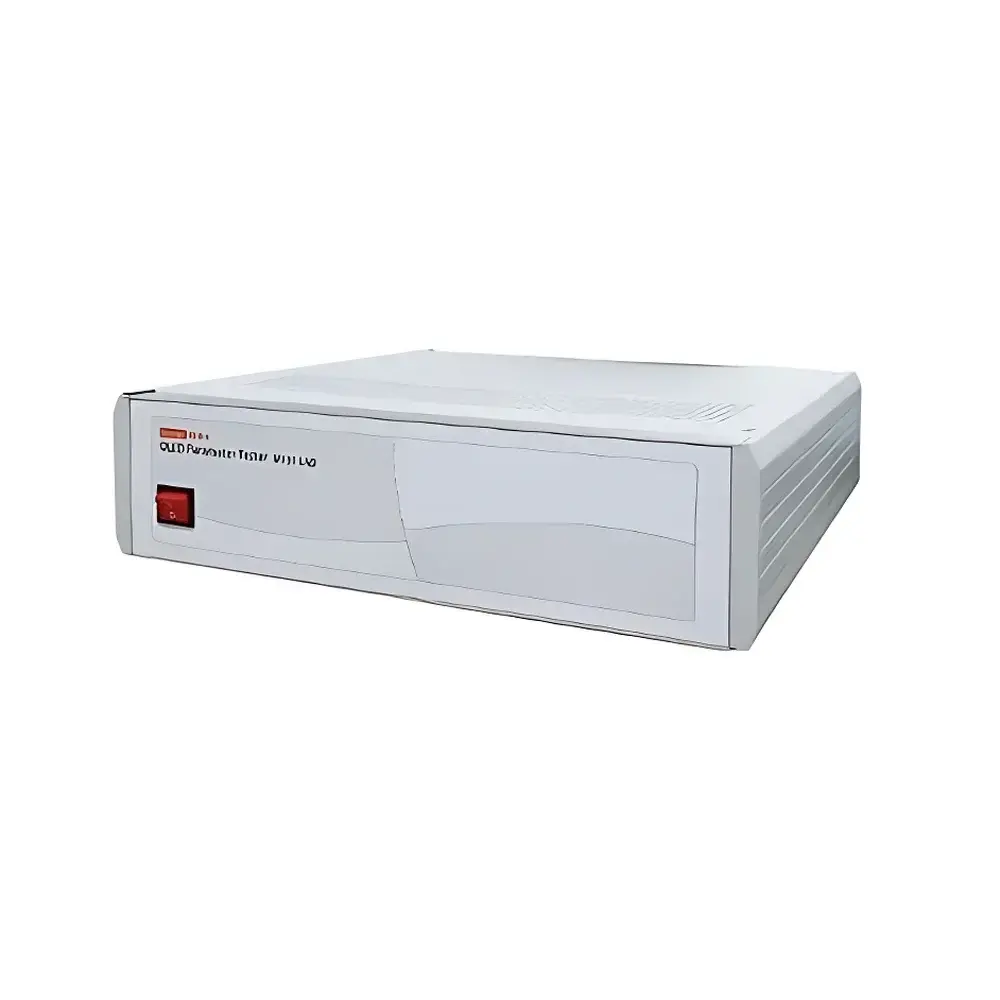
McScience M131 Precision Electrical Parameter Analyzer
| Brand | McScience |
|---|---|
| Origin | South Korea |
| Model | M131 |
| Operating Modes | DC & AC (up to 1 kHz sinusoidal) |
| Quadrants | Four-Quadrant Source/Measure Capability |
| Compliance Function | Voltage/Current Limiting with Real-Time Protection |
| Communication Interface | Ethernet (LAN) |
| Customization | Available per customer requirements |
| Category | Semiconductor Device Testing Instrument |
| Application Scope | Flat Panel Display (LCD, OLED), Micro/Mini LED, Lithium-ion Battery Characterization, General Electronic Component Evaluation |
Overview
The McScience M131 Precision Electrical Parameter Analyzer is a high-fidelity, four-quadrant source-measure unit (SMU) engineered for rigorous electrical characterization of semiconductor devices, active and passive electronic components, and emerging optoelectronic structures. It operates on the fundamental principle of synchronized voltage sourcing and current measurement—or vice versa—enabling precise control of bias conditions while capturing device response under both forward and reverse bias regimes. Unlike conventional multimeters or basic power supplies, the M131 integrates real-time compliance enforcement, sub-millisecond transient response, and low-noise analog front-end architecture to support stable DC I-V sweeps, pulsed measurements, and AC small-signal analysis up to 1 kHz. Its design targets laboratories engaged in R&D, process validation, and QA/QC workflows where traceable, repeatable electrical parameter extraction—such as threshold voltage (Vth), on-resistance (Ron), leakage current (Ileak), diode ideality factor, and capacitance-voltage (C-V) profiles—is essential.
Key Features
- Four-quadrant operation enables seamless sourcing and sinking of voltage or current, critical for characterizing bidirectional devices including LEDs, photodiodes, and battery electrodes.
- DC and AC excitation modes: supports steady-state DC sweeps and low-frequency sinusoidal AC stimulation (0.1 Hz – 1 kHz), facilitating impedance-related assessments without requiring external lock-in amplifiers.
- Programmable compliance functions actively limit output voltage or current in real time, preventing thermal runaway or dielectric breakdown during sensitive measurements on thin-film transistors (TFTs), micro-LED chips, or solid-state electrolytes.
- Ethernet (LAN)-based communication ensures deterministic command-response latency and integration into automated test environments using SCPI-compliant protocols.
- Modular hardware architecture allows configuration tailoring—including optional high-voltage or high-current modules—aligned with application-specific requirements in display pixel testing, wafer-level reliability screening, or pouch-cell interface analysis.
- Low-noise measurement circuitry achieves sub-picoampere current resolution and millivolt-level voltage accuracy, meeting sensitivity demands for leakage and subthreshold conduction analysis in advanced CMOS and wide-bandgap semiconductor devices.
Sample Compatibility & Compliance
The M131 accommodates a broad range of sample interfaces—from probe stations (manual and semi-automated) to custom fixture-mounted DUT boards—via standard triaxial and banana-jack terminals. It is routinely deployed in cleanroom-adjacent lab settings for evaluating TFT backplanes, OLED emissive layers, and silicon carbide (SiC) power diodes. While not certified to a specific regulatory standard out-of-the-box, its operational repeatability, audit-ready data logging, and deterministic stimulus sequencing support alignment with ISO/IEC 17025 calibration frameworks. When integrated with validated software workflows, it contributes to GLP-compliant reporting for internal quality documentation and pre-submission characterization packages intended for IEC 62471 (LED safety) or JEDEC JESD22-A114 (ESD stress testing) evaluations.
Software & Data Management
The M131 operates with McScience’s proprietary PC-based control suite, supporting script-driven test sequences via Python API and native SCPI command execution. All measurements are timestamped and stored in HDF5 format—ensuring hierarchical, metadata-rich datasets compatible with MATLAB, Python (Pandas/H5Py), and laboratory information management systems (LIMS). The software enforces user role-based access control, session-level audit trails, and exportable calibration certificates traceable to national metrology institutes. Optional FDA 21 CFR Part 11 compliance packages include electronic signatures, change logs, and immutable record archiving—suitable for regulated environments involved in medical electronics or automotive-grade component qualification.
Applications
- Flat panel display manufacturing: pixel-level I-V characterization of AMOLED and LTPS-TFT arrays; aging studies under constant current stress.
- Micro/Mini LED development: forward voltage uniformity mapping, reverse-bias leakage screening, and electrostatic discharge (ESD) robustness verification.
- Lithium-ion battery R&D: interfacial resistance profiling (e.g., SEI layer evolution), charge-transfer kinetics via low-frequency AC impedance, and formation cycle monitoring.
- Semiconductor process control: parametric testing of discrete MOSFETs, GaN HEMTs, and MEMS switches across temperature-controlled stages.
- Academic and industrial materials research: contact resistance extraction in 2D material heterostructures, Schottky barrier height determination, and trap density estimation via deep-level transient spectroscopy (DLTS)-compatible pulsing.
FAQ
What types of devices can be tested with the M131?
The M131 is optimized for two-terminal and three-terminal semiconductor devices, thin-film electronics, electrochemical interfaces, and packaged discrete components—provided appropriate probing or fixture integration is implemented.
Does the M131 support automated test sequencing?
Yes—through its SCPI command set and Python SDK, users can define multi-step bias schedules, conditional branching based on measurement thresholds, and synchronized data acquisition across multiple channels.
Is remote operation possible over LAN?
Yes—Ethernet connectivity enables full instrument control, real-time waveform streaming, and firmware updates from any node on the local network without USB dependency.
Can the M131 perform capacitance-voltage (C-V) measurements?
While not a dedicated C-V analyzer, its 1 kHz AC sourcing capability permits quasi-static C-V profiling when combined with external integration or derivative calculation methods, particularly for low-leakage junctions.
What calibration standards does the M131 reference?
Factory calibration is performed against NIST-traceable references; end-user recalibration intervals follow ISO/IEC 17025 guidelines and are configurable based on usage intensity and environmental stability.