
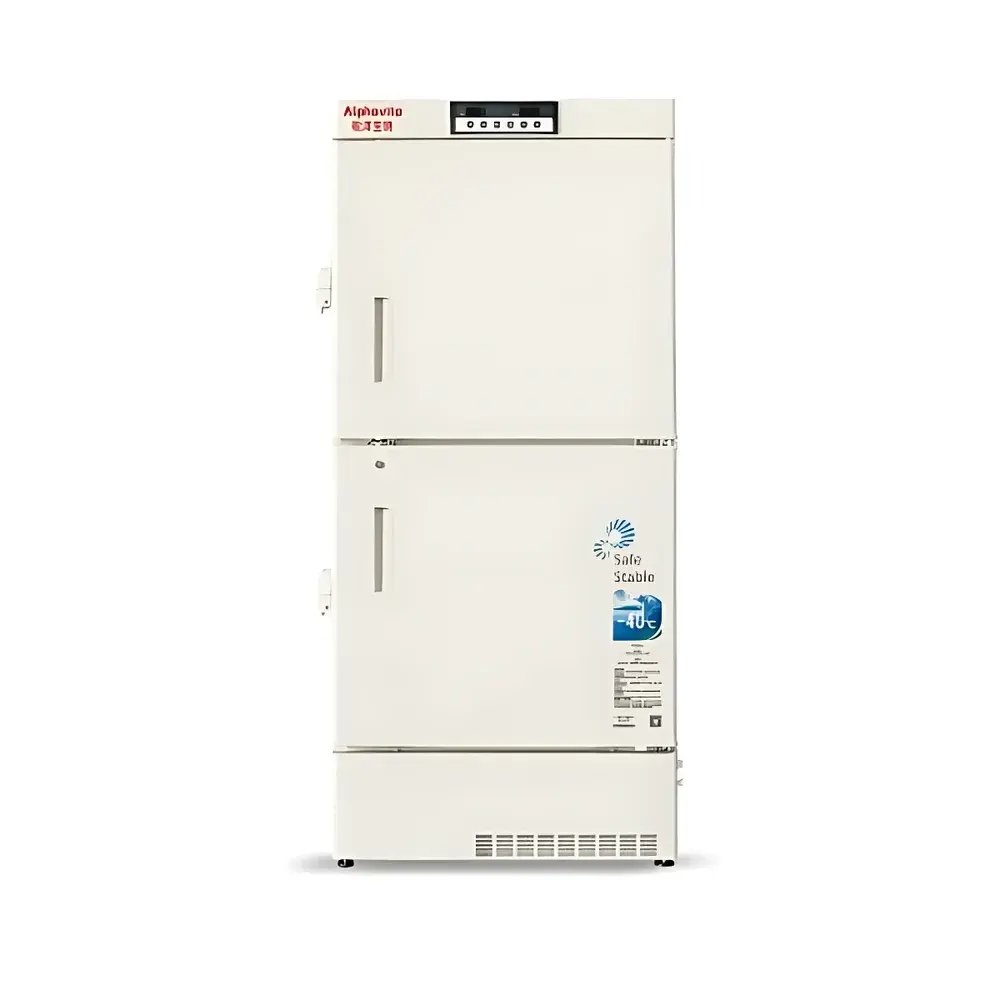
MDF-540DH Dual-Zone Medical Low-Temperature Storage Cabinet
| Brand | Alphavita |
|---|---|
| Model | MDF-540DH |
| Temperature Range | –20 °C to –40 °C |
| External Dimensions (W×D×H) | 793 × 770 × 1806 mm |
| Internal Dimensions (W×D×H) | 649 × 614 × 600 mm × 2 |
| Total Net Volume | 548 L |
| Net Weight | 175 kg |
| Rated Input Power | 491 W |
| Refrigerant | Hydrocarbon (R290/R600a) |
| Control Interface | Microprocessor-based digital controller with non-volatile memory |
| Communication | Standard RS485 port, optional USB data export |
| Safety | Dual-key locking system (integrated key lock + provision for auxiliary padlock) |
| Construction | Powder-coated steel interior and exterior panels |
| Cooling System | Direct-cooling evaporator coils embedded in inner cabinet walls |
| Shelf Configuration | Adjustable-height wire shelving per compartment |
Overview
The Alphavita MDF-540DH is a dual-zone medical low-temperature storage cabinet engineered for reliable, long-term preservation of temperature-sensitive biological specimens—including plasma, serum, tissue samples, vaccines, and reagents—in clinical laboratories, blood banks, biobanks, and pharmaceutical quality control environments. Unlike single-chamber ultra-low temperature freezers or general-purpose cold rooms, the MDF-540DH implements a physically separated dual-compartment architecture, each equipped with an independent refrigeration circuit and microprocessor-controlled temperature regulation. This design eliminates thermal cross-talk between zones and enables simultaneous operation at two distinct setpoints within the –20 °C to –40 °C range—supporting heterogeneous sample storage protocols without compromising stability or traceability. The unit employs hydrocarbon refrigerants (R290/R600a), compliant with global F-Gas regulations and offering significantly lower global warming potential (GWP < 10) compared to traditional HFC-based systems. Its direct-cooling evaporator system—featuring pre-embedded copper-aluminum coils integrated into the inner cabinet walls—ensures uniform thermal distribution, minimizes frost accumulation, and reduces maintenance frequency associated with conventional forced-air defrost cycles.
Key Features
- Dual independent refrigeration circuits with separate compressors, condensers, and evaporators—enabling true zone isolation and operational redundancy.
- Microprocessor-based digital temperature controller with non-volatile memory retention, preserving user-defined parameters during power interruption.
- Direct-cooling evaporator technology: refrigerant coils are structurally embedded into the inner cabinet walls, eliminating exposed tubing and mitigating corrosion risks from prolonged exposure to saline or humid environments.
- Adjustable-height wire shelving in both compartments—allowing flexible partitioning of internal volume to accommodate variable container formats (e.g., cryovials, racks, bags, or trays).
- Low-noise operation achieved through optimized compressor mounting, acoustic insulation, and hydrocarbon refrigerant thermodynamics—measured at ≤48 dB(A) at 1 m distance under standard load conditions.
- Comprehensive safety architecture: integrated key-lock mechanism plus dual-point padlock-ready latches; powder-coated steel construction resists abrasion, chemical splashes, and microbial adhesion.
Sample Compatibility & Compliance
The MDF-540DH supports storage of primary human biospecimens (whole blood, PBMCs, isolated DNA/RNA), diagnostic reagents, monoclonal antibodies, and cold-chain pharmaceutical intermediates requiring stable sub-zero conditions. Its dual-zone capability aligns with ISO 20387:2018 (biobanking requirements) and supports GLP-compliant workflows where segregation of control vs. experimental batches—or pre- vs. post-processing samples—is mandated. While not certified as a Class II medical device under FDA 21 CFR Part 820, the cabinet meets IEC 61010-1:2010 safety standards for laboratory equipment and incorporates design elements consistent with Annex 15 of the EU GMP Guidelines for cold chain integrity. Temperature uniformity across each chamber is validated per ASTM F554–19 (Standard Practice for Performance Testing of Cold Boxes), with typical deviation ≤ ±1.5 °C at steady state under full-load conditions.
Software & Data Management
The cabinet includes a standard RS485 serial interface supporting Modbus RTU protocol for integration into centralized environmental monitoring systems (EMS) used in regulated facilities. Optional USB data logging enables periodic export of time-stamped temperature records—including min/max/average values per zone, alarm timestamps, and defrost cycle history—to CSV or PDF format for audit submission. All logged data retain metadata such as operator ID (if EMS-authenticated), timestamp with UTC synchronization capability, and event classification (e.g., “door open”, “power failure”, “manual defrost”). The system supports configurable alarm thresholds, visual/audible alerts, and relay outputs for external notification devices—facilitating alignment with 21 CFR Part 11 requirements when deployed with validated third-party EMS platforms.
Applications
- Clinical specimen archiving in hospital core labs and regional reference laboratories.
- Storage of temperature-critical vaccine formulations during stability testing or short-term holding prior to distribution.
- Blood bank inventory management—separating fresh frozen plasma (–18 °C to –30 °C) from cryoprecipitate or platelet concentrates requiring deeper freeze (–30 °C to –40 °C).
- Biobank infrastructure supporting multi-cohort longitudinal studies with divergent storage criteria per biosample type.
- QC/QA labs maintaining calibrated reference standards and stability-indicating controls under defined thermal profiles.
FAQ
Does the MDF-540DH support remote monitoring via Ethernet or Wi-Fi?
No—the unit provides only RS485 Modbus RTU connectivity as standard. Ethernet or wireless modules are not available as factory options but may be added via third-party gateway devices compatible with Modbus TCP conversion.
Can both compartments operate at the same temperature setting?
Yes—each zone can be independently configured to identical or different setpoints within the specified operating range, allowing either segregated or mirrored storage conditions.
What is the recommended maintenance interval for the refrigeration system?
Alphavita recommends annual verification of refrigerant charge integrity, evaporator coil cleanliness, door gasket seal performance, and calibration of temperature sensors using NIST-traceable references.
Is validation documentation (IQ/OQ/PQ protocols) provided with the unit?
Factory-supplied documentation includes electrical safety test reports and basic operational qualification templates. Full installation, operational, and performance qualification packages must be developed in-house or by qualified service providers per site-specific regulatory requirements.
How does the hydrocarbon refrigerant impact service accessibility and technician certification?
Service personnel must hold valid hydrocarbon refrigerant handling certification per local jurisdiction (e.g., EPA Section 608 Type I or equivalent). Alphavita-certified technicians are required for warranty-covered interventions involving refrigerant recovery or system modification.



