
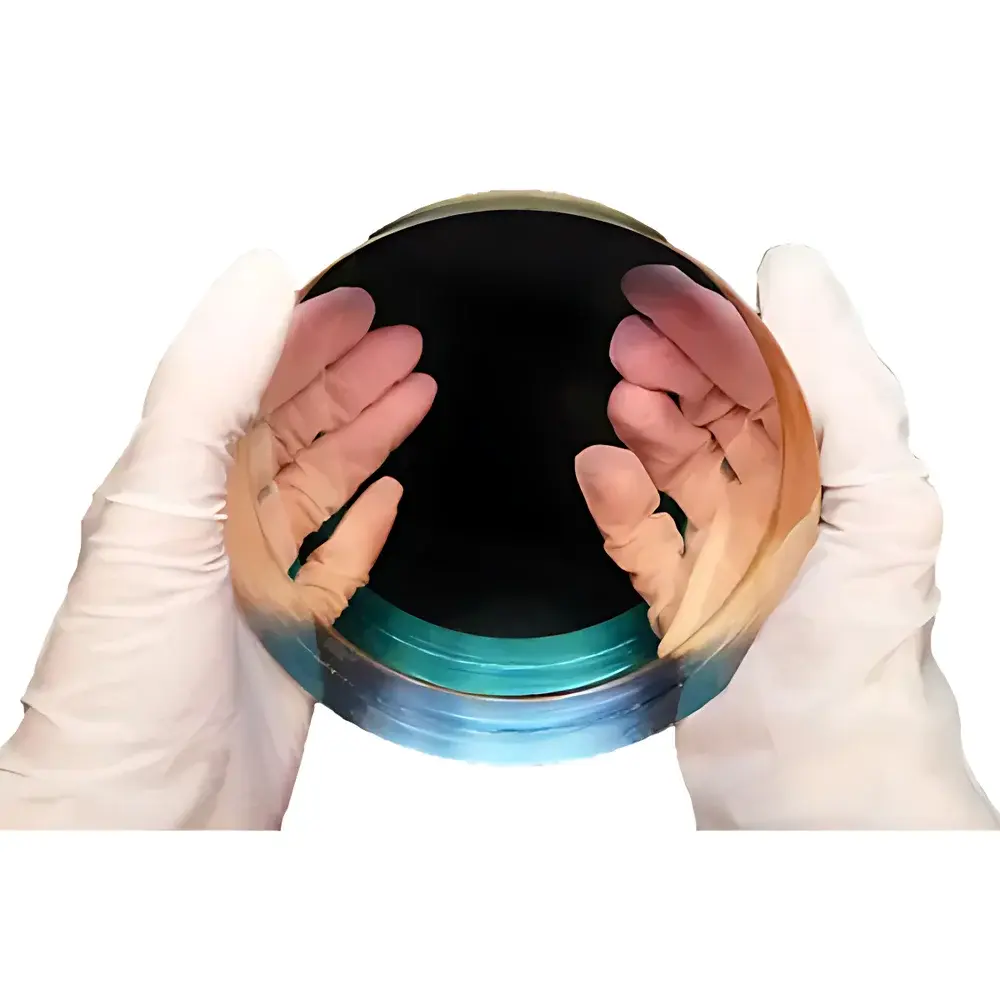
Meadowlark Optics 150-mm-Aperture True-Zero-Order Waveplate / Retarder
| Brand | Meadowlark Optics |
|---|---|
| Origin | USA |
| Manufacturer Type | Authorized Distributor |
| Origin Category | Imported |
| Model | Polarization Device |
| Price | Upon Request |
| Diameter | Up to 150 mm (6") |
| Clear Aperture | >90% of OD |
| Retardation Options | λ/4, λ/2, or Custom |
| Wavelength Range | 300–2500 nm (center wavelength specified) |
| Retardation Accuracy (center) | ≤ λ/100 to ≤ λ/350 |
| Spatial Uniformity | ≤ 2% over clear aperture |
| Transmission Wavefront Distortion (TWD) | ≤ λ (P-V @ 633 nm), λ/4 to λ/20 (RMS @ 633 nm) |
| Substrate Materials | Polymer, Crystalline Quartz, Magnesium Fluoride, Sapphire, Liquid Crystal |
| Thickness | < 15 mm |
| Surface Quality | 40–20 to 80–50 scratch-dig |
| Acceptance Angle | Wide |
| Order Type | True Zero-Order |
| Achromatic Option | Available upon customization |
Overview
The Meadowlark Optics 150-mm-Aperture True-Zero-Order Waveplate is a high-precision polarization control component engineered for demanding optical systems in astronomy, aerospace instrumentation, defense-grade electro-optical systems, and advanced laser diagnostics. Operating on the principle of birefringent phase retardation, this waveplate introduces a controlled, spatially uniform phase shift between orthogonal polarization components—enabling precise manipulation of polarization states across ultraviolet (300 nm), visible, and near-infrared (up to 2500 nm) spectral bands. Unlike multi-order or compound zero-order designs, its true zero-order architecture ensures exceptional thermal stability, minimal angular sensitivity, and broad spectral acceptance—critical for collimated beam applications with stringent wavefront fidelity requirements. Manufactured in the United States using proprietary fabrication and metrology protocols, each unit undergoes full-aperture interferometric characterization and spatial retardation mapping to guarantee performance consistency across the entire 150-mm clear aperture.
Key Features
- True zero-order design for superior thermal and angular stability, eliminating order-related dispersion and sensitivity to incident angle variations
- Large clear aperture up to 150 mm (6 inches) with >90% utilization ratio and <2% spatial retardation non-uniformity across the active area
- Multiple substrate options—including polymer, crystalline quartz, magnesium fluoride, sapphire, and liquid crystal—enabling optimized transmission, damage threshold, and dispersion characteristics per application band
- Retardation accuracy ranging from ≤ λ/100 to ≤ λ/350 at specified center wavelength, verified via calibrated photoelastic modulator (PEM)-based polarimetry
- Transmission wavefront distortion (TWD) characterized at 633 nm: peak-to-valley ≤ λ, RMS ≤ λ/20—ensuring compatibility with diffraction-limited imaging and interferometric setups
- Customizable retardation values (λ/4, λ/2, or arbitrary phase delay), center wavelengths, and achromatic configurations for broadband polarization management
- Surface quality compliant with MIL-O-13830A standards (40–20 to 80–50 scratch-dig), supporting high-power laser operation and cleanroom integration
Sample Compatibility & Compliance
This waveplate supports collimated beams with diameters up to 140 mm (within clear aperture) and accommodates both pulsed and CW sources. It is compatible with vacuum environments when mounted on kinematic or low-outgassing holders. All units comply with ISO 10110-7 (optical element surface imperfections) and ISO 9001:2015 manufacturing controls. For regulated sectors—including defense contractors and FDA-regulated optical diagnostic platforms—the device documentation includes full traceability to NIST-traceable calibration standards, material certifications (e.g., ASTM F273 for sapphire), and batch-level retardation uniformity reports. While not inherently certified to DO-160 or MIL-STD-810, mechanical mounting solutions and environmental qualification support are available upon request.
Software & Data Management
Meadowlark Optics provides comprehensive metrology data packages for each delivered unit, including full-aperture retardation maps (2D pixel-resolved δ(x,y)), TWD interferograms (Zygo or 4D PhaseCam format), and spectral transmittance curves (200–2500 nm). These datasets are delivered in ASCII and HDF5 formats, enabling direct import into MATLAB, Python (NumPy/H5Py), or Zemax OpticStudio for system-level polarization modeling. No proprietary software runtime is required; all characterization files adhere to IEEE 1596.3 metadata conventions for polarization optics. For integration into automated test benches, digital twin models (including Jones matrix parameterization) can be supplied under NDA for co-simulation with LabVIEW, Python-based control frameworks, or OPC UA-compliant SCADA systems.
Applications
- Astronomical adaptive optics systems requiring large-aperture, low-wavefront-distortion retarders for polarization calibration and atmospheric turbulence correction
- High-energy laser beamlines (e.g., petawatt-class facilities) where thermal lensing resistance and damage threshold (>5 J/cm² @ 1064 nm, 10 ns) are critical
- Spaceborne spectropolarimeters (e.g., solar vector magnetographs) needing radiation-hardened substrates and long-term retardation stability (<0.01°/year drift)
- Quantum optics experiments involving entangled photon state preparation and analysis over extended free-space paths
- Industrial inline process monitoring—such as semiconductor wafer stress mapping—using Mueller matrix polarimetry with large-field illumination
- Defense applications including IR countermeasure systems, polarization-encoded LIDAR, and EO/IR sensor calibration targets
FAQ
What is the maximum usable beam diameter for a 150-mm waveplate?
The clear aperture exceeds 140 mm; however, optimal performance (≤2% spatial non-uniformity) is guaranteed over ≥90% of the physical diameter. For critical wavefront-sensitive applications, we recommend limiting beam diameter to ≤135 mm.
Can this waveplate be used in vacuum or cryogenic environments?
Yes—polymer and crystalline quartz variants are routinely deployed in UHV (10⁻⁹ Torr) and at temperatures down to 77 K. Sapphire and MgF₂ substrates support operation below 4 K. Mounting hardware and outgassing data sheets are available upon request.
Is FDA 21 CFR Part 11 compliance supported for metrology data files?
While the waveplate itself is not a regulated medical device, all delivered metrology datasets include embedded electronic signatures, audit trails, and timestamped revision history—fully compatible with Part 11–compliant document management systems.
Do you offer anti-reflection coating options?
Yes—single-layer or V-coatings optimized for specific wavelength bands (e.g., 532 nm, 1064 nm, or broadband 400–900 nm) are available as standard options, with R < 0.25% per surface.
How is retardation uniformity measured across the full aperture?
Using a custom-built, motorized PEM-based imaging polarimeter with 50-µm spatial resolution and <0.05° retardation sensitivity—traceable to NIST SRM 2085.





