
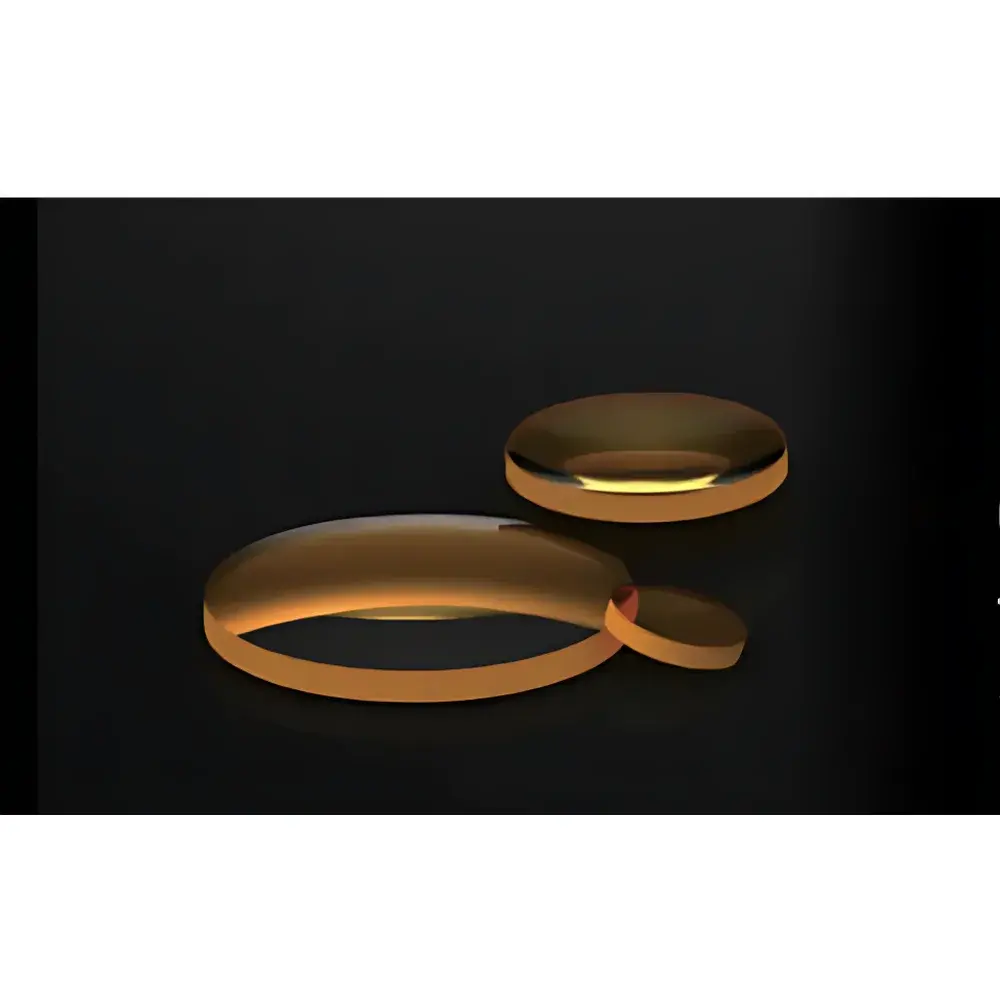
Meg1030 ZnSe Positive Meniscus Lens
| Brand | MiXran |
|---|---|
| Origin | Beijing, China |
| Model | Meg1030 |
| Component Category | Optical Element |
| Coating Options | Uncoated or IR2 Broadband Anti-Reflection Coating (Ravg < 1.5% @ 8–12 µm) |
| Diameter | 12.5–50 mm |
| Focal Length (EFL) | 25–500 mm |
| Material | Zinc Selenide (ZnSe) |
| Transmission Range | ~0.5–20 µm (optimized for MWIR/LWIR) |
Overview
The Meg1030 ZnSe Positive Meniscus Lens is a precision optical component engineered for demanding mid-wave and long-wave infrared (MWIR/LWIR) applications, including thermal imaging, CO₂ laser beam shaping, FTIR spectroscopy, and gas sensing systems. Constructed from high-purity, CVD-grown zinc selenide (ZnSe), this lens exhibits exceptional transmission (>70% per surface, uncoated) across the 8–12 µm atmospheric window — a spectral region critical for industrial process monitoring and environmental remote sensing. Its positive meniscus geometry provides controlled beam convergence while minimizing spherical aberration in collimated or near-collimated IR paths. Unlike plano-convex or biconvex alternatives, the meniscus form enables optimized wavefront correction when used in conjunction with curved detectors or off-axis parabolic mirrors — a configuration common in compact Fourier-transform spectrometers and laser cavity alignment setups.
Key Features
- Zinc selenide substrate with ≥99.995% purity and low absorption coefficient (<0.0005 cm⁻¹ @ 10.6 µm), ensuring minimal thermal lensing under high-power CO₂ laser irradiation (up to 500 W continuous wave).
- Precision diamond-turned surfaces with surface figure accuracy λ/4 @ 633 nm (verified via interferometry) and scratch-dig specification of 20–10 per MIL-PRF-13830B.
- Two standard coating options: uncoated for maximum UV–NIR flexibility, or IR2 broadband anti-reflection coating optimized for 8–12 µm (Ravg < 1.5%, residual reflectance < 0.8% at 10.6 µm).
- Thermal expansion coefficient of 7.6 × 10⁻⁶ /°C ensures dimensional stability across operational ranges from –40 °C to +80 °C — compatible with uncooled microbolometer arrays and cryogenically stabilized MCT detectors.
- Available in 11 standard diameters (12.5 mm to 50 mm) and 16 focal lengths (25 mm to 500 mm), all adhering to ISO 10110-1 surface quality and centering tolerances (≤3 arcmin).
Sample Compatibility & Compliance
The Meg1030 lens is fully compatible with industry-standard kinematic and threaded lens mounts (e.g., SM1, SM2, RMS threads), including the GL75P-series retaining rings referenced in the product matrix. It meets RoHS Directive 2011/65/EU and REACH Annex XVII requirements for cadmium-free ZnSe manufacturing. While not certified to ISO 9001 as a finished device (as it is a passive optical component), its production follows traceable batch-controlled protocols aligned with ISO 10110 optical drawing standards. No biocompatibility or explosion-proof certifications apply, as the component is intended solely for laboratory and industrial optical instrumentation use.
Software & Data Management
As a passive optical element, the Meg1030 requires no embedded firmware, drivers, or software integration. However, full optical prescription data — including radius of curvature (R₁, R₂), center thickness (Tc), edge thickness (Te), effective focal length (EFL), back focal length (BFL), and refractive index dispersion (Sellmeier coefficients for ZnSe) — are provided in Zemax .ZMX and CODE V .SEQ formats upon request. These files support rigorous system-level modeling of thermal drift, chromatic focus shift, and polarization-dependent transmission loss. All dimensional and coating performance data are archived in accordance with GLP-compliant documentation practices, enabling audit-ready traceability for regulated R&D environments.
Applications
- CO₂ laser focusing optics in material processing systems (cutting, welding, marking), where high damage threshold (>500 MW/cm² for 10 ns pulses) and low wavefront distortion are essential.
- Condenser lenses in portable FTIR spectrometers operating in the fingerprint region (600–4000 cm⁻¹), leveraging ZnSe’s low dispersion and high transmittance at 10 µm.
- Objective elements in uncooled LWIR camera modules (e.g., VOx or a-Si microbolometers), where the meniscus shape improves off-axis illumination uniformity.
- Beam collimation and expansion in quantum cascade laser (QCL) systems targeting trace gas detection (e.g., CH₄, NO₂, NH₃) within the 7–12 µm range.
- Reference optics in radiometric calibration sources compliant with ASTM E1256-22 for spectral emissivity measurement.
FAQ
Is the Meg1030 lens suitable for use with pulsed CO₂ lasers?
Yes — its CVD ZnSe substrate supports pulse energy densities up to 500 MW/cm² (10 ns, 10 Hz) without measurable coating delamination or bulk damage.
What is the maximum operating temperature before thermal deformation becomes significant?
Continuous operation up to +80 °C is validated; above this, cumulative stress-induced birefringence may exceed λ/10 wavefront error over a 10-mm clear aperture.
Can custom diameters or focal lengths be manufactured?
Yes — MiXran offers OEM fabrication services for non-standard geometries, subject to minimum order quantities and extended lead times (typically 8–12 weeks).
Does the IR2 coating affect transmission outside the 8–12 µm band?
The IR2 stack is designed for minimal out-of-band reflectance; transmission remains >65% at 3–5 µm and >40% at 0.633 µm, though AR performance degrades significantly outside the design window.
Are mounting fixtures included with purchase?
No — lens mounts (e.g., GL75P series) and retaining rings must be ordered separately; compatibility information is provided in the mechanical drawings shipped with each unit.




