
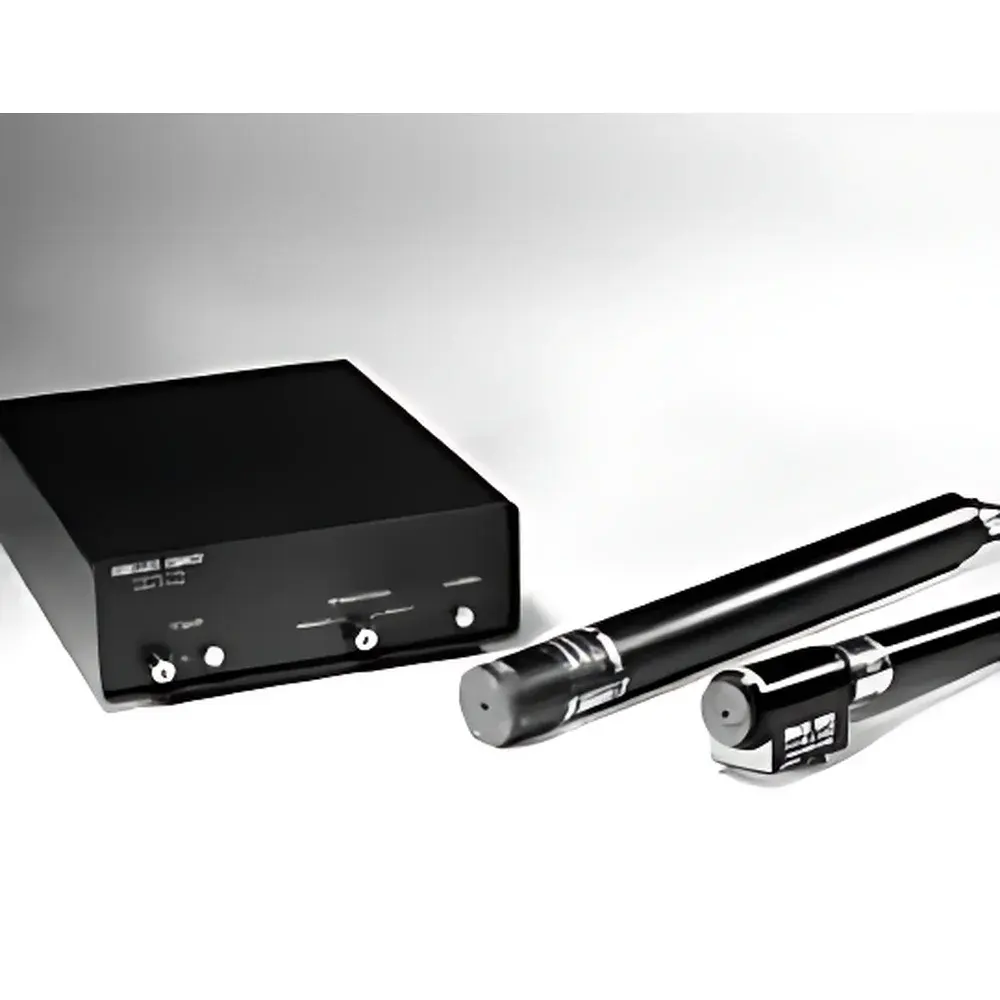
MellesGriot 204 High-Stability Single-Frequency He-Ne Laser
| Origin | Imported |
|---|---|
| Manufacturer Type | Authorized Distributor |
| Model | 204 |
| Price | Upon Request |
| Output Power | 1.0 mW |
| Wavelength | 632.8 nm |
| Beam Diameter | 0.5 mm |
| Beam Divergence | 1.60 mrad |
| Transverse Mode | TEM₀₀ (>90%) |
| Polarization Ratio | 1000:1 |
| Intensity Noise | <0.05% RMS |
| Frequency Stability (1 min / 1 hr / 8 hrs) | ±0.5 / ±2.0 / ±2.0 MHz (frequency-lock mode) |
| Power Stability (1 min / 1 hr / 8 hrs) | 1.0% RMS (frequency-lock) |
| Tuning Range | ±300 MHz |
| Frequency Drift | ±150 MHz (comparative mode), ±50 Hz (beat-down mode) |
| Temperature Coefficient | 0.5 MHz/°C (frequency-lock) |
| Lock Temperature Range | 10–30 °C |
| Coherence Length | >1 km |
| Extinction Ratio | >5000:1 |
| Safety Classification | CDRH Class IIIa, IEC Class 3B |
Overview
The MellesGriot 204 High-Stability Single-Frequency He-Ne Laser is a precision-stabilized gas laser engineered for metrology-grade applications requiring long coherence length, narrow linewidth, and exceptional temporal stability. Operating at the fundamental helium–neon transition wavelength of 632.8 nm, this laser delivers a diffraction-limited TEM00 output with >90% modal purity, enabling interferometric measurements with sub-nanometer resolution over path differences exceeding one kilometer. Its frequency stabilization architecture—based on saturated absorption spectroscopy in iodine vapor or internal cavity reference—ensures sub-MHz short-term frequency deviation and drift rates below ±2.0 MHz over eight hours. This level of spectral fidelity supports traceable calibration of optical encoders, displacement sensors, and wavelength standards in ISO/IEC 17025-accredited laboratories.
Key Features
- Single longitudinal mode (SLM) operation with coherence length >1 km, verified via Michelson interferometry
- Two stabilization modes: frequency-lock (±0.5 MHz RMS over 1 minute) and intensity-lock (±0.1% RMS power stability over 1 hour)
- Active thermal control maintains lock within 10–30 °C ambient range; temperature coefficient of frequency <0.5 MHz/°C
- Beam quality characterized by M² 5000:1
- Low-intensity noise (<0.05% RMS, 10 Hz–10 MHz bandwidth) suitable as a low-noise reference for photodetector linearity verification
- Frequency tunability of ±300 MHz via piezoelectric cavity length adjustment, supporting heterodyne interferometry and cavity ring-down spectroscopy
- Compliant with CDRH Class IIIa and IEC 60825-1:2014 Class 3B laser safety requirements; includes interlock-ready connector and key-switch enable
Sample Compatibility & Compliance
The 204 laser is designed for integration into optical benches, vacuum-compatible metrology systems, and automated alignment platforms. Its 0.5 mm collimated beam diameter and low divergence facilitate coupling into single-mode fibers (SMF-28, NA = 0.14) with >75% efficiency using standard aspheric couplers. The unit meets mechanical and electrical interface standards for OEM integration, including 24 VDC input, TTL-compatible modulation input (0–5 V), and RS-232 serial port for remote parameter readout. From a regulatory standpoint, it supports GLP/GMP-aligned workflows through optional audit-trail-enabled firmware (compatible with FDA 21 CFR Part 11-compliant data acquisition systems). While not certified to ASTM E2698 or ISO 10110-5 directly, its performance envelope satisfies the stability and repeatability thresholds required for compliance with ISO 10012 (measurement management systems) and ISO/IEC 17025 clause 6.4.10 (reference material traceability).
Software & Data Management
Control and monitoring are supported via MellesGriot’s proprietary LaserLink™ software suite (Windows 10/11, 64-bit), which provides real-time plotting of output power, cavity temperature, and lock status. Logged data—including timestamped frequency error, RMS noise spectra, and thermal drift profiles—is exported in CSV and HDF5 formats for post-processing in MATLAB, Python (NumPy/Pandas), or LabVIEW. The RS-232 interface enables programmable automation using SCPI-like command syntax (e.g., :MEAS:POW? , :STAT:LOCK?), facilitating integration into custom QC/QA test sequences compliant with ASTM E2913 (standard practice for laser-based dimensional measurement). Optional firmware upgrades support NIST-traceable calibration certificate generation with uncertainty budgets per GUM (JCGM 100:2008).
Applications
- Homodyne and heterodyne interferometry for nanoscale displacement metrology (e.g., stage calibration per ISO 230-2)
- Reference source for wavelength calibration of spectrometers, optical spectrum analyzers, and tunable lasers
- Coherent optical testing of surface flatness, roughness, and micro-defects via phase-shifting interferometry (PSI)
- Stabilized seed source for fiber amplifier systems requiring low RIN and high SBS threshold
- Fundamental research in quantum optics, including cavity QED experiments and optical lattice clock development
- Validation of photonic integrated circuit (PIC) performance, especially in silicon photonics modulator linearity and phase response characterization
FAQ
What is the typical warm-up time to achieve full frequency stability?
The laser achieves nominal lock within 15 minutes, but full specification-grade frequency stability (±0.5 MHz over 1 min) is guaranteed after 30 minutes of continuous operation at stable ambient temperature.
Can the 204 be operated in an evacuated environment?
No—the laser head contains sealed gas discharge tube and thermally sensitive optics; operation under vacuum or inert gas purge is not supported per manufacturer specifications.
Is external frequency referencing possible?
Yes—via the analog modulation input (±5 V, 10 kHz bandwidth), users may inject external error signals from iodine-stabilized references or Fabry–Pérot cavities for hybrid locking schemes.
Does the unit include a factory calibration certificate?
Standard shipment includes a NIST-traceable calibration report covering output power, wavelength, beam divergence, and polarization ratio; frequency stability data is available upon request with additional lead time.
What is the expected lifetime of the plasma tube?
Rated for ≥20,000 hours of continuous operation under specified thermal and drive-current conditions; end-of-life is defined as >20% drop in nominal output power or failure to maintain lock under nominal conditions.




