
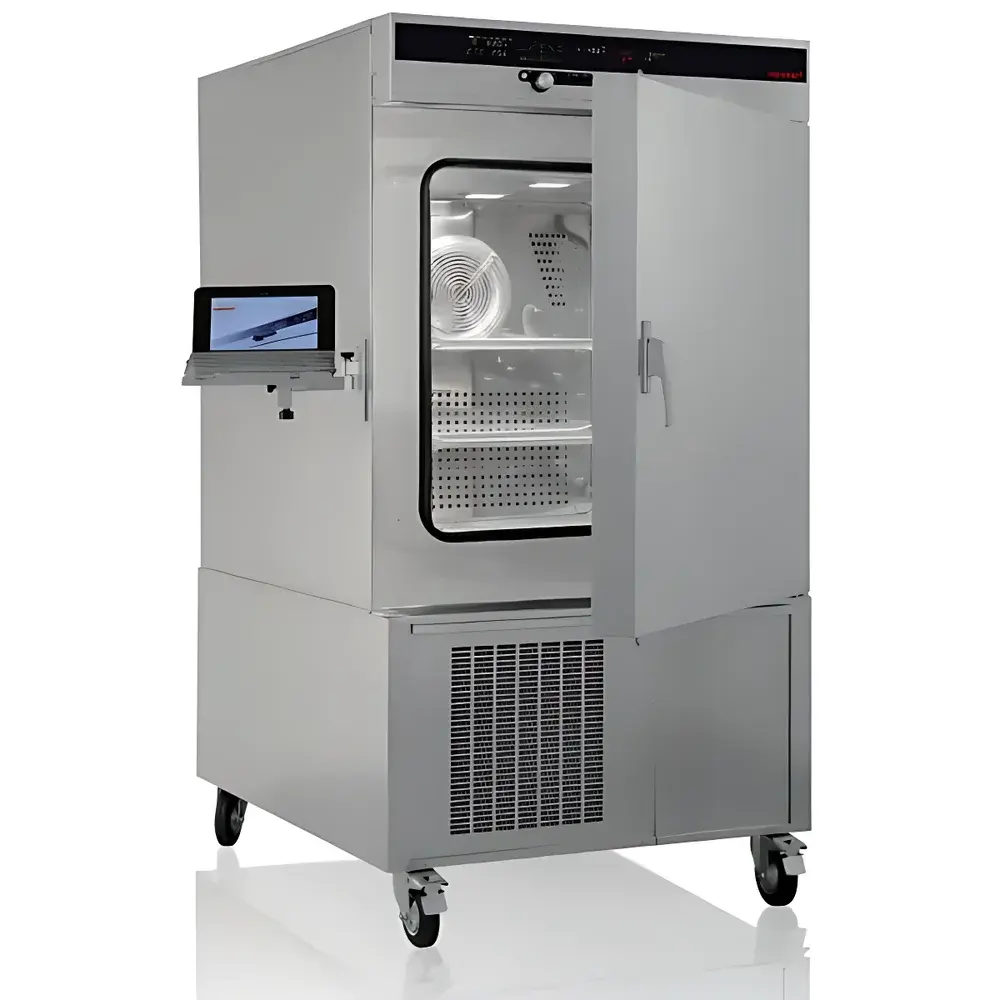
Memmert CTC/TTC Environmental Test Chamber
| Brand | Memmert (Germany) |
|---|---|
| Origin | Germany |
| Model | CTC/TTC 256 |
| Temperature Range | –42 °C to +190 °C (dry operation) |
| Humidity Range | 10–98 %RH (CTC models only) |
| Compliance | DIN EN 60068-2-1, -2-2, -2-3 |
| Insulation | Triple-layer aerospace-grade vacuum-insulated walls |
| Refrigeration | Dual parallel compressors with electronic refrigerant metering |
| Defrost | Automatic hot-gas defrost system |
| Construction | Stainless steel evaporator, corrosion-resistant interior |
| Noise Level | <62 dB(A) at 1 m |
| Cooling/Heating Rate | ~–40 °C in 80 min from +180 °C |
Overview
The Memmert CTC/TTC Environmental Test Chamber is a precision-engineered climatic testing system designed for rigorous material stability, aging, and qualification testing under tightly controlled thermal and hygrothermal conditions. Built upon a foundation of aerospace-derived thermal management architecture, the chamber employs a triple-layer vacuum-insulated wall structure that minimizes thermal bridging, suppresses condensation ingress, and ensures exceptional temperature uniformity (±0.3 K) and stability (±0.1 K) across the entire working volume. Its core measurement principle relies on high-resolution Pt100 sensors coupled with adaptive PID algorithms and dual-stage refrigeration—enabling accurate, repeatable simulation of real-world environmental stress profiles defined in international standards such as DIN EN 60068-2-1 (cold), -2-2 (dry heat), and -2-3 (damp heat). Unlike conventional chambers relying on single-compressor systems or passive humidity generation, the CTC/TTC integrates dynamic humidification and dehumidification modules—allowing continuous, closed-loop RH control between 10% and 98% RH while maintaining full temperature range integrity within its specified operational envelope.
Key Features
- Triple-wall vacuum insulation derived from aerospace thermal management principles—reducing energy consumption by up to 35% compared to standard insulated chambers while improving thermal homogeneity.
- Dual parallel refrigeration compressors with electronically regulated refrigerant injection—enabling precise capacity modulation, extended compressor service life, and optimized cooling/heating ramp rates (e.g., –40 °C in ≤80 min from +180 °C; +180 °C in ≤20 min from –40 °C).
- Stainless steel evaporator and corrosion-resistant internal chamber surfaces—ensuring long-term reliability in aggressive humidity cycling and saline environments.
- Automatic hot-gas defrost system—eliminating manual intervention and ensuring uninterrupted test continuity during prolonged low-temperature operation.
- Low-noise operation (<62 dB(A) at 1 m)—suitable for integration into shared laboratory spaces without acoustic interference.
- Integrated dew point monitoring and vapor pressure control logic—supporting stable RH setpoints even during rapid temperature transitions.
Sample Compatibility & Compliance
The CTC/TTC series accommodates a broad spectrum of sample types—including polymer composites, printed circuit boards (PCBs), pharmaceutical packaging, automotive components, and battery cells—without compromising chamber integrity or test fidelity. Its validated thermal and humidity performance meets the physical testing requirements of ISO 17025-accredited laboratories and supports compliance-driven workflows aligned with IEC 60068, ASTM D4332, MIL-STD-810H, and EU Regulation (EC) No 765/2008. All models are CE-marked and manufactured in accordance with DIN EN 61000-6-3 (EMC) and DIN EN 61000-6-4 (emissions), ensuring safe deployment in regulated R&D and QA/QC environments. The chamber’s construction materials and sealing mechanisms conform to RoHS and REACH directives, and its electrical safety design complies fully with DIN EN 61010-1.
Software & Data Management
Equipped with Memmert’s proprietary Peltier-based controller and optional V3.0 software suite, the CTC/TTC provides full audit-trail capability compliant with FDA 21 CFR Part 11 requirements—including electronic signatures, user-level access control, and immutable event logging. Real-time data acquisition records temperature, relative humidity, setpoint deviation, compressor status, and alarm history at configurable intervals (down to 1-second resolution). Export formats include CSV and PDF reports with embedded metadata (operator ID, timestamp, calibration certificate references). Optional Ethernet/IP and Modbus TCP interfaces enable seamless integration into centralized LIMS or MES platforms for automated test protocol execution and remote supervision across multi-site operations.
Applications
- Accelerated aging of polymeric materials and elastomers per ISO 188 and ASTM D573.
- Thermal shock and cyclic humidity testing of electronic assemblies per JEDEC JESD22-A104 and A110.
- Stability studies for pharmaceutical primary and secondary packaging under ICH Q1A(R2) and Q5C guidelines.
- Qualification of lithium-ion battery modules under extreme thermal-hygric stress (UN 38.3, Section 38.3.4).
- Corrosion resistance validation of coated metals and fasteners using alternating dry/wet cycles per ISO 9227 (NSS, AASS, CASS).
- Calibration verification of temperature and humidity sensors in metrology labs supporting ISO/IEC 17025 scope accreditation.
FAQ
What is the difference between CTC and TTC models?
The CTC (Climate Test Chamber) includes integrated humidification and dehumidification systems, enabling full 10–98 %RH control within its +10 °C to +95 °C operating range. The TTC (Temperature Test Chamber) is optimized for dry thermal testing only, offering the extended temperature range of –42 °C to +190 °C.
Does the chamber support GLP/GMP-compliant data integrity?
Yes—when configured with the optional V3.0 software and hardware security module, it delivers full 21 CFR Part 11 compliance, including role-based access, electronic signatures, and tamper-evident audit trails.
Can the chamber be validated for IQ/OQ/PQ protocols?
All CTC/TTC units ship with factory calibration certificates traceable to national standards (DAkkS or UKAS equivalents). Comprehensive validation documentation packages—including URS templates, test scripts, and summary reports—are available upon request.
Is remote monitoring possible over a corporate network?
Yes—via standard Ethernet connectivity, users can access live chamber status, historical trends, alarms, and event logs through any modern web browser or third-party SCADA platform using Modbus TCP or HTTP API endpoints.
What maintenance is required to sustain long-term accuracy?
Annual recalibration of Pt100 sensors and humidity transducers is recommended. The stainless steel evaporator and sealed refrigeration circuit require no routine servicing; only periodic inspection of door gaskets and filter elements is advised per the maintenance schedule in the operator manual.



