
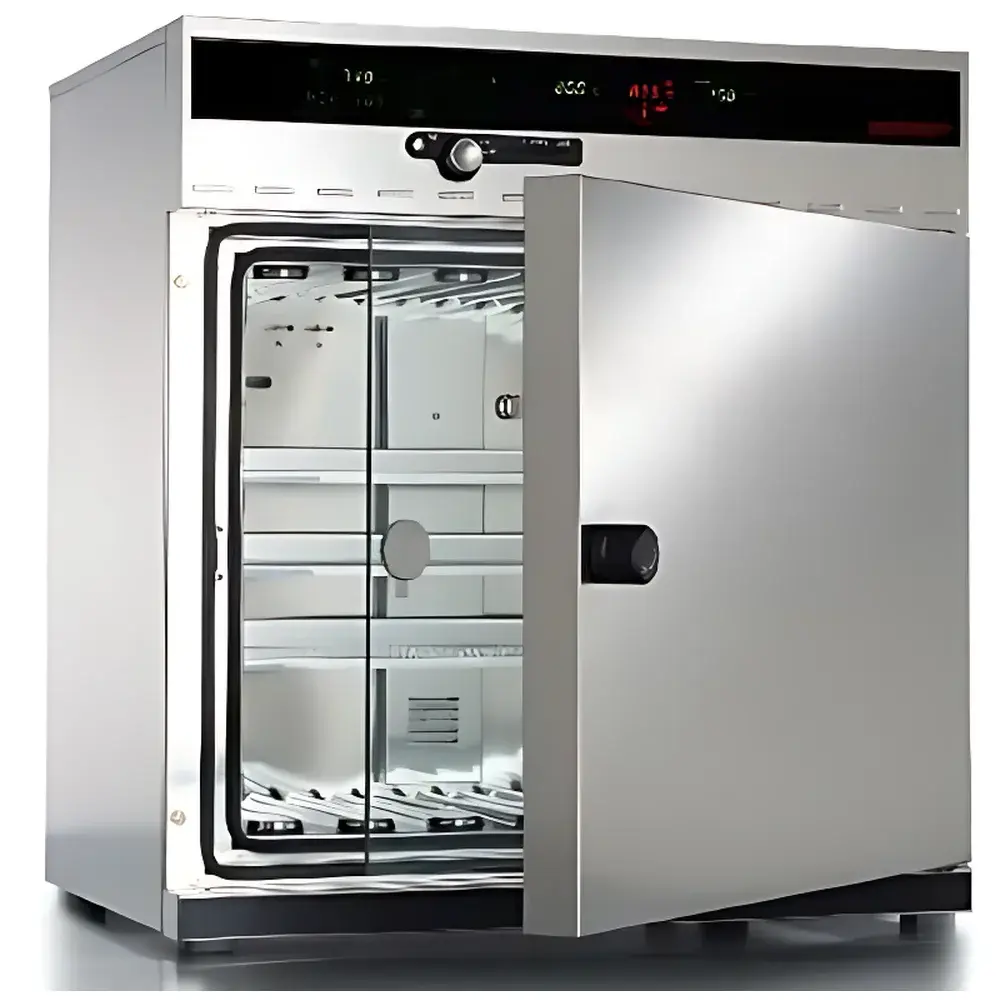
MEMMERT HCP108 Climate Chamber
| Origin | Germany |
|---|---|
| Manufacturer Type | Authorized Distributor |
| Origin Category | Imported |
| Model | HCP108 |
| Pricing | Upon Request |
Overview
The MEMMERT HCP108 Climate Chamber is a precision-engineered, ISO 17025-aligned environmental simulation system designed for laboratories requiring strict control of temperature (20–90 °C, up to 160 °C for sterilization) and relative humidity (20–95 % RH) under GxP-compliant conditions. Built upon a dual-sensor Pt100 A-class, 4-wire measurement architecture and capacitive humidity sensing with full autoclavability, the HCP108 employs laminar airflow management—fully enclosed, non-turbulent circulation—to ensure DIN 12880-compliant temperature uniformity (≤ ±0.3 °C at 50 °C) and rapid humidity recovery without condensation. Its microprocessor-based controller integrates real-time diagnostics, triple independent thermal protection (mechanical TB, electronic TWW, and ASF auto-shutdown), and validated sterilization cycles (160 °C for 4 h via STERICard), making it suitable for stability testing (ICH Q1–Q5), accelerated aging, material conditioning, and GLP/GMP-regulated environmental qualification.
Key Features
- Stable, turbulence-free internal air circulation ensuring homogeneous temperature distribution per DIN 12880
- Fuzzy logic control algorithm for simultaneous, decoupled regulation of temperature and humidity—minimizing overshoot and stabilizing setpoints within tight tolerances
- Integrated calibration capability: 3-point temperature and 2-point humidity (20 % & 90 % RH) adjustment directly on controller—no external PC required
- Triple redundant safety architecture: mechanical temperature limiter (TB), electronically adjustable thermal watchdog (TWW), and MEMMERT’s proprietary Automatic Safety Function (ASF) with dual platinum sensor cross-verification
- Continuous monitoring and audible/visual alarms for over-/under-temperature, over-/under-humidity, door-open duration >30 s, empty water reservoir, and sensor failure
- Full-system sterilization support: steam generation from distilled water, bacterial filtration for dehumidification, and STERICard-enabled 160 °C chamber disinfection cycle (non-load sterilization)
- RS232 standard interface; optional RS485 (up to 16 units), Ethernet (W6), or USB connectivity with MEMMERT Celsius Ethernet Edition software
Sample Compatibility & Compliance
The HCP108 accommodates diverse sample configurations—including stacked trays, metal grid shelves (E7), and electro-polished stainless-steel sliding racks—with internal dimensions of 560 × 480 × 400 mm (W × H × D) and usable volume of 108 L. Its electropolished stainless-steel interior (DIN 1.4301) and fully sealed, insulated double-glass door meet ISO 14644-1 Class 5 cleanroom compatibility requirements when operated under controlled ambient conditions. The chamber complies with DIN 12880 (temperature uniformity), DIN 12900-1 (interface documentation), and EN 61000-6-3 (EMC). Optional accessories—including NAMUR NE28-compliant dry-contact outputs (H5, D4), user-ID access cards (V9), and IQ/OQ validation kits (Z5, Q1, Q2)—enable full 21 CFR Part 11 compliance when paired with Celsius FDA Edition software (Q2/Q3), supporting audit trails, electronic signatures, and ALCOA+ data integrity principles.
Software & Data Management
Standard inclusion of Celsius 2005 software (v10.0, Windows NT4/2000/XP/Vista compatible) enables remote programming, real-time monitoring, and export of time-stamped temperature/humidity logs. The internal ring-buffer memory (1024 KB) stores up to three months of minute-interval data—including setpoints, actual values, alarms, and error codes—with timestamping compliant with ISO/IEC 17025 clause 7.7. Optional MEMmoryCard XL supports up to 40 programmable ramp/soak segments and offline logging. For regulated environments, the Celsius FDA Edition (Q2) provides full 21 CFR Part 11 functionality: role-based user authentication, immutable audit trails, electronic signature capture, and secure data export in PDF/A or CSV formats. All data records are traceable to NIST-traceable factory calibration certificates (e.g., Z5, Q1, H6).
Applications
The HCP108 serves critical roles across pharmaceutical development (ICH Q1A–Q5E stability studies), polymer aging (ASTM D3045), electronics reliability testing (JEDEC JESD22-A119), seed germination research (ISTA protocols), and bioburden reduction validation. Its precise humidity recovery (<15 min from 20 % to 95 % RH at 37 °C) and low-drift thermal control support long-term hygrothermal stress testing per ISO 11784 and ASTM E145. The optional STERICard and integrated steam generator allow routine chamber decontamination between batches—essential for microbiological containment workflows. Academic labs use its 40-segment programmability for diurnal cycling simulations (e.g., climate change impact modeling), while QC departments rely on its built-in validation support for equipment qualification per EU Annex 15 and USP .
FAQ
What is the maximum operating temperature with humidity control enabled?
The HCP108 maintains humidity control from 20 °C to 90 °C. Above 90 °C, humidity control is disabled; the chamber may operate up to 160 °C solely for dry sterilization cycles.
Is the internal humidity sensor autoclavable?
Yes—the capacitive humidity sensor is fully autoclavable at 121 °C and compatible with STERICard sterilization protocols.
Can the HCP108 be integrated into a multi-chamber network?
Yes—via optional RS485 interface (V1) or Ethernet (W6), up to 16 units can be centrally managed using Celsius FDA Edition or Celsius Ethernet Edition software.
Does the system support 21 CFR Part 11 compliance out-of-the-box?
Not by default—the base configuration includes Celsius 2005. Full 21 CFR Part 11 compliance requires purchase and installation of Celsius FDA Edition (Q2), associated validation packages (Q1, Z5), and user-ID access cards (V9).
What is the data retention capacity of the internal memory?
The 1024 KB ring buffer stores approximately 3 months of minute-interval temperature and humidity data, including timestamps, alarms, and setpoint changes.



