
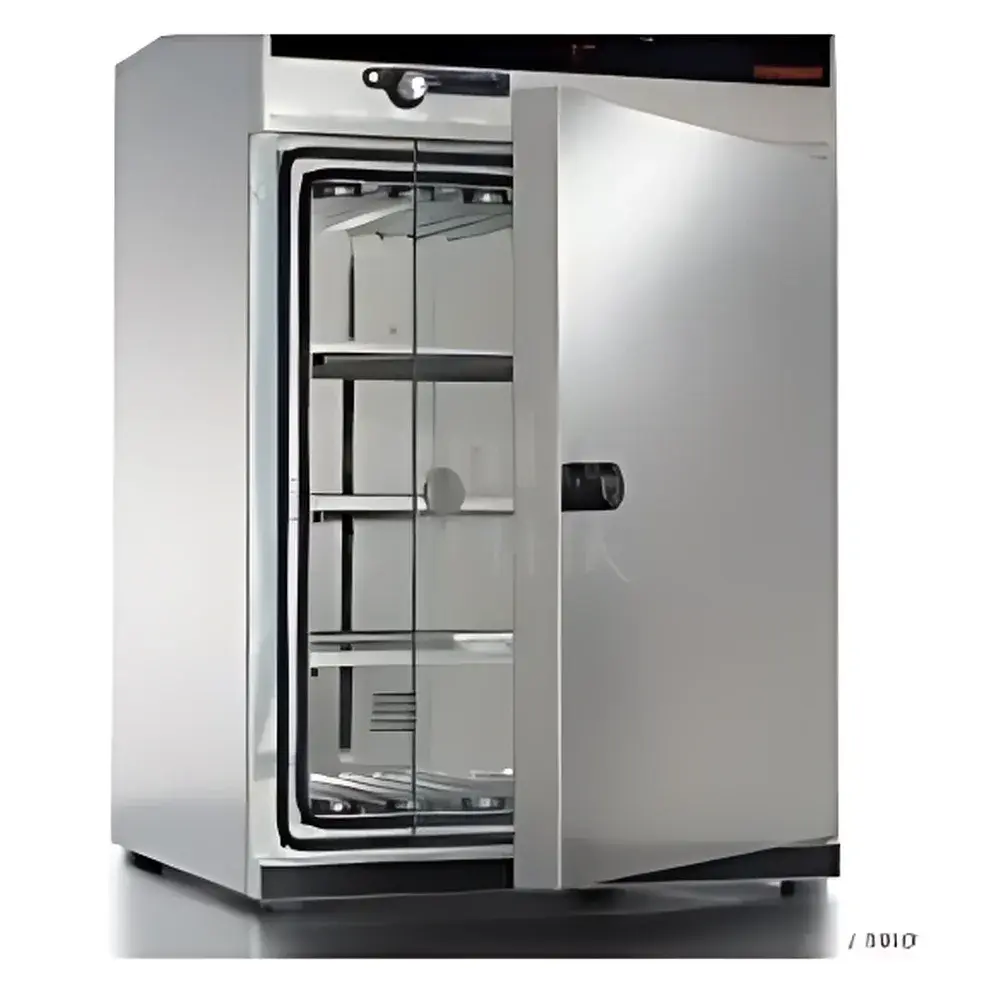
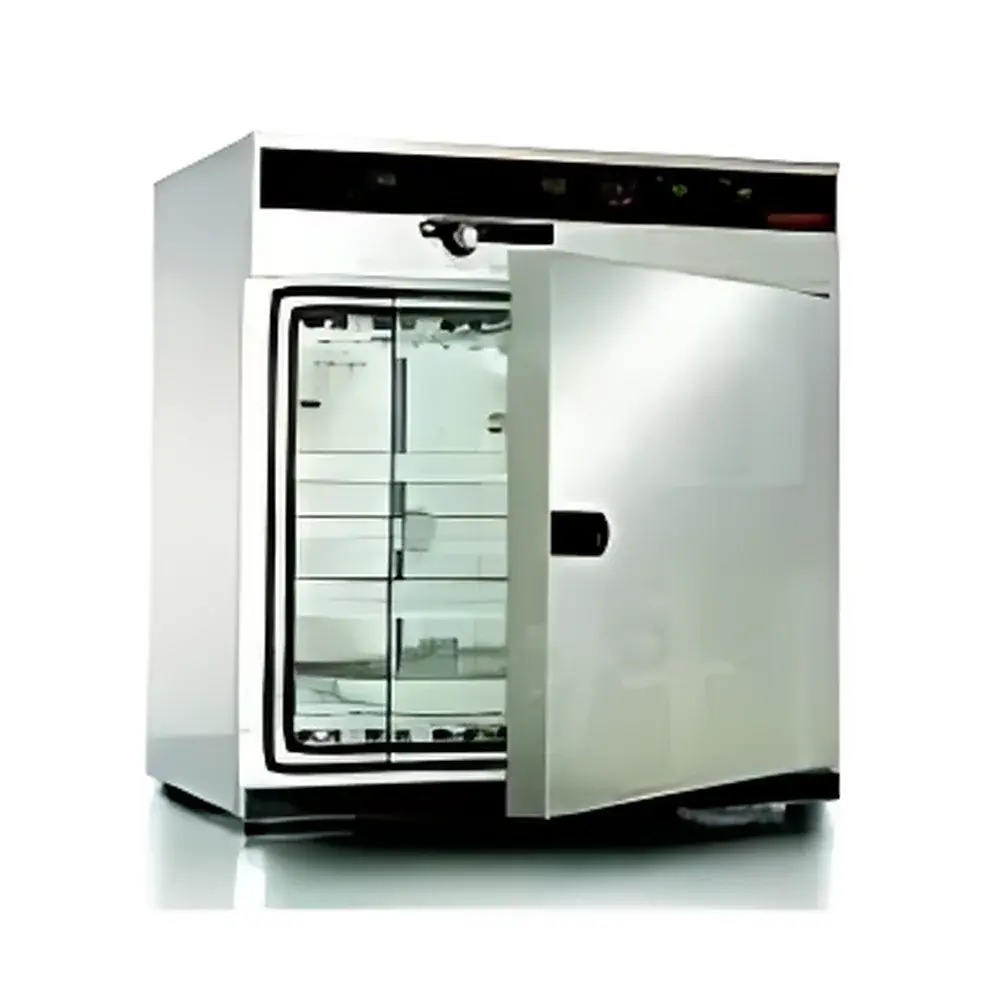
MEMMERT HCP246 Temperature and Humidity Controlled Chamber
| Brand | MEMMERT |
|---|---|
| Origin | Germany |
| Model | HCP246 |
| Chamber Type | Upright |
| Internal Volume | 246 L |
| Internal Dimensions (W×H×D) | 640 × 640 × 600 mm |
| External Dimensions (W×H×D) | 790 × 938 × 750 mm |
| Construction | Electropolished Stainless Steel Interior, Galvanized Steel Exterior |
| Temperature Range (without humidity control) | 20–160 °C |
| Temperature Uniformity (per DIN 12880, at 50 °C) | ≤ ±0.3 °C |
| Temperature Stability (per DIN 12880, at 50 °C) | ≤ ±0.15 °C |
| Humidity Range | 20–95 % RH (capable of sterilization at 160 °C) |
| Humidity Sensor | Sterilizable capacitive sensor |
| Control System | Microprocessor-based dual-loop PID controller with integrated diagnostics |
| Calibration | 3-point temperature & 2-point humidity calibration via front panel |
| Data Logging | 1024 KB circular memory (≈3 months @ 1-min interval) |
| Compliance | DIN 12880, DIN 12900-1, FDA 21 CFR Part 11 (with optional Celsius FDA Edition software), GLP/GMP-ready architecture |
Overview
The MEMMERT HCP246 is a precision-engineered upright temperature and humidity controlled chamber designed for demanding laboratory and industrial applications requiring strict environmental reproducibility. Built in Germany to ISO 9001-certified manufacturing standards, the HCP246 employs a non-turbulent, closed-loop air circulation system with electrostatically balanced airflow distribution—ensuring uniform thermal and hygroscopic conditions throughout the 246 L electropolished stainless steel chamber. Its measurement foundation relies on dual A-class Pt100 sensors (4-wire configuration) for temperature and a sterilizable capacitive humidity sensor, both continuously monitored by an embedded microprocessor with real-time self-diagnostic capability. The unit supports validated operation across a temperature range of 20–160 °C (with dry heat sterilization cycle up to 160 °C for 4 hours) and relative humidity from 20–95 % RH. All critical parameters—including setpoint deviation, sensor fault detection, door status, water reservoir level, and over/under-humidity events—are actively supervised and logged with timestamped metadata.
Key Features
- Triple-layer temperature safety architecture: mechanical temperature limiter (TB), electronically adjustable temperature watchdog (TWW), and MEMMERT’s proprietary Automatic Safety Function (ASF), which cross-validates readings between redundant platinum sensors to guarantee fail-safe thermal control.
- Fuzzy logic-based dual-loop PID control algorithm enabling rapid humidity stabilization (<60 min recovery after door opening) and minimized condensation risk through intelligent steam generation and bacterial-filtered dehumidification.
- Integrated sterile-capable humidification system: self-priming peristaltic pump draws distilled water from external reservoir; steam generation occurs via heated evaporation, followed by inline bacterial filtration during dehumidification.
- Front-panel accessible 3-point temperature and 2-point humidity calibration—no external PC required—ensuring traceable adjustments aligned with ISO/IEC 17025 metrological principles.
- Standard RS232 interface (RS485 optional at no cost); Ethernet and USB connectivity available via accessory modules (e.g., W6, W1, V2) for integration into centralized lab networks or LIMS environments.
- Real-time data logging to internal 1024 KB flash memory with circular buffer architecture, storing temperature, humidity, alarms, setpoints, and diagnostic flags at user-selectable intervals (1 min default).
Sample Compatibility & Compliance
The HCP246 accommodates diverse sample types—including pharmaceutical stability test batches, polymer aging specimens, electronic component stress testing, and biological culture media—within its corrosion-resistant electropolished stainless steel interior. Its design conforms to DIN 12880 (temperature uniformity and stability testing), DIN 12900-1 (validation documentation requirements), and supports full IQ/OQ qualification per GMP Annex 15 and USP . With the optional Celsius FDA Edition software (Q2/Q3), the system meets FDA 21 CFR Part 11 requirements for electronic records and signatures—including audit trails, role-based access control, and electronic signature workflows. Optional MemmertCard XL (V3/V4) enables portable program transfer and sterilization cycle portability, while NAMUR NE28-compliant dry-contact outputs (H5/H6) allow seamless integration with building management systems or PLC-controlled facilities.
Software & Data Management
The standard Celsius 2005 software (v10.0, Windows NT4/2000/XP/Vista compatible) provides remote programming, real-time monitoring, and exportable CSV/PDF reporting. For regulated environments, the Celsius FDA Edition delivers full 21 CFR Part 11 compliance: electronic signatures with biometric or token-based authentication, immutable audit trails covering all parameter changes and user actions, and secure encrypted storage of raw log files. Data integrity is reinforced via hardware-level write protection on the internal memory card and synchronized time-stamping using NTP-enabled Ethernet modules (W6). All logs include contextual metadata: operator ID (when paired with V9 user-ID cards), chamber state transitions, alarm acknowledgments, and calibration event timestamps—fully supporting GLP audit readiness and regulatory inspection preparedness.
Applications
- ICH Q1A–Q1E stability studies under controlled temperature/humidity conditions (25 °C/60 % RH, 30 °C/70 % RH, etc.)
- Accelerated aging tests for medical device packaging per ISO 11607 and ASTM F1980
- Material property evaluation: moisture absorption kinetics of composites, hygroscopic expansion of ceramics, and thermal degradation profiling of polymers
- Biological incubation support where humidity-sensitive cultures require precise vapor pressure control
- Dry heat sterilization validation of glassware, stainless steel tools, and powder-filled containers (160 °C for 4 h, STERICard-assisted)
- Environmental stress screening of printed circuit boards and automotive electronics per JEDEC JESD22-A110
FAQ
Does the HCP246 support automated validation protocols?
Yes—optional IQ/OQ documentation packages (Q1/Q2) include pre-formatted test templates aligned with DIN 12880 and FDA guidance, supporting user-executed qualification with factory-provided reference certificates (e.g., Z5, Q1OQ).
Can humidity be controlled independently of temperature?
No—the system uses coupled dual-loop control; however, humidity setpoints remain stable across the full operational temperature range (20–160 °C), including during sterilization hold phases.
Is the internal humidity sensor autoclavable?
The capacitive sensor is fully sterilizable at 160 °C and withstands repeated dry-heat cycles without recalibration drift.
What data security measures are implemented for electronic records?
With Celsius FDA Edition, all data is cryptographically signed upon creation; audit trails record every access, modification, or deletion event with immutable timestamps and authenticated user IDs.
How is temperature uniformity verified during installation?
A 27-point temperature mapping study (Q1OQ option) can be commissioned per DIN 12880, generating a certified report documenting spatial variance across the working volume at user-specified setpoints.



