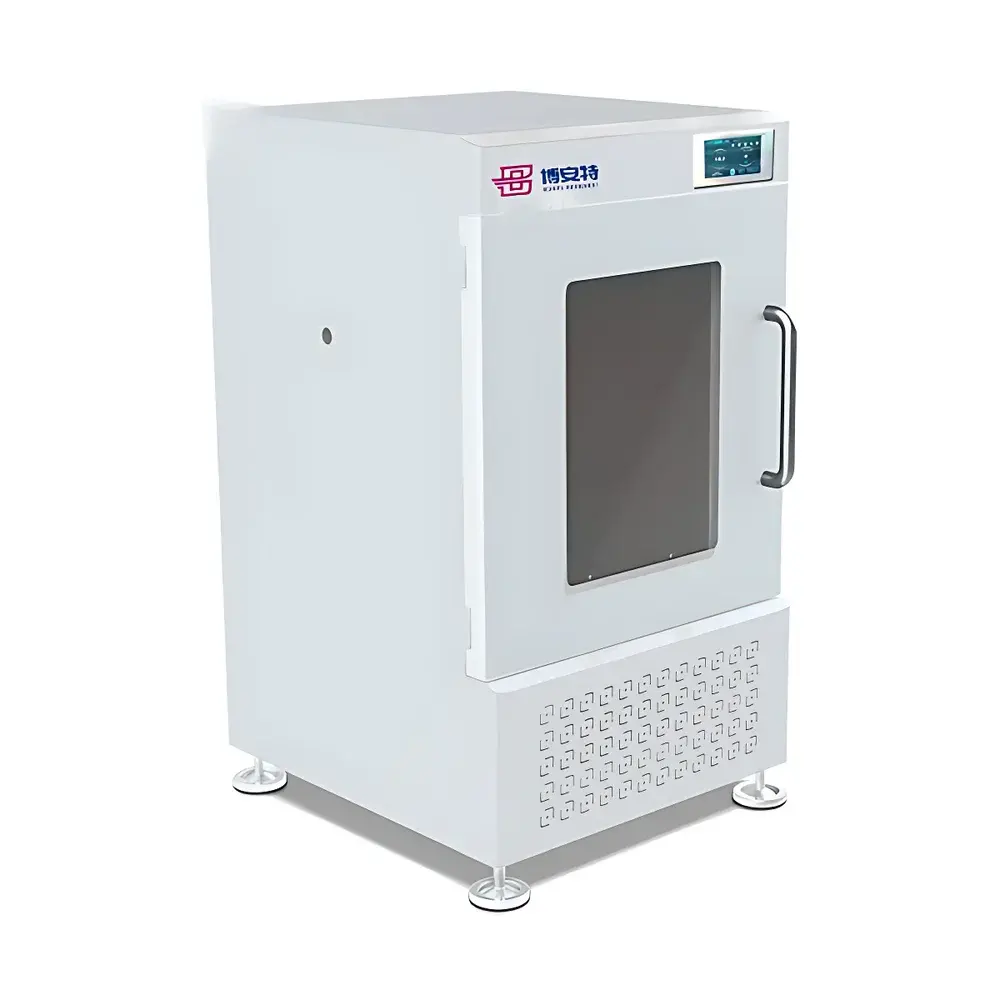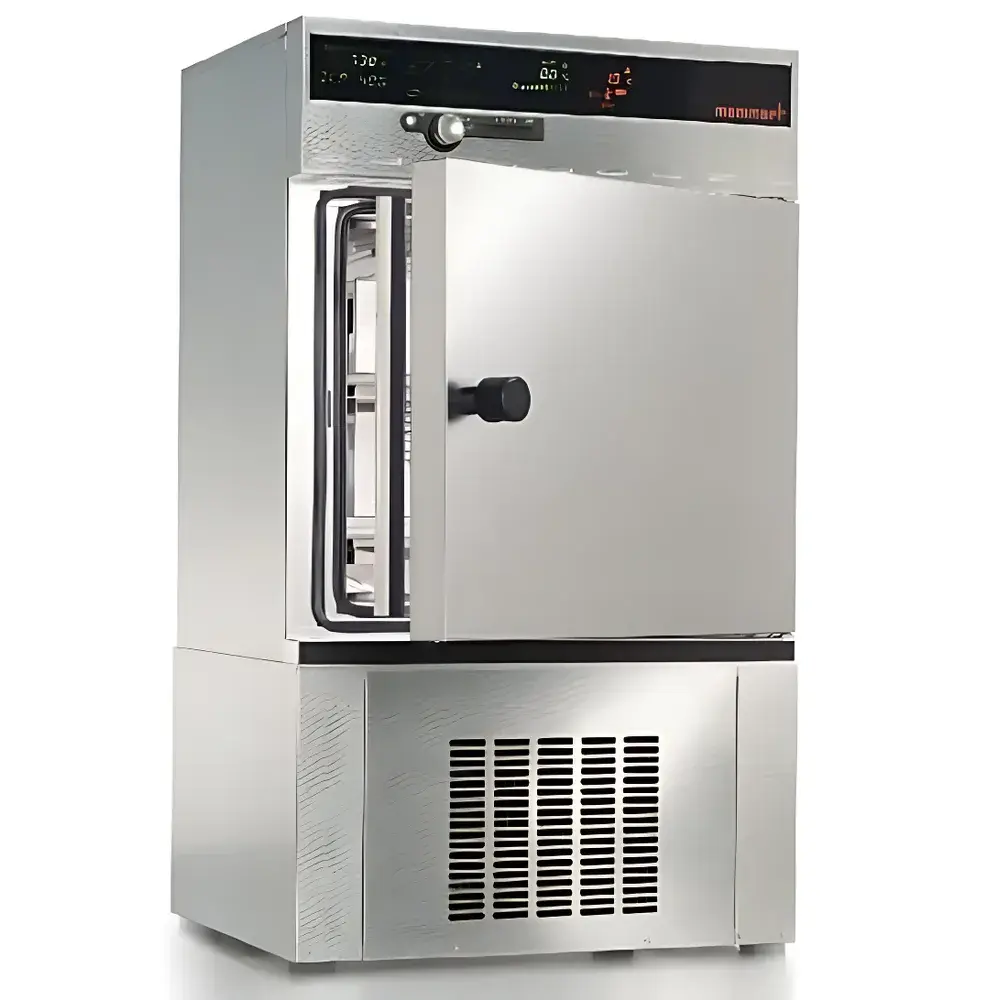
MEMMERT ICP400 Refrigerated Biochemical Incubator
| Brand | MEMMERT |
|---|---|
| Origin | Germany |
| Model | ICP400 |
| Temperature Range | 0–60 °C |
| Chamber Volume | 53 L |
| Interior Dimensions (W×H×D) | 400×400×330 mm |
| Exterior Dimensions (W×H×D) | 558×967×486 mm |
| Heating/Cooling System | Fully Enclosed Air-Jacket |
| Refrigerant | R134a (CFC-free) |
| Control | Microprocessor-based Fuzzy Logic Controller with 9-Stage Programmable Ramp/Soak Profiles |
| Interface | RS232 (upgradeable to RS485) |
| Memory Card Support | MEMoryCardXL |
| Safety | Dual Independent Overtemperature Protection (TWW Class 3.1 + TB Class 1) |
| Compliance | Designed for GLP/GMP environments |
Overview
The MEMMERT ICP400 Refrigerated Biochemical Incubator is a precision-engineered, air-jacketed incubation system designed for stable, long-term cultivation of temperature-sensitive biological samples under tightly controlled thermal conditions. Operating across a continuous range of 0 °C to +60 °C, the ICP400 integrates active cooling and independent heating via a fully enclosed air-jacket architecture—eliminating conventional simultaneous heating/cooling conflicts and enabling true integral temperature control. This design ensures uniform thermal distribution (±0.3 °C at 37 °C, typical), minimizes internal humidity loss, and avoids sample desiccation—a critical advantage over forced-air or water-jacketed alternatives. The unit employs R134a refrigerant, a zero-ozone-depletion potential (ODP) and low-global-warming-potential (GWP) alternative compliant with EU F-Gas Regulation (EU No. 517/2014). Its microprocessor-based fuzzy logic controller continuously monitors chamber dynamics and adjusts output in real time, delivering high reproducibility essential for cell culture, microbiological assays, enzyme kinetics, and stability testing.
Key Features
- Fully enclosed air-jacket heating and cooling system—separates thermal zones (heating unit top-mounted, refrigeration unit bottom-mounted) to prevent thermal overshoot (“overshoot” or “temperature冲温”) and ensure smooth, integral temperature ramping
- Dual independent overtemperature protection: TWW (Class 3.1) actively regulates chamber temperature back to setpoint upon deviation; TB (Class 1) provides fail-safe cut-off at hardware level if both primary and secondary controllers malfunction
- 9-stage programmable temperature profiles with ramp/soak capability—enables simulation of diurnal cycles, circadian rhythm studies, or multi-phase incubation protocols
- Automatic defrost cycle executed without interrupting incubation—no manual shutdown required, preserving experimental continuity during extended runs (e.g., 7+ day microbial growth or tissue differentiation)
- Stainless steel interior and exterior (AISI 304)—corrosion-resistant, non-porous, and compatible with common laboratory disinfectants and sterilization protocols
- Optional fluorescent lighting module—integrates programmable on/off timing to emulate photoperiods, supporting photobiological applications including algal culture and plant tissue incubation
- RS232 interface standard (field-upgradeable to RS485)—enables centralized monitoring and control of up to six ICP units from a single PC using MEMMERT’s validated incubator management software
- MEMoryCardXL support—stores and replicates complete program configurations (temperature, fan speed, lighting, hold/delay timers) across multiple units or users, ensuring protocol traceability and inter-laboratory consistency
Sample Compatibility & Compliance
The ICP400 accommodates standard microbiological and cell culture formats—including Petri dishes, multiwell plates, flasks, and roller bottles—within its 53 L stainless steel chamber. Its humidity-retentive air-jacket design maintains ambient relative humidity >70% (unmeasured but stabilized by minimal air exchange and no internal fan-induced evaporation), making it suitable for non-humidified applications where moisture conservation is critical. The unit complies with IEC 61010-1 (Safety Requirements for Electrical Equipment for Measurement, Control, and Laboratory Use) and meets electromagnetic compatibility standards per EN 61326-1. When paired with MEMMERT’s optional software suite and audit-trail-enabled configuration, the system supports adherence to FDA 21 CFR Part 11, ISO/IEC 17025, and GLP/GMP documentation requirements—including electronic signature, user access control, and immutable event logging.
Software & Data Management
MEMMERT provides native Windows-compatible software for remote parameter configuration, real-time monitoring, and data export (CSV/Excel). The software supports scheduled data logging at user-defined intervals (1 sec–60 min), alarm notification via email/SNMP, and synchronized multi-unit control. All program changes, alarm events, and system status transitions are recorded with timestamps, operator IDs, and contextual metadata—fulfilling ALCOA+ (Attributable, Legible, Contemporaneous, Original, Accurate, Complete, Consistent, Enduring, Available) data integrity principles. MEMoryCardXL cards serve as portable, tamper-evident protocol carriers—each card stores up to 20 programs and retains calibration history, eliminating manual re-entry errors and enabling rapid setup replication across shifts or facilities.
Applications
- Low-temperature bacterial and fungal culture (e.g., Listeria, Yersinia, psychrophilic strains)
- Enzyme activity assays requiring precise sub-ambient stabilization
- Seed germination and plant tissue culture under controlled photoperiods
- Long-duration stability studies (ICH Q1A–Q5C) for pharmaceutical intermediates and biologics
- Quality control of diagnostic reagents and molecular biology kits
- Environmental microbiology—water and soil sample incubation per ISO 9308-1, ISO 6222, or EPA Method 1603
- Cell line maintenance at reduced metabolic rates (e.g., stem cell quiescence models)
FAQ
What is the purpose of the dual overtemperature protection system?
It comprises two physically independent circuits: TWW (Temperature Watchdog Wide-range) actively corrects deviations using fuzzy logic, while TB (Temperature Breaker) is a passive, self-contained thermal fuse that cuts power if chamber temperature exceeds the instrument’s structural safety limit—ensuring protection even during catastrophic controller failure.
Can the ICP400 maintain humidity without a humidification system?
Yes—the sealed air-jacket design eliminates convective drying; internal RH remains inherently stable (>70%) during standard operation, though external humidification is not supported nor required for most biochemical applications.
Is the RS232 interface compatible with modern lab informatics systems?
Yes—RS232 enables direct integration with LIMS and ELN platforms via ASCII command protocol; optional RS485 upgrade supports Modbus RTU for industrial SCADA environments.
How does the air-jacket system improve temperature uniformity compared to forced-air incubators?
By eliminating internal fans and relying on passive convection within an insulated air cavity, the ICP400 avoids localized turbulence, cold/hot spots, and evaporative cooling—achieving ±0.3 °C spatial uniformity across the full chamber volume.
Does MEMMERT provide validation documentation for GxP environments?
Yes—IQ/OQ documentation templates, factory calibration certificates (traceable to DKD/DAkkS), and software validation packages (including risk assessment and test scripts) are available upon request for regulated laboratories.