
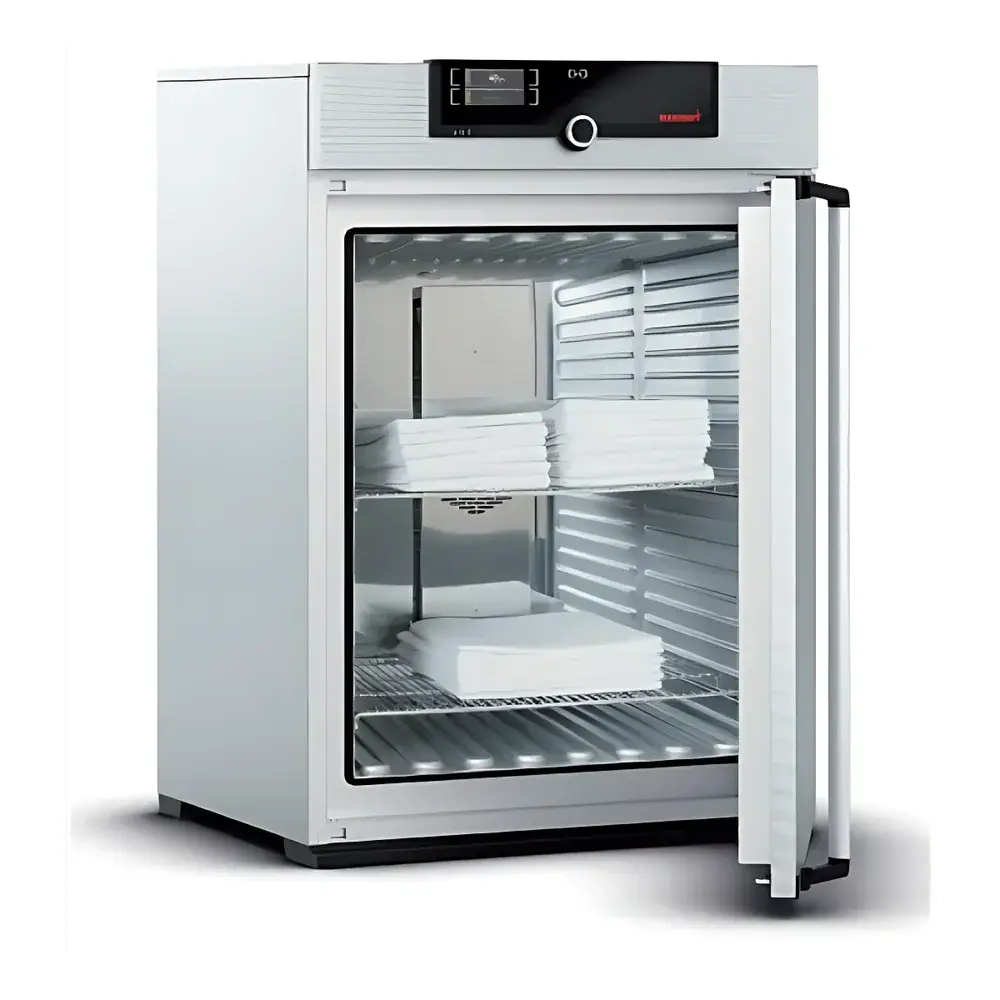
Memmert IFbw Series Medical Blanket Thermostatic Incubator
| Brand | Memmert (Germany) |
|---|---|
| Origin | Germany |
| Model | IFbw |
| Heating Configuration | Quadruple-wall heating with independent temperature monitoring |
| Airflow Control | Adjustable fan speed in 10% increments (0–100%) |
| Fresh Air Preheating System | Integrated preheat chamber for incoming ambient air |
| Internal Airflow | Minimized forced convection to prevent surface desiccation |
| Compliance | Designed for GLP-compliant environments |
Overview
The Memmert IFbw Series Medical Blanket Thermostatic Incubator is a precision-engineered temperature-controlled chamber specifically developed for applications requiring stable, low-temperature operation—typically between +5 °C and +60 °C—with exceptional thermal uniformity and minimal sample disturbance. Unlike conventional forced-convection incubators, the IFbw employs a quadruple-wall heating architecture combined with a dedicated reference sensor embedded in the chamber wall, enabling real-time compensation for thermal gradients and ambient fluctuations. Its defining operational principle centers on *reduced air movement* rather than high-velocity circulation: by limiting convective airflow, the IFbw mitigates evaporative cooling at sample surfaces—a critical requirement when conditioning medical blankets, hydrogel dressings, temperature-sensitive biologics, or hygroscopic pharmaceutical intermediates where surface moisture retention directly impacts functional performance or stability assessment outcomes.
Key Features
- Quadruple-wall heating system with independent platinum resistance thermometer (Pt100) monitoring at each wall junction, ensuring symmetrical heat distribution and eliminating cold spots.
- Dual-sensor temperature control: one integrated into the chamber wall for spatial stability feedback, another in the working volume for precise setpoint regulation—enabling ±0.1 °C temperature homogeneity (measured per VDI/VDE 2655 Part 3 at 37 °C).
- Adjustable low-turbulence fan: stepwise speed control from 0% to 100% in 10% increments allows fine-tuning of internal air exchange without inducing desiccation—essential for moisture-critical protocols.
- Integrated fresh-air preheating chamber: all externally sourced air passes through a thermally buffered zone prior to entering the main chamber, preventing transient thermal shocks and maintaining setpoint integrity during continuous ventilation.
- Robust stainless-steel interior with rounded corners and seamless welds—compliant with ISO 14644-1 Class 7 cleanroom-compatible cleaning protocols and compatible with common disinfectants including 70% ethanol and hydrogen peroxide vapor (HPV) decontamination cycles.
- Microprocessor-based controller with password-protected access levels, event logging, and configurable alarm thresholds for temperature deviation, door opening duration, and fan failure.
Sample Compatibility & Compliance
The IFbw is routinely deployed in regulated environments across clinical research laboratories, pharmaceutical quality control units, and medical device manufacturing facilities. It supports validation under Good Laboratory Practice (GLP) and Good Manufacturing Practice (GMP) frameworks. Its design facilitates compliance with ICH Q5C (stability testing of biotechnological/biological products), USP (pharmaceutical packaging and storage), and ASTM F2476-22 (standard specification for warming devices used in perioperative settings). The absence of turbulent airflow ensures fidelity in testing thermal response of textile-based medical devices—including electrically heated blankets, phase-change material wraps, and moisture-retentive wound coverings—where surface hydration state must remain invariant throughout conditioning.
Software & Data Management
Equipped with Memmert’s optional *Binder Control Software* (v5.x), the IFbw supports audit-trail-enabled data acquisition compliant with FDA 21 CFR Part 11 requirements. Logged parameters include chamber temperature (primary and wall-reference), fan speed percentage, door-open events, and alarm history—all time-stamped with UTC synchronization. Data export is available in CSV and PDF formats, with optional integration into LIMS via Modbus TCP or RS485 interfaces. Calibration certificates traceable to DKD/DAkkS-accredited standards are provided upon installation and may be re-verified annually using external Pt100 reference probes.
Applications
- Conditioning and functional testing of reusable and single-use therapeutic warming blankets prior to clinical deployment.
- Stability assessment of moisture-sensitive drug formulations during accelerated aging studies at controlled low-temperature setpoints.
- Preconditioning of hydrocolloid dressings, alginate gels, and silicone-based wound interfaces to standardized humidity-temperature states before adhesion or permeability testing.
- Storage and equilibration of temperature-labile reagents, calibration standards, and reference materials in metrology labs requiring drift-free thermal environments.
- Supporting ISO 10993-12 extraction protocols where solvent evaporation kinetics must remain unaffected by chamber airflow dynamics.
FAQ
What temperature range is supported by the IFbw series?
The standard operating range is +5 °C to +60 °C, with extended low-temperature models available down to –20 °C upon request.
Is the IFbw suitable for use in ISO Class 5 cleanrooms?
While the chamber itself meets ISO 14644-1 Class 7 surface cleanliness requirements, integration into higher-class cleanrooms requires additional HEPA-filtered air supply and structural containment—consult Memmert Application Engineering for site-specific qualification support.
Can the preheating chamber accommodate humidified air input?
No—the preheat module is designed exclusively for dry ambient air; integration of humidification requires external RH-controlled air handling units upstream of the incubator inlet.
Does the IFbw include a built-in printer or USB port for local data export?
No local printing interface is included; data export is performed via Ethernet-connected PC software or optional RS485-to-USB adapter.
What is the maximum allowable door-open duration before thermal recovery exceeds specification limits?
At 37 °C setpoint, full thermal recovery to ±0.2 °C occurs within ≤12 minutes after a 30-second door opening—verified per VDI/VDE 2655 Part 3 test protocol.



