
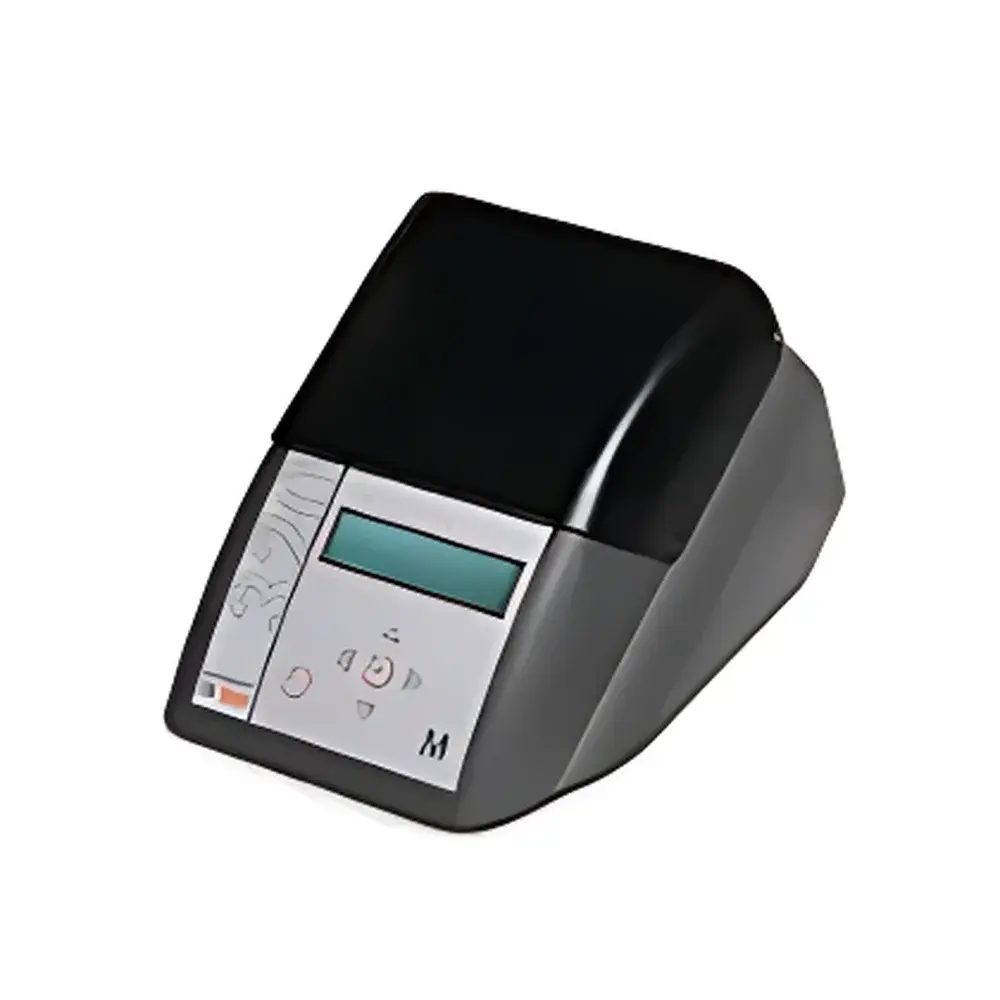
Merck TR 320 Heating Block Digestion System
| Brand | Merck |
|---|---|
| Origin | Germany |
| Model | TR 320 |
| Digestion Method | Rapid Digestion |
| Heating Modules | Dual Independent Heating Blocks |
| Batch Capacity | 12 samples |
| Temperature Setpoints | 100 °C, 120 °C, 148 °C |
| Temperature Accuracy | ±1.0 °C |
| Digestion Tube Diameter | 16 mm |
| Display | LCD with Real-Time Setpoint & Actual Temperature/Time Monitoring |
| Safety Features | Touch-Safe Heating Surface, Integrated Protective Cover |
| Power Supply | 115–230 V, 50–60 Hz |
| Dimensions (H×W×L) | 180 × 256 × 307 mm |
| Weight | 2.85 kg |
Overview
The Merck TR 320 Heating Block Digestion System is a precision-engineered, dual-zone thermal digestion platform designed for standardized wet-chemical sample preparation in environmental water quality laboratories. It operates on the principle of controlled conductive heating to accelerate oxidation reactions—specifically optimized for rapid chemical oxygen demand (COD), total organic carbon (TOC), and metal speciation analysis (including Cd, Cr, CN⁻, Fe, Pb, Ni, N, P, Ag, Zn) according to internationally recognized methods such as ISO 6060 (COD), EN 1484 (TOC), and EPA 200.7/200.8 (metals). Unlike open-flame or microwave-based digesters, the TR 320 employs calibrated resistive heating blocks with direct thermal coupling to 16-mm borosilicate glass digestion tubes, ensuring uniform heat distribution, minimal evaporation loss, and high inter-run reproducibility. Its compact benchtop footprint and low thermal mass enable rapid temperature stabilization and energy-efficient operation—critical for high-throughput compliance testing in accredited environmental labs.
Key Features
- Dual independent heating blocks allow simultaneous execution of two distinct digestion protocols (e.g., COD at 148 °C and TOC at 120 °C), reducing turnaround time without cross-contamination risk.
- Eight pre-programmed, method-validated digestion routines—including DIN 38409-H41 (COD), ISO 8467 (permanganate index), and Merck Spectroquant® application-specific protocols—are stored in non-volatile memory and accessible via intuitive button navigation.
- LCD interface displays real-time setpoint vs. actual temperature and elapsed time with 1-second resolution; LED status indicators differentiate between ramp-up (flashing red), hold phase (steady red), and cooldown (off).
- Touch-safe heating surface (EN 61000-3-2 compliant) and integrated protective cover meet IEC 61010-1 safety requirements for Class II laboratory equipment.
- Calibration traceability supported via optional external Pt100 probe input (not included); factory calibration certificate available upon request for GLP/GMP documentation.
Sample Compatibility & Compliance
The TR 320 accommodates standard 16-mm OD digestion tubes used across Merck’s Spectroquant® test kits (e.g., 1.14520, 1.14521, 1.14522) and compatible third-party reagents. Its fixed temperature setpoints (100 °C, 120 °C, 148 °C) align precisely with regulatory digestion conditions specified in ISO 6060 Annex A (148 °C/2 h for dichromate-based COD), ASTM D1252-12 (150 °C alternative), and US EPA Method 410.4 (TOC persulfate oxidation). The system is CE-marked and conforms to electromagnetic compatibility (EMC) Directive 2014/30/EU and Low Voltage Directive 2014/35/EU. For audit readiness, it supports documented operation under ISO/IEC 17025:2017 and fulfills instrumental prerequisites for ISO 5667-3 (water sampling) and ISO 11566 (trace metal analysis).
Software & Data Management
While the TR 320 operates as a standalone hardware platform without embedded data logging or PC connectivity, its deterministic timing and temperature control architecture ensures full traceability when paired with Merck’s Spectroquant® photometers (e.g., NOVA 60, PHARO 300) via manual entry of digestion parameters into instrument software. All eight built-in programs are named and version-controlled per Merck’s internal QA documentation (SOP-MER-TR320-01). For laboratories implementing 21 CFR Part 11 compliance, external electronic lab notebooks (ELNs) may record operator ID, batch number, start/stop timestamps, and observed endpoint conditions—leveraging the unit’s stable thermal performance as a validated ancillary device within the analytical workflow.
Applications
- Routine COD determination in municipal wastewater influent/effluent per ISO 6060 and national discharge permits.
- TOC oxidation prior to NPOC measurement using persulfate/UV digestion protocols.
- Acid digestion of filtered water samples for total recoverable metals (EPA 200.7, ISO 17294-2) prior to ICP-OES or AAS analysis.
- Standardized cyanide distillation support (APHA 4500-CN⁻ F) requiring precise 100 °C reflux control.
- Phosphate and nitrate digestion in nutrient monitoring programs aligned with EU WFD (2000/60/EC) reporting requirements.
FAQ
Does the TR 320 support programmable ramp rates or variable dwell times?
No—the TR 320 implements fixed-temperature, fixed-duration protocols only. Time and temperature are discrete settings; ramp profiles are not configurable.
Can the heating blocks be calibrated independently?
Yes—each block has separate calibration offset adjustment via service mode, enabling compensation for minor thermal drift between zones.
Is the unit compatible with 20-mm digestion tubes?
No—it is mechanically engineered exclusively for 16-mm OD tubes; use of larger diameters compromises thermal contact and safety certification.
What maintenance is required for long-term accuracy?
Annual verification with NIST-traceable dry-block calibrator (e.g., Fluke 9142) is recommended; no user-serviceable parts require replacement under normal operating conditions.
Does Merck provide method validation reports for TR 320-based procedures?
Yes—application notes and validation summaries (e.g., “TR 320 Performance Verification for COD per ISO 6060”) are available through Merck’s Technical Support Portal upon registration.
Related Products







