
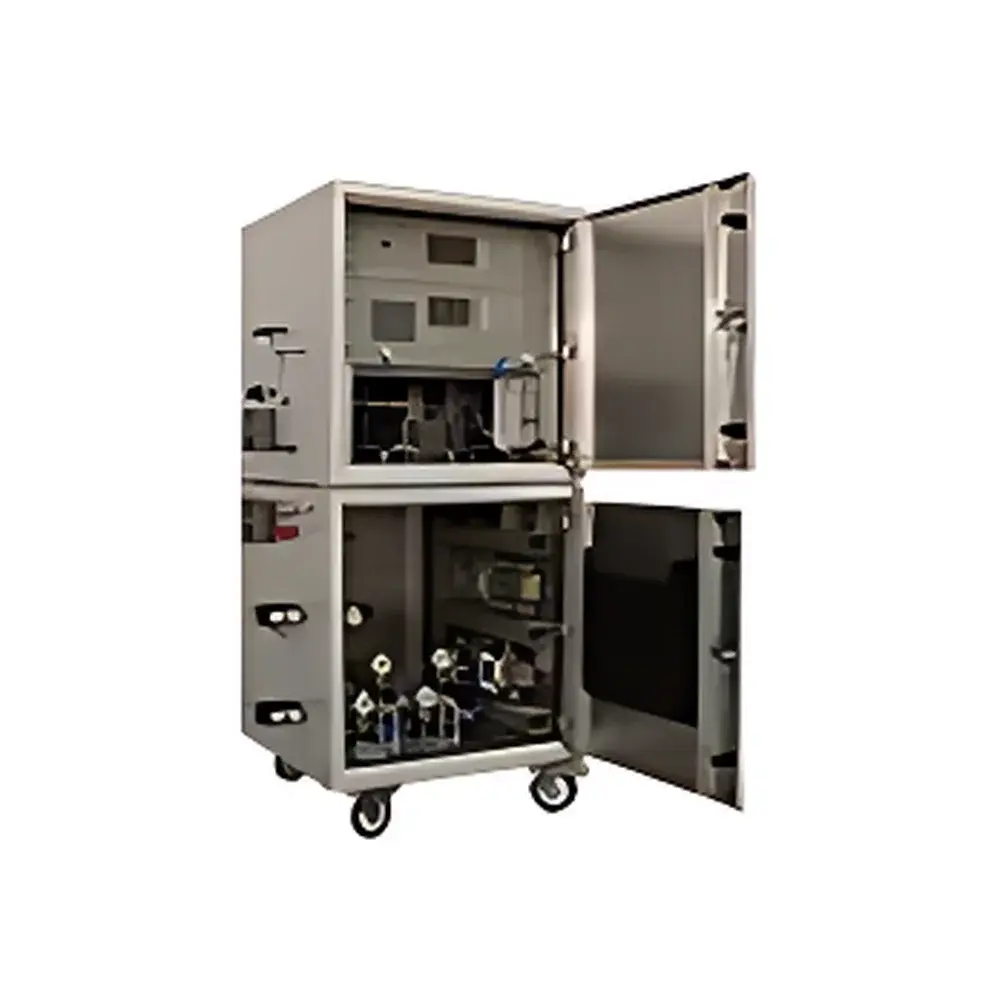
Mercury Instruments SM-4 Mobile Flue Gas Mercury Continuous Emission Monitoring System
| Brand | Mercury Instruments |
|---|---|
| Origin | Germany |
| Model | SM-4 Mobile |
| Detection Principle | Cold Vapor Atomic Fluorescence Spectrometry (CVAFS) with Gold Amalgamation Pre-concentration |
| Measurement Range | 0.05–100 µg/m³ (Hg⁰, Hg²⁺, Hgₚ after catalytic conversion) |
| Response Time (t₉₀) | ≤180 s |
| Sample Line Length | Up to 73 m (240 ft) |
| Dilution Ratio | Adjustable, typically 1:10 to 1:100 |
| Operating Temperature | Heated sample path up to 180 °C |
| Compliance | EPA Method 29 / ASTM D6784-22 / EN 14181 QAL1 & QAL3 certified |
| Calibration Options | Integrated NIST-traceable elemental Hg vapor generator (optional), QAL3-compliant ionized Hg⁰ calibration source (optional) |
Overview
The Mercury Instruments SM-4 Mobile is a fully integrated, transportable flue gas mercury continuous emission monitoring system (CEMS) engineered for regulatory-grade measurement of total gaseous mercury (HgT) in high-temperature, high-moisture, and chemically aggressive stack environments. It employs cold vapor atomic fluorescence spectrometry (CVAFS) coupled with gold amalgamation pre-concentration — a technique recognized by EPA Method 29, ASTM D6784-22, and EN 14181 for its exceptional sensitivity, selectivity, and immunity to spectral interferences. The system operates on a dry, thermal catalytic conversion principle: all mercury species — elemental (Hg⁰), oxidized (Hg²⁺), and particulate-bound (Hgp) — are quantitatively converted to Hg⁰ upstream of detection via a high-efficiency, maintenance-free catalyst bed operating at >650 °C. This eliminates dependence on wet chemistry, liquid reagents, or consumable sorbent cartridges, ensuring long-term operational stability under real-world industrial conditions.
Key Features
- Heated, corrosion-resistant sampling probe with integrated thermocouple and pressure sensor, installed directly in the flue gas stream at temperatures up to 200 °C
- Automated, maintenance-free diaphragm vacuum pump with real-time pressure feedback control to sustain constant volumetric flow independent of stack backpressure fluctuations
- Programmable dilution module with precision orifice-based flow stabilization — decouples sample pressure from stack dynamics and suppresses matrix interference from SO2, NOx, HCl, and fly ash
- Thermally insulated PFA sample transfer line (up to 73 m / 240 ft), maintained at ≥120 °C to prevent mercury adsorption or condensation
- Gold-coated quartz trap with programmable thermal desorption — delivers sub-0.05 µg/m³ detection capability and <5% RSD over 30-day operation
- Self-cleaning heated particulate filter with automatic back-pulse cycle; no manual filter replacement required during 90-day campaigns
- Onboard NIST-traceable elemental mercury vapor generator (optional) enabling automated QAL3 performance verification per EN 14181
Sample Compatibility & Compliance
The SM-4 Mobile is validated for continuous operation in flue gases containing up to 5,000 ppm SO2, 1,000 ppm NOx, 1,000 ppm HCl, and ≥10 g/m³ particulate loading — typical of coal-fired power plants, municipal waste incinerators, cement kilns, and non-ferrous metal smelters. All wetted components are constructed from inert, high-purity materials (e.g., Hastelloy C-276, fused silica, PFA) to resist halogen-induced corrosion and mercury amalgamation. The system meets QAL1 requirements per EN 14181 and has passed U.S. EPA Relative Accuracy Test Audit (RATA) protocols with ≤10% RA across 0.1–100 µg/m³ range. Data integrity complies with FDA 21 CFR Part 11 when paired with Mercury Instruments’ optional audit-trail-enabled software package.
Software & Data Management
The embedded Linux-based controller runs Mercury Instruments’ CEMS-OS v4.2 firmware, supporting ISO/IEC 17025-aligned data handling workflows. Real-time concentration values, system diagnostics (vacuum pressure, trap temperature, catalyst status), and calibration logs are timestamped and stored locally with 12-month retention. Data export supports Modbus TCP, OPC UA, and ASCII CSV formats for seamless integration into plant DCS or environmental reporting platforms (e.g., EPA CDX, EU ETS MRV). Optional GLP/GMP mode enables electronic signatures, user role-based access control, and immutable audit trails compliant with ISO 17025:2017 Clause 7.11.
Applications
- Regulatory compliance monitoring for MATS (U.S.), IED (EU), and China’s GB 13223-2011 emission limits
- Process optimization and mercury mass balance studies in coal combustion and co-firing operations
- Performance validation of activated carbon injection (ACI) and brominated sorbent systems
- Long-term trend analysis in waste-to-energy facilities subject to strict HgT annual averaging requirements
- Mobile reference measurements during CEMS certification, commissioning, or troubleshooting
FAQ
Does the SM-4 Mobile require wet chemical reagents or liquid waste disposal?
No. It uses a completely dry, thermal catalytic conversion method and generates zero liquid or solid hazardous waste.
Can it measure speciated mercury (Hg⁰ vs. Hg²⁺) without additional hardware?
No — the SM-4 Mobile reports total gaseous mercury (HgT) only. Speciation requires integration with a separate, EPA-approved sorbent trap module (e.g., Ontario Hydro method-compatible add-on).
What is the minimum detectable concentration under field conditions?
0.05 µg/m³ (at 1 m³/h sample flow, 30-minute averaging period), verified per ASTM D6784-22 Annex A4.
Is remote diagnostics and firmware updates supported?
Yes — via secure TLS-encrypted Ethernet or optional 4G/LTE cellular gateway with configurable alert thresholds and SNMP v3 trap support.
How often is calibration required for routine compliance use?
Zero-point and span checks every 7 days are recommended; full QAL3 verification using the optional onboard Hg⁰ generator is performed automatically every 30 days per EN 14181.







