
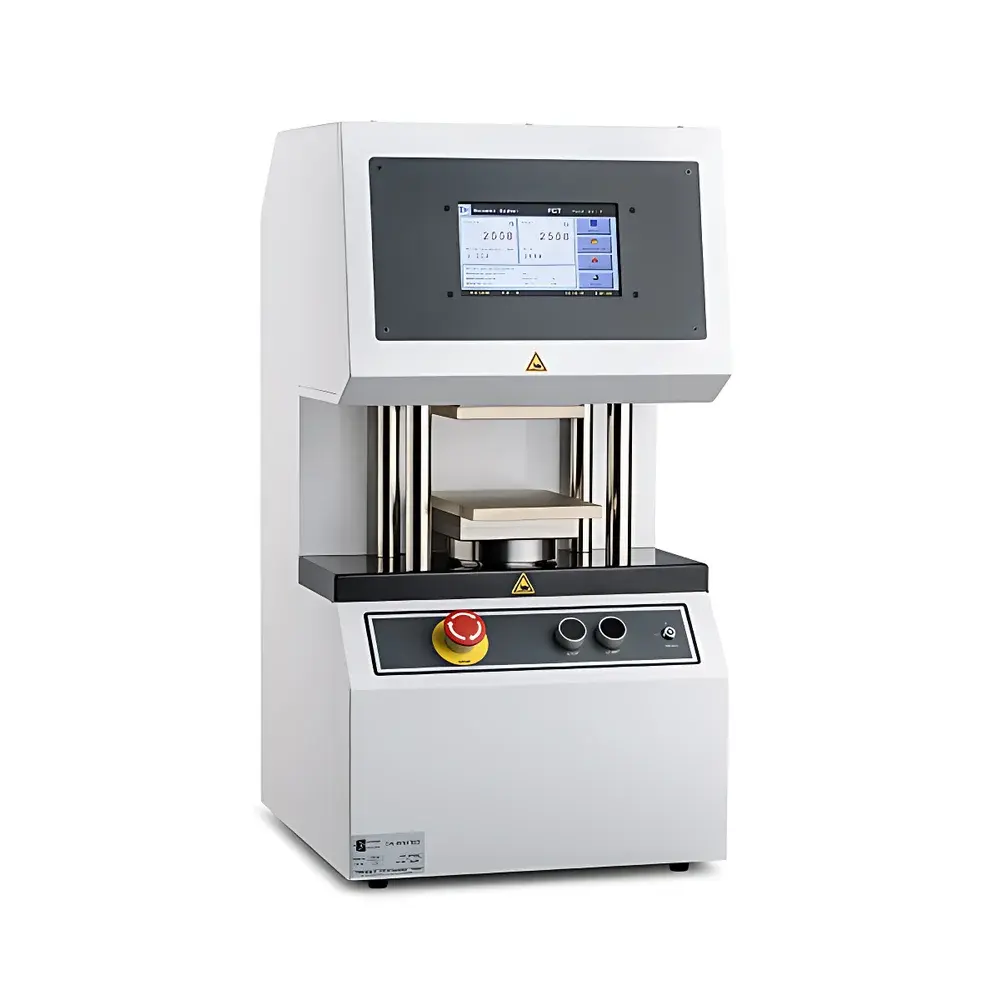
Messmer Büchel 17-56 Crush Resistance Tester
| Brand | Buchel BV |
|---|---|
| Origin | Netherlands |
| Model | 17-56 |
| Force Range | 0–5000 N |
| Travel Distance | 4–78 mm |
| Test Speed | 5–50 mm/min |
| Return Speed | ±100 mm/min |
| Units | N, lb, N/m, lb/in, kPa, lb/ft², lb/in², kN/m |
| Compliance | ISO 12192, ISO 7263, ISO 3037, ISO 13821, ISO 3035, TAPPI T822, T809, T843, T821, T811, T823, T838, T839, T825, T829, DIN 53134, DIN 53149, FEFCO No. 6/8/11, APPITA/AS 1301.407s/429s/434s/430s/444s, PPITA/AS 1301.429s |
Overview
The Messmer Büchel 17-56 Crush Resistance Tester is a precision-engineered mechanical compression instrument designed for standardized evaluation of compressive resistance in corrugated fiberboard, linerboard, fluting medium, and finished packaging structures. It operates on the principle of controlled uniaxial compression under defined geometric constraints—applying calibrated force at constant crosshead velocity to determine peak load at structural collapse (i.e., “crush” or “crimp failure”). Unlike general-purpose universal testers, the 17-56 integrates application-specific kinematics, sample geometry enforcement, and regulatory-aligned test protocols to deliver repeatable, traceable results required for quality assurance in paper and packaging manufacturing. Its architecture supports all major international crush test methodologies—including Ring Crush Test (RCT), Corrugated Medium Test (CMT), Concora Crush Test (CCT), Pin Adhesion Test (PAT), Edge Crush Test (ECT), Flat Crush Test (FCT), and Short Span Compression Test (SQT)—without hardware modification, only via certified fixture interchange.
Key Features
- High-stability load frame with rigid aluminum alloy construction and vibration-damped base, engineered for long-term dimensional stability under cyclic loading.
- Integrated 5000 N load cell with over-range protection (±5000 N full scale) and linearity error < ±0.5% FS per ISO 376:2011 calibration reference.
- Motor-driven crosshead with closed-loop servo control ensuring consistent test speed accuracy (±0.5% deviation across 5–50 mm/min range).
- Color TFT touchscreen interface with intuitive icon-based navigation, real-time force–displacement curve visualization, and on-device data logging (up to 10,000 test records).
- Ergonomically optimized work height (850 mm) and adjustable sample access zone to minimize operator fatigue during high-volume QC workflows.
- Modular fixture system compliant with ISO 13821 Annex A and TAPPI T822 Annex B specifications; includes RCT mandrels, ECT clamping jaws, FCT platens, and SQT anvil sets—all manufactured to ±0.05 mm geometric tolerance.
Sample Compatibility & Compliance
The 17-56 accommodates standard test specimens per ISO, TAPPI, and FEFCO guidelines: RCT samples (15.0 ± 0.1 mm × 152.4 ± 0.2 mm), ECT strips (25.4 ± 0.1 mm wide × ≥150 mm long), FCT specimens (100 × 100 mm), and SQT coupons (15 × 15 mm). All fixtures enforce strict edge alignment and parallelism to prevent eccentric loading—a known source of inter-laboratory variability. The instrument meets mechanical and metrological requirements of ISO/IEC 17025:2017 for accredited testing laboratories and supports audit-ready documentation for GLP/GMP environments. Firmware includes embedded compliance flags that auto-verify test parameters against selected standards (e.g., enforcing 12.7 mm/min for TAPPI T822 RCT or 1.0 mm/min for ISO 3035 FCT) prior to execution.
Software & Data Management
Data acquisition and reporting are managed via Buchel’s proprietary CrushControl™ firmware (v4.2+), which stores raw force–displacement data at 100 Hz sampling rate with timestamp, operator ID, environmental conditions (optional via external sensor integration), and calibration certificate traceability. Export formats include CSV (for LIMS ingestion), PDF test reports with digital signature support, and XML structured for ERP synchronization. Optional PC-based CrushLink™ software enables advanced statistical process control (SPC), multi-instrument fleet monitoring, and automated generation of control charts (X̄–R, Cpk). All electronic records comply with FDA 21 CFR Part 11 requirements for audit trails, user authentication, and electronic signatures when configured with networked domain authentication.
Applications
This tester serves as a primary metrology tool across pulp & paper R&D, converting plant QA/QC, and third-party certification labs. Typical use cases include: prediction of box compression strength (BCT) via empirical models (e.g., McKee equation using ECT and caliper); validation of adhesive bond integrity in multi-ply board; assessment of moisture-induced strength loss in recycled fiber blends; qualification of new fluting geometries (e.g., micro-flute, ultra-thin); and root-cause analysis of field failures through comparative crush profile analysis (peak load, energy absorption, post-yield deformation slope). It is routinely deployed in supplier qualification programs aligned with Amazon Packaging Support and Certification (APSC), Walmart Sustainable Packaging Playbook, and EU Directive 94/62/EC compliance frameworks.
FAQ
What standards does the 17-56 natively support without firmware updates?
All listed ISO, TAPPI, DIN, FEFCO, and APPITA/AS standards are pre-configured in firmware v4.2; no user programming is required to initiate compliant tests.
Can the instrument be integrated into an existing MES or LIMS environment?
Yes—via Ethernet TCP/IP or RS-232 serial interface using Modbus RTU or custom ASCII protocol; CrushLink™ provides OPC UA gateway functionality for Industry 4.0 architectures.
Is calibration traceable to national metrology institutes?
Yes—factory calibration certificates are issued with NIST-traceable load cell verification and include uncertainty budgets per ISO/IEC 17025 Annex A.3.
What maintenance intervals are recommended for daily QC operation?
Daily visual inspection of fixtures and load path; monthly verification of crosshead alignment and speed accuracy; annual full recalibration with certified deadweight standards.
Does the system support multi-language UI for global manufacturing sites?
Yes—interface language can be switched among English, German, French, Spanish, and Chinese directly from the touchscreen settings menu.



