
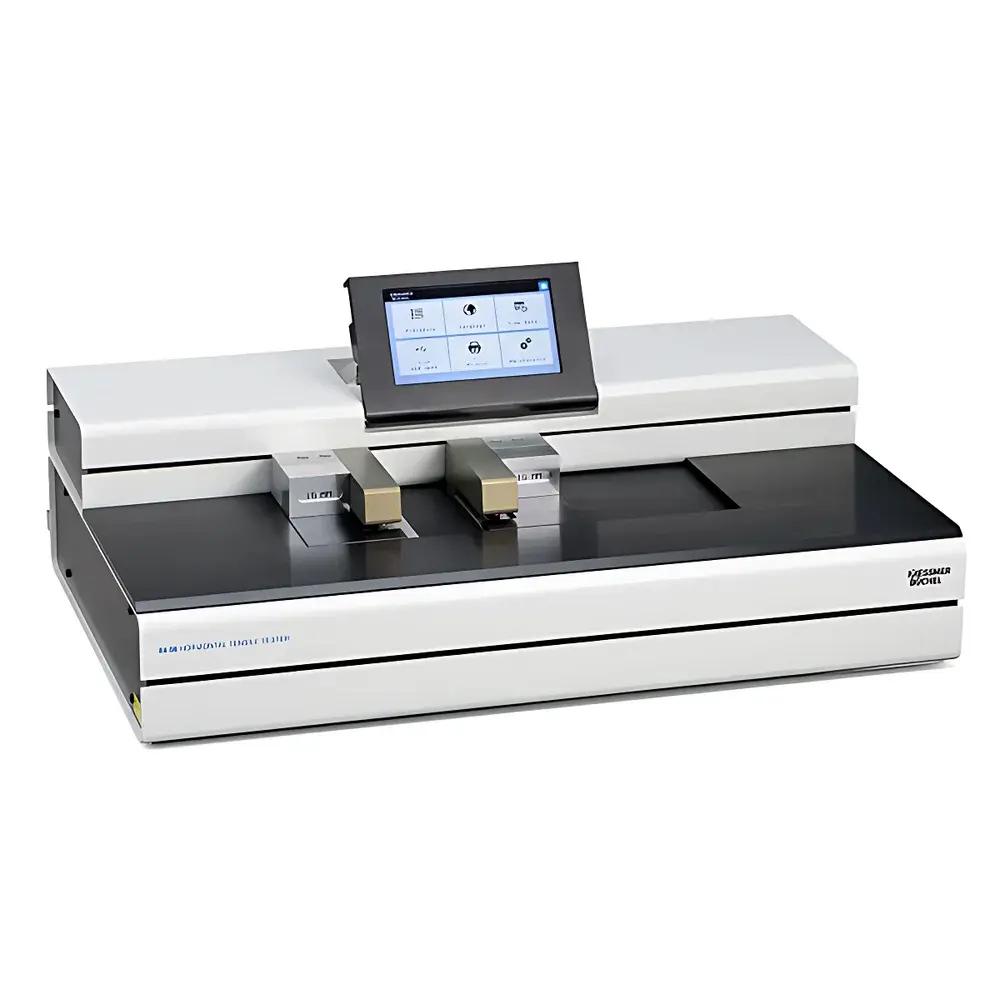
Messmer Büchel 84-56 Horizontal Tensile Strength Tester
| Brand | Buchel BV |
|---|---|
| Origin | Netherlands |
| Model | 84-56 Horizontal Tensile Strength Tester |
| Accuracy | ±0.5% |
| Test Speed Range | 10–200 mm/min |
| Clamping Length | 50–180 mm |
| Sample Width Options | 15, 25, 50, 75 mm |
| Compliant Standards | ISO 12625-4/5, TAPPI T-494, GB/T 12914-2008, BS EN ISO 1924-2/3, DIN 53112, JIS P8113, AS/NZS 1301.448, SCAN P38, CPPA D34 |
Overview
The Messmer Büchel 84-56 Horizontal Tensile Strength Tester is a precision-engineered instrument designed for the static tensile evaluation of flexible sheet materials—particularly paper, board, tissue, nonwovens, films, and thin composite laminates. Operating on the principle of constant-rate-of-extension (CRE), the system applies uniaxial tensile force to a standardized specimen until rupture, measuring peak load, elongation at break, tensile energy absorption (TEA), and tensile stiffness in accordance with internationally recognized mechanical testing protocols. Its horizontal configuration ensures optimal alignment control, minimal gravitational interference, and consistent sample handling—critical for high-reproducibility measurements across low-modulus, high-elongation substrates. The instrument is not intended for metallic or rigid structural materials; rather, it addresses the specific metrological demands of the pulp, paper, packaging, hygiene product, and specialty converting industries where width-normalized strength metrics (kN/m) and wet/dry comparative analysis are essential for quality assurance and process validation.
Key Features
- Large-format color touchscreen interface with intuitive icon-driven navigation and multilingual support—including English, German, French, Spanish, and Chinese—enabling seamless operation across global R&D and QC laboratories.
- Modular clamping system accommodating standardized sample widths of 15 mm, 25 mm, 50 mm, and 75 mm (3 in), with tool-free quick-change jaw inserts and pneumatic-assisted gripping for consistent clamping pressure and minimized slippage.
- High-resolution load cell calibrated to ±0.5% full-scale accuracy, traceable to national standards, supporting dynamic range from sub-newton to 100 N (customizable up to 500 N upon request).
- Programmable test speed from 10 to 200 mm/min (0.2–0.8 in/min), compliant with ISO 1924-2, TAPPI T-494, and GB/T 12914-2008 requirements for both dry and wet tensile assessment.
- Optional Wet Tensile Module featuring controlled immersion time (0–300 s adjustable in 1-s increments), temperature-stabilized water bath integration, and automated post-wet clamping sequence to eliminate operator variability during wet strength evaluation.
- Integrated real-time data visualization: immediate post-test display of tensile strength (kN/m), breaking force (N), elongation (%), TEA (J/m²), and tensile stiffness (mN·m), all calculated and formatted per standard conventions.
Sample Compatibility & Compliance
The 84-56 is validated for use with planar, isotropic, or orthotropic flexible materials exhibiting thicknesses between 0.02 mm and 3.0 mm and tensile moduli ranging from 100 MPa to 5 GPa. It supports ASTM D828, ISO 1924-2/3, ISO 12625-4 (dry) and -5 (wet), TAPPI T-494, GB/T 12914-2008, BS EN ISO 1924-2/3, DIN 53112, JIS P8113, AS/NZS 1301.448, SCAN P38, and CPPA D34 test methods. All firmware and calibration routines adhere to ISO/IEC 17025:2017 general requirements for competence of testing and calibration laboratories. Instrument qualification documentation—including Installation Qualification (IQ), Operational Qualification (OQ), and Performance Qualification (PQ)—is available upon request to support GLP, GMP, and FDA-regulated environments.
Software & Data Management
The embedded firmware includes built-in statistical reporting (mean, SD, CV%, min/max) for up to 99 test cycles per batch, with export capability to CSV and PDF formats via USB port. Optional PC-based software (Buchel TestSuite v4.x) provides advanced features including audit trail logging compliant with 21 CFR Part 11 requirements, user role-based access control, electronic signature capture, raw waveform visualization (force vs. extension), and automated report generation aligned with internal SOPs or external regulatory templates. All measurement metadata—including operator ID, environmental conditions (optional sensor input), sample ID, test date/time, and calibration certificate reference—is permanently embedded in each result file.
Applications
- Quality control of virgin and recycled paper grades for printing, packaging, and labeling applications.
- Wet strength validation of towel, tissue, and facial tissue products under simulated usage conditions.
- Development and benchmarking of biodegradable films, hydroentangled nonwovens, and fiber-reinforced composites.
- Supplier qualification and incoming material verification against contractual tensile specifications.
- Correlation studies between tensile performance and fiber morphology, refining degree, or chemical additive dosage.
- Regulatory submission support for FDA 510(k), CE marking, and eco-label certification (e.g., EU Ecolabel, FSC Chain-of-Custody).
FAQ
What standards does the 84-56 fully support out-of-the-box?
The instrument is factory-configured to execute ISO 12625-4/5, TAPPI T-494, GB/T 12914-2008, BS EN ISO 1924-2/3, DIN 53112, JIS P8113, AS/NZS 1301.448, SCAN P38, and CPPA D34 without software modification.
Can the system be integrated into a LIMS environment?
Yes—via optional Ethernet or RS-232 interface, the 84-56 supports ASTM E1384-compliant HL7 and ASTM E2500 data exchange protocols for direct LIMS or MES connectivity.
Is third-party calibration certification included with purchase?
Each unit ships with a UKAS-accredited calibration certificate covering load, displacement, and speed axes, valid for 12 months from shipment date.
Does the wet tensile module require external plumbing or compressed air?
No—the module operates autonomously using an integrated reservoir and solenoid-controlled water delivery system; no external utilities are required beyond standard 100–240 VAC power.
What is the recommended maintenance interval?
Preventive maintenance is advised every 12 months or after 10,000 test cycles, whichever occurs first; service includes load cell recalibration, jaw wear inspection, motion system lubrication, and firmware integrity verification.



