
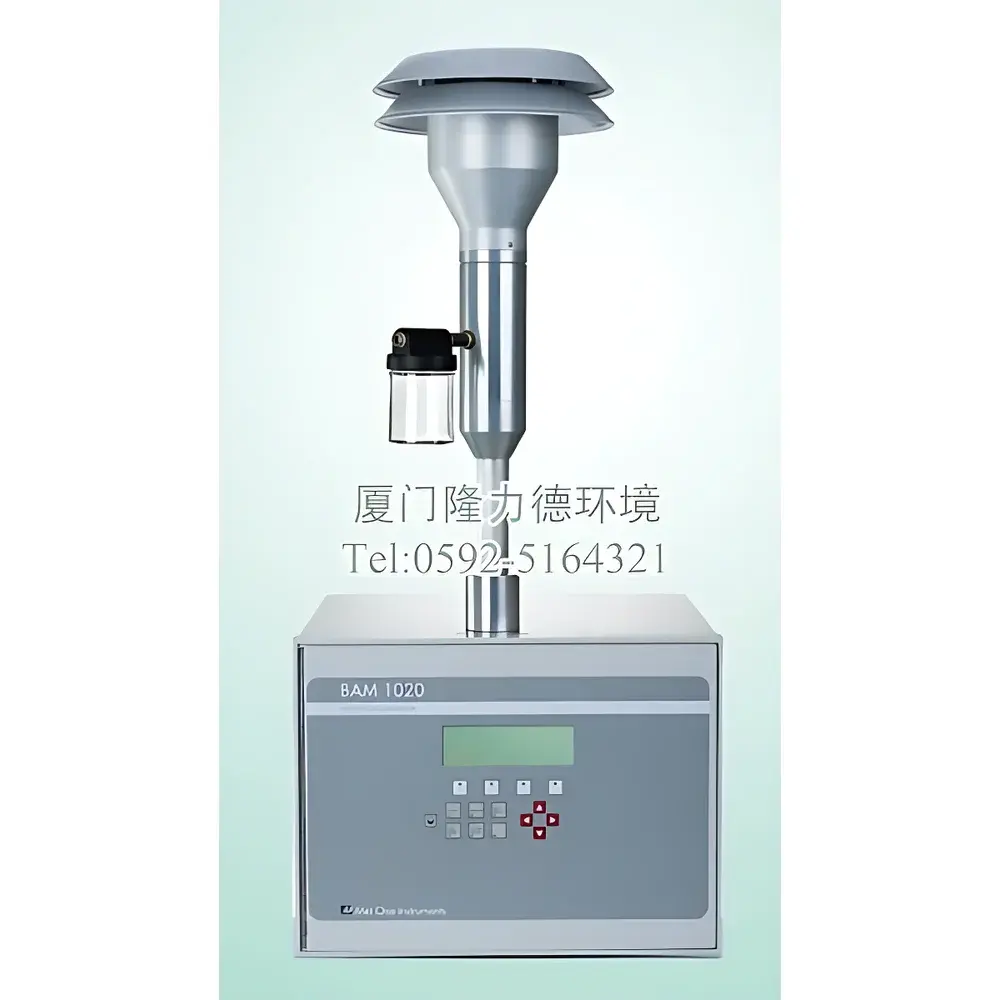
Met One BAM-1020 Beta Attenuation Mass Monitor for PM2.5
| Brand | Met One Instruments (USA) |
|---|---|
| Origin | USA |
| Model | BAM-1020 |
| Certification | EPA EQPM-0798-122 |
| Measurement Principle | Beta Ray Attenuation |
| Range | 0–50 mg/m³ |
| Sampling Method | Impaction with Rotating Glass Impactor |
| Filter Tape | Circular, 30-sample capacity |
| Calibration | Automated zero & span drift correction using reference membrane |
| Data Storage | 182 days internal memory |
| Humidity Control | Integrated heater for RH conditioning |
| Connectivity | RS-232 serial interface |
| Compliance | EPA Reference Method for PM2.5 and PM10 |
Overview
The Met One BAM-1020 Beta Attenuation Mass Monitor is a federally recognized reference-grade ambient air particulate matter analyzer engineered for continuous, unattended measurement of PM2.5 and PM10 mass concentrations. It operates on the beta ray attenuation principle—a physically robust, gravimetrically traceable method in which airborne particles are collected onto a moving filter tape, and their mass is determined by quantifying the attenuation of beta radiation (from a 14C source) passing through the loaded filter. Unlike optical scattering or tapered element oscillating microbalance (TEOM) techniques, beta attenuation is inherently insensitive to particle composition, color, refractive index, or hygroscopic growth—making it highly suitable for regulatory compliance monitoring across diverse climatic and urban environments. The BAM-1020 meets U.S. Environmental Protection Agency (EPA) Equivalent Method designation EQPM-0798-122 for both PM2.5 and PM10, and has been independently verified under UK MCERTS, Korean K-EMF, and Chinese HJ 653–2013 standards.
Key Features
- Fully automated, microprocessor-controlled operation with real-time diagnostics and self-validation routines
- Rotating glass impactor stage supporting up to 30 sequential sample collections per tape roll
- Integrated relative humidity control via precision-heated sampling line to minimize water vapor interference
- Hourly filter exchange cycle to mitigate volatile organic compound (VOC) artifact and semi-volatile aerosol losses
- Automated zero-point verification at start and end of each measurement cycle using clean filter substrate
- Span drift correction performed by inserting a certified reference membrane into the beta beam path
- LCD interface with local display of hourly, daily, and 30-day averaged concentration values
- Internal data logger storing 182 days of 1-hour resolution data; expandable via external storage or network transfer
- RS-232 serial port for direct connection to data acquisition systems, modems, printers, or SCADA networks
- Remote telemetry capability supporting 60-day unattended operation with web-based status monitoring and firmware updates
Sample Compatibility & Compliance
The BAM-1020 is validated for use with standard Federal Reference Method (FRM) calibration membranes and compatible with EPA-approved PM2.5 and PM10 inlet configurations—including WINS, VSCC, and sharp-cut cyclones. Its impaction-based sampling design ensures representative collection of fine-mode aerosols without size-dependent bias. Instrument performance conforms to ISO 12103-1 (A2 test dust), ASTM D1317 (for particulate mass determination), and EN 12341:2014 (ambient air quality—standardization of PM measurements). All firmware and data handling protocols support audit-ready operation under GLP and GMP frameworks, including full electronic record retention, user-access logging, and timestamped event flags for power interruption, calibration failure, or maintenance alerts.
Software & Data Management
The BAM-1020 supports native ASCII output over RS-232 and integrates seamlessly with third-party environmental data management platforms (e.g., AQS, AirWatch, EQuIS). Internal firmware includes configurable data validation rules—such as outlier detection based on ±3σ deviation from rolling 24-hour mean, spike identification thresholds, and instrument fault flagging. Each recorded value carries embedded metadata: date/time stamp, cycle ID, filter position, temperature, RH, flow rate, and diagnostic status. All calibration events—including zero checks, span verifications, and reference membrane insertions—are logged with full traceability. Optional software packages provide 21 CFR Part 11-compliant electronic signatures, audit trails, and secure remote download capabilities.
Applications
- National and municipal ambient air quality monitoring networks (AQMNs)
- Regulatory compliance reporting for EPA, EU Directive 2008/50/EC, and China’s GB 3095–2012
- Long-term trend analysis and epidemiological exposure assessment studies
- Source apportionment campaigns requiring gravimetrically anchored baseline data
- Industrial fence-line monitoring where chemical neutrality and low maintenance are critical
- Research-grade field deployments in high-humidity, high-dust, or coastal environments
FAQ
Is the BAM-1020 approved as a Federal Reference Method (FRM) monitor in the United States?
Yes—the BAM-1020 holds EPA EQPM certification EQPM-0798-122 for both PM2.5 and PM10, qualifying it for inclusion in the U.S. National Ambient Air Quality Standards (NAAQS) monitoring network.
How frequently does the instrument perform automatic calibration?
Zero-point verification occurs before and after every hourly sampling cycle; span drift correction is executed automatically every 24 hours using a NIST-traceable reference membrane.
Can the BAM-1020 measure total suspended particulates (TSP)?
Yes—by installing a TSP-specific inlet and configuring the data processing algorithm accordingly, the BAM-1020 can report TSP mass concentration alongside PM10 and PM2.5.
What is the role of the heated sampling line?
The integrated heater maintains sample air at a controlled temperature (typically 30–40°C), reducing relative humidity to below 40% to prevent water adsorption on collected particles and ensure stable beta attenuation response.
Does the BAM-1020 support remote data retrieval and system diagnostics?
Yes—via RS-232 over modem or Ethernet-to-serial bridge, users can initiate data downloads, review diagnostic logs, execute manual calibrations, and update firmware remotely without site visits.







