
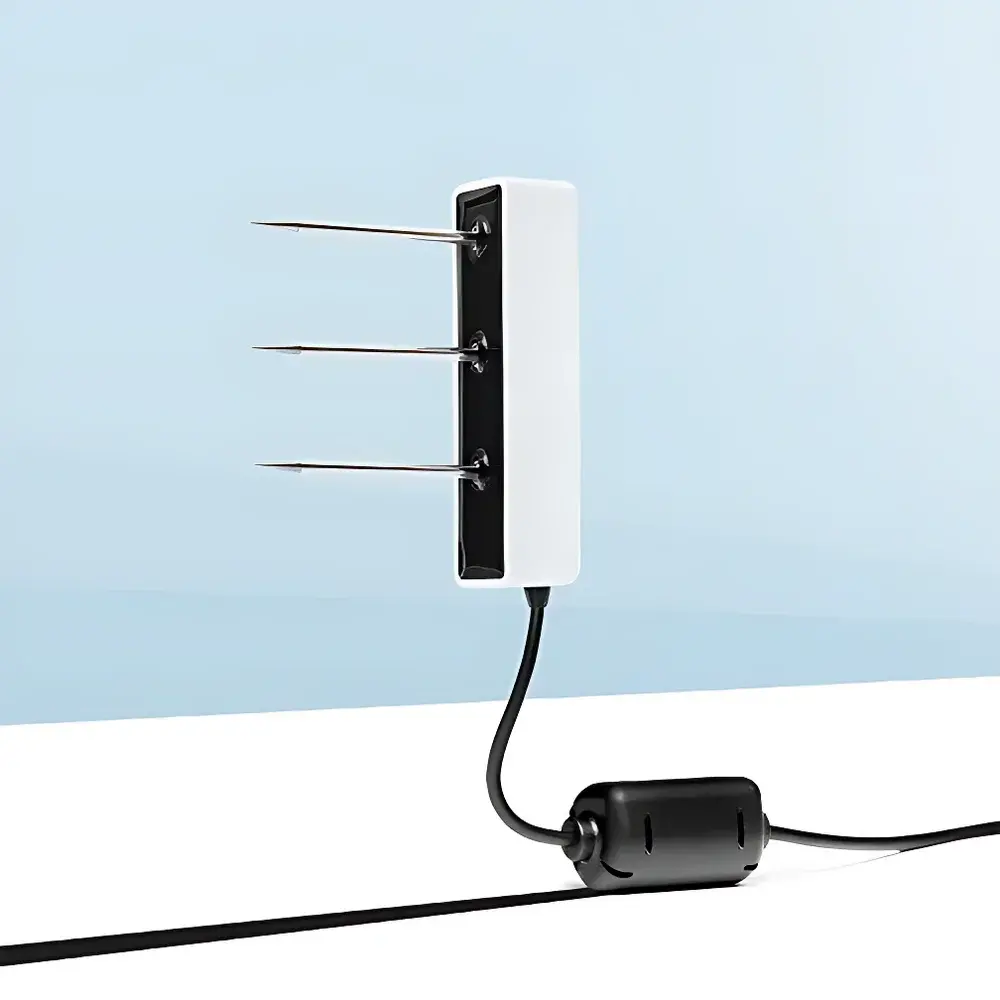
METER TEROS 11 Volumetric Water Content and Soil Temperature Sensor
| Brand | METER |
|---|---|
| Origin | USA |
| Manufacturer | METER Group, Inc. (formerly Decagon Devices) |
| Model | TEROS 11 |
| Measurement Principle | 70 MHz Capacitive Dielectric Sensing |
| Output Protocol | SDI-12 / DDI Serial |
| Compliance | ISO 9001:2015, EN 61326-1:2013, EN 55022/CISPR 22, CE Marked per 2014/30/EU & 2011/65/EU |
| Sensor Dimensions | 9.4 × 2.4 × 7.5 cm (L×W×H) |
| Probe Length | 5.5 cm |
| Cable Length | Standard 5 m (custom up to 75 m) |
| Operating Temperature | −40 to +60 °C |
| VWC Range (mineral soil) | 0.00–0.70 m³/m³ |
| VWC Accuracy (generic mineral soil cal) | ±0.03 m³/m³ (EC < 8 dS/m) |
| Temp Accuracy | ±1.0 °C (−40 to 0 °C), ±0.5 °C (0 to 60 °C) |
| Temp Resolution | 0.1 °C |
| VWC Resolution | 0.001 m³/m³ |
| Dielectric Range | 1–80 (εₐ) |
| Frequency | 70 MHz |
| Power Supply | 4.0–15.0 VDC |
| Sleep Current | ~0.03 mA |
| Active Current (25 ms) | 3.0–16.0 mA |
| Interface | 3.5 mm TRS or bare-wire termination |
Overview
The METER TEROS 11 is a high-fidelity, field-deployable sensor engineered for continuous, in situ measurement of volumetric water content (VWC) and soil temperature. It employs 70 MHz capacitive dielectric sensing—a well-established physical principle grounded in the relationship between bulk soil permittivity and water content. Unlike time-domain reflectometry (TDR) or neutron scattering methods, this frequency-specific capacitance technique minimizes sensitivity to soil salinity and textural heterogeneity while maintaining robustness across diverse porous media. The sensor’s compact 9.4 cm form factor enables precise spatial resolution within a representative sampling volume of approximately 1010 mL—ideal for layered soil profiling, root zone monitoring, and calibration validation against gravimetric or neutron probe data. Its epoxy-encapsulated head and corrosion-resistant stainless-steel probes ensure long-term mechanical integrity and electrochemical stability under variable field conditions, including saline, acidic, or freeze-thaw environments.
Key Features
- 70 MHz capacitive sensing architecture optimized to reduce dielectric dispersion effects from dissolved salts and clay-bound water, delivering improved accuracy in high-EC soils (up to 8 dS/m) without requiring site-specific recalibration.
- Factory-calibrated for mineral soils with traceable uncertainty: ±0.03 m³/m³ VWC (typical), validated per ISO/IEC 17050:2010 and traceable to NIST-traceable reference standards.
- Integrated dual-parameter measurement: simultaneous VWC and temperature output eliminates need for co-located thermistors and reduces spatial mismatch error.
- Ruggedized mechanical design: epoxy-sealed electronics, 316 stainless-steel probes, and IP68-rated housing rated for continuous burial at depths up to 1 m.
- Low-power operation: typical active current draw of 3.6 mA during 25 ms measurement cycles; sleep current < 0.03 mA supports multi-year deployments on solar-recharged systems.
- Flexible integration: native SDI-12 and DDI serial protocols enable interoperability with METER ZL6, EM60, and Em50 data loggers—as well as third-party loggers compliant with SDI-12 v1.3 or TTL-level asynchronous serial interfaces.
Sample Compatibility & Compliance
The TEROS 11 is validated for use in mineral soils, peat, potting mixes, hydroponic substrates, and engineered landfill covers. Its extended dielectric range (εₐ = 1–80) accommodates air-dry to saturated conditions, including near-zero VWC measurements critical for evaporation studies. For non-mineral media (e.g., perlite, vermiculite), METER provides application-specific calibration curves derived from controlled laboratory testing. All units are manufactured under ISO 9001:2015 quality management systems. Electromagnetic compatibility (EMC) and safety compliance includes EN 61326-1:2013 (industrial environment immunity/emission), CISPR 22 Class B radiated emissions, and RoHS/REACH directives. CE marking confirms conformity with EU EMC Directive 2014/30/EU and Restriction of Hazardous Substances Directive 2011/65/EU.
Software & Data Management
Data acquisition is supported natively through METER’s ZL6 logger firmware and ZentraCloud platform—a secure, browser-accessible SaaS environment compliant with ISO/IEC 27001 information security standards. ZentraCloud provides automated firmware updates, configurable alert thresholds (e.g., VWC deviation >0.05 m³/m³), audit-trail logging per ALCOA+ principles, and export-ready CSV/JSON outputs compatible with MATLAB, R, Python (Pandas), and GIS workflows. For GLP/GMP-regulated applications, optional 21 CFR Part 11-compliant user access controls, electronic signatures, and immutable data archiving are available via enterprise licensing. Raw sensor outputs—including εₐ, temperature, and diagnostic flags—are preserved alongside calibrated VWC values to support traceable reprocessing using updated calibration models.
Applications
- Irrigation scheduling and deficit irrigation trials in agronomic research and precision agriculture.
- Soil moisture–temperature coupling analysis for biogeochemical modeling (e.g., denitrification, methane flux).
- Long-term climate observatory networks requiring low-maintenance, high-reproducibility sensors (e.g., NEON, FLUXNET, COSMOS-USA).
- Validation of satellite-derived soil moisture products (e.g., SMAP, Sentinel-1) at field scale.
- Contaminant transport studies where pore-water saturation governs solute mobility and redox dynamics.
- Green infrastructure monitoring—including bioswales, rain gardens, and permeable pavements—where rapid infiltration response must be quantified.
FAQ
What calibration options are available for non-mineral substrates?
Custom calibration curves are provided for common horticultural media (e.g., coconut coir, rockwool, pine bark) upon request. These are generated using gravimetric drying and dielectric characterization across moisture gradients.
Can TEROS 11 be used in frozen soil?
Yes—the sensor operates continuously down to −40 °C and reports dielectric permittivity changes associated with phase transition. However, standard VWC algorithms assume liquid-phase dominance; users should apply freezing-corrected models (e.g., Topp equation variants) or consult METER’s cryosolic calibration guidelines.
Is cable length extension supported beyond 75 m?
While standard configurations cap at 75 m, custom shielded twisted-pair cabling with impedance matching and noise filtering can be engineered for longer runs. Signal integrity verification via SDI-12 handshake latency and CRC error rate is recommended for installations >50 m.
How does TEROS 11 handle electrical interference in high-EMI environments?
The 70 MHz carrier frequency lies outside common industrial noise bands (e.g., 50/60 Hz harmonics, VFD switching frequencies). Combined with differential signal encoding in SDI-12 mode and internal digital filtering, the sensor maintains stable readings near pumps, motors, or radio transmitters when installed per METER’s grounding and separation guidelines.






