
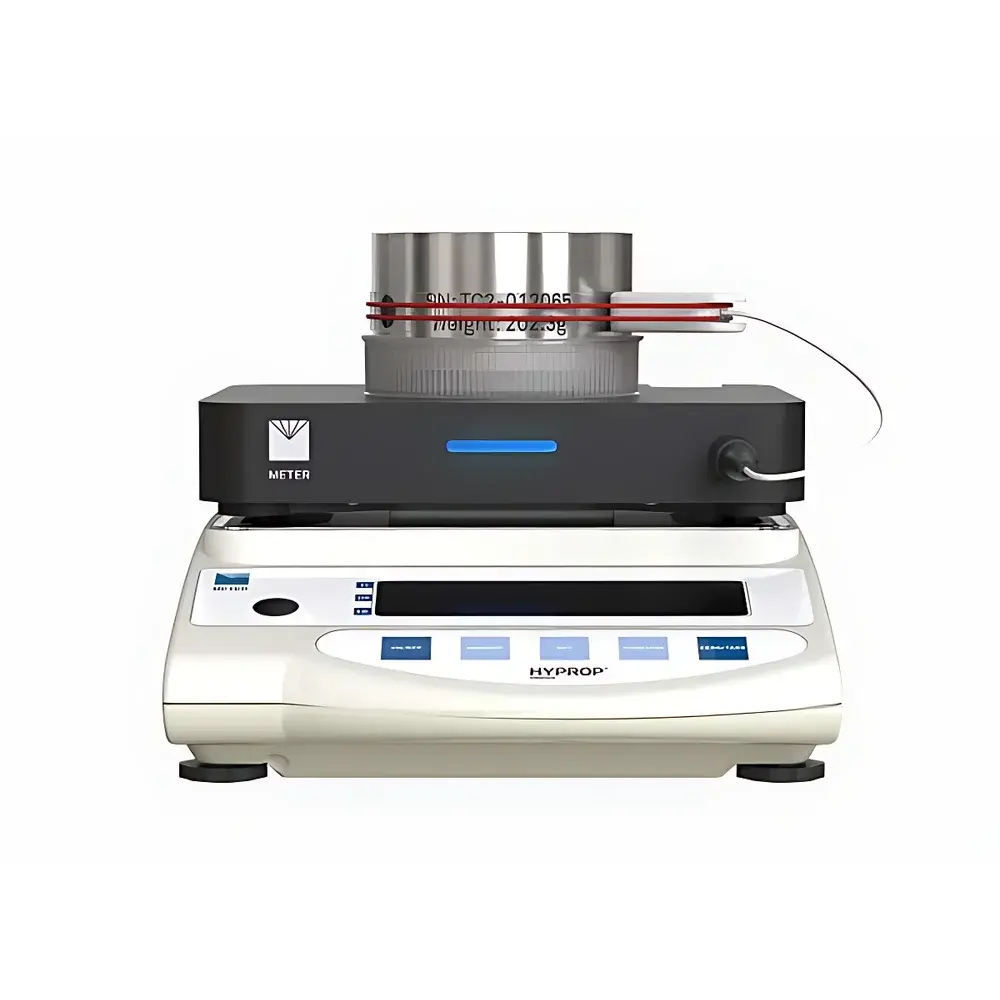
METER VARIOS Automated Soil Thermal Property Curve Analyzer
| Brand | METER |
|---|---|
| Origin | Germany |
| Model | VARIOS |
| Instrument Type | Multifunctional Soil Analyzer |
| Measurement Principle | Transient Line Heat Source (TLHS) |
| Compliance | IEEE Std 442-2017, ASTM D5334, ISO 9001:2015, EM ISO/IEC 17050:2010 (CE) |
| Thermal Conductivity Range (TC-S70) | 1.3–10.3 W/m·K |
| Thermal Conductivity Range (TC-S100) | 0.8–6 W/m·K |
| Temperature Range (Storage/Drying) | −50 to 120 °C |
| Operating Temperature Range | −40 to 85 °C |
| Temperature Resolution | 0.01 °C |
| Temperature Accuracy | ±0.1 °C |
| Heating Current Range | 20–200 mA |
| Heating Current Resolution | 10 µA |
| Heating Current Accuracy | ±0.05% |
| Linear Power Output Range | 0.5–20 W/m |
| Power Resolution | 20 mW/m |
| Power Accuracy | ±0.1% |
| Balance Capacity | 2200 g |
| Balance Readability | 0.01 g |
| Balance Repeatability & Linearity | 0.01 g |
| Probe Dimensions (TC-S70) | 114.0 × 19.4 × 13.25 mm |
| Probe Dimensions (TC-S100) | 144.0 × 19.4 × 13.25 mm |
| Balance Dimensions | 162 × 185 × 30 mm |
| Power Supply | 12 V / 1 A |
| Interface | USB |
| OS Compatibility | Windows 10 or later |
Overview
The METER VARIOS Automated Soil Thermal Property Curve Analyzer is an integrated, laboratory-grade system engineered for high-reproducibility measurement of thermal conductivity and volumetric water content evolution during soil desiccation. It implements the transient line heat source (TLHS) method—standardized in IEEE Std 442-2017 and ASTM D5334—to quantify thermal transport properties with minimal perturbation to the sample’s moisture distribution. Unlike steady-state techniques, TLHS applies brief, low-power heating pulses (typically < 10 s), minimizing convective water movement and thermal lag while enabling rapid, repeatable acquisition of hundreds of data points across the entire drying trajectory. The VARIOS uniquely couples this thermal sensing with real-time gravimetric monitoring via a high-resolution balance (0.01 g readability), allowing simultaneous derivation of both thermal conductivity (λ) and water content (θ) without manual interpolation or post-processing assumptions. Developed initially for the Suedlink underground HVDC cable project in Germany—a 400-mile infrastructure initiative requiring precise thermal backfill characterization—the system has been validated across thousands of drying curves under field-deployed engineering conditions.
Key Features
- Simultaneous dual-parameter acquisition: Direct, synchronized measurement of thermal conductivity and gravimetric water content throughout desiccation
- High-fidelity temperature sensing: ±0.1 °C accuracy and 0.01 °C resolution over −40 to 85 °C operating range
- Adaptive TLHS excitation: Programmable heating current (20–200 mA) and duration enable optimization for diverse soil textures and saturation states
- Automatic thermal drift compensation: Real-time correction of baseline offset during extended measurements (e.g., multi-hour drying cycles)
- Two operational modes: Continuous time-series acquisition or discrete-point sampling at user-defined intervals
- Modular probe compatibility: Interchangeable TC-S70 (1.3–10.3 W/m·K) and TC-S100 (0.8–6 W/m·K) sensors for broad thermal range coverage
- Compact benchtop architecture: Minimal footprint (balance: 162 × 185 × 30 mm) supports small-sample testing in constrained lab environments
- Full-system integration: Includes calibrated probes, precision balance, USB interface, mounting hardware, and proprietary software—no third-party components required
- Compliance-ready design: Manufactured under ISO 9001:2015; CE-marked per EM ISO/IEC 17050:2010
Sample Compatibility & Compliance
The VARIOS accepts saturated or partially saturated intact soil cores (typically 100–500 cm³ volume) placed directly on the integrated balance. Its non-destructive TLHS methodology ensures minimal disturbance to pore structure and water redistribution—critical for replicating in-situ thermal behavior in geotechnical and energy infrastructure applications. The system supports clay, silt, sand, loam, and engineered backfill materials, including bentonite-amended soils used in cable trenching. All measurements adhere to IEEE Std 442-2017 (Standard for Soil Thermal Resistivity Measurements) and ASTM D5334 (Standard Test Method for Determining Thermal Conductivity of Soils and Soft Rock by Thermal Needle Probe Procedure). Data integrity meets GLP-aligned traceability requirements: every curve includes embedded timestamps, sensor calibration IDs, environmental metadata (ambient T, RH), and audit-trail logs for regulatory review.
Software & Data Management
VARIOS Control & Analysis Software (Windows 10+) provides end-to-end workflow automation—from instrument initialization and parameter configuration to real-time visualization, curve fitting, and export. The software automatically computes λ(θ) relationships using standard van Genuchten–Mualem or modified Kersten models, generates publication-ready plots (thermal conductivity vs. water content, λ vs. time), and exports CSV, Excel, and PDF reports compliant with internal QA protocols. Raw sensor data (voltage, current, temperature, mass) are stored in open-format HDF5 files, ensuring long-term archival stability and third-party interoperability. Audit trails record all user actions, parameter changes, and calibration events—supporting FDA 21 CFR Part 11 readiness when configured with Windows domain authentication and electronic signatures.
Applications
- Thermal resistivity modeling for underground power cable backfill selection and ampacity rating
- Validation of numerical heat transfer simulations in geotechnical and energy infrastructure projects
- Soil thermal property database development for climate modeling and land-surface parameterization
- Research on soil–water–heat coupling dynamics in vadose zone hydrology
- Quality assurance of engineered soils used in landfill liners, pipeline bedding, and foundation systems
- Calibration support for field-deployed thermal probes and distributed temperature sensing (DTS) networks
FAQ
What standards does the VARIOS comply with?
IEEE Std 442-2017, ASTM D5334, ISO 9001:2015, and EM ISO/IEC 17050:2010 (CE marking).
Can the VARIOS measure frozen soils?
Yes—within its storage/drying temperature range (−50 to 120 °C); however, phase-change transitions require careful interpretation due to latent heat effects.
Is the balance internally calibrated?
The HYPROP-class balance includes internal calibration routines and supports external verification with NIST-traceable weights.
How is probe-to-soil contact resistance addressed?
The TLHS method inherently mitigates interfacial resistance errors through short-duration heating and analytical correction based on sensor geometry and thermal diffusivity estimation.
Does the software support automated report generation for regulatory submissions?
Yes—PDF and Excel outputs include metadata, calibration certificates, raw data links, and operator audit trails suitable for GLP/GMP documentation.
Related Products







