
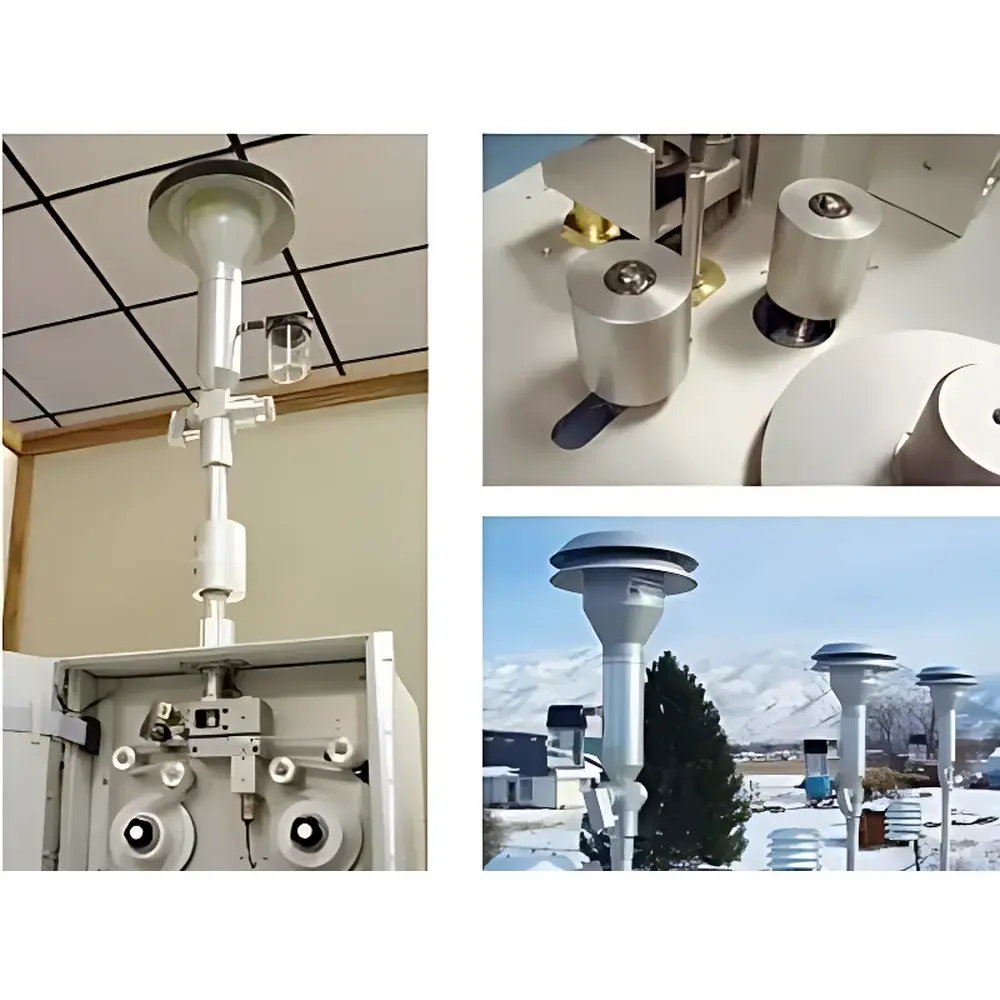
MetOne BAM-1020 Beta Attenuation Mass Monitor for PM₂.₅ and PM₁₀
| Brand | METONE |
|---|---|
| Country of Origin | USA |
| Model | BAM-1020 |
| Measurement Principle | Beta Ray Attenuation (¹⁴C source) |
| Measured Parameters | PM₂.₅, PM₁₀, TSP (with optional inlets) |
| Measurement Range | 0–1.000 mg/m³ |
| Sampling Flow Rate | 16.7 L/min (nominal, adjustable 0–20 L/min) |
| Detection Limit | 0.1 µg/m³ (1-hour average) |
| Measurement Interval | 1 hour |
| Flow Stability | ±2% over operating range |
| EPA Certification | U.S. EPA EQPM-0607-193 (PM₂.₅), EQPM-0607-194 (PM₁₀) |
| Operating Temperature | –30°C to +50°C |
| Relative Humidity Control | Integrated heated inlet with RH stabilization <40% |
Overview
The MetOne BAM-1020 is a U.S. Environmental Protection Agency (EPA)-certified continuous ambient particulate matter monitor engineered for regulatory-grade measurement of PM₂.₅ and PM₁₀ mass concentrations. It operates on the beta attenuation mass (BAM) principle—utilizing a low-energy ¹⁴C radioactive source to emit beta particles through a continuously advancing glass fiber tape. As airborne particles deposit onto the tape during sampling, they attenuate the beta flux proportionally to their mass. A high-sensitivity scintillation detector quantifies the transmitted radiation before and after sampling, enabling direct calculation of mass concentration (µg/m³ or mg/m³) without reliance on particle optical properties, density assumptions, or calibration against surrogate aerosols. This physical measurement principle ensures high reproducibility across diverse aerosol types—including urban soot, desert dust, sea salt, and secondary sulfate—regardless of particle size distribution, refractive index, or color. The BAM-1020 integrates a thermally regulated inlet system that maintains sample relative humidity below 40%, minimizing volatilization artifacts from semi-volatile compounds such as ammonium nitrate—a critical requirement for compliance with EPA Reference Method (RM) and Federal Equivalent Method (FEM) performance criteria.
Key Features
- EPA EQPM-certified for both PM₂.₅ (EQPM-0607-193) and PM₁₀ (EQPM-0607-194) monitoring, meeting 40 CFR Part 53 requirements
- Automated hourly sampling cycle with integrated zero and span calibration—zero check performed pre- and post-sampling using clean tape segments; span verification via motorized reference membrane insertion
- Thermally stabilized inlet with precision RH control (<40% RH), reducing bias from semi-volatile particle losses
- Robust mechanical architecture: sealed optical path, corrosion-resistant housing (NEMA 4X rated), and maintenance-free ¹⁴C source with 5,730-year half-life
- Onboard microprocessor with LCD interface, real-time diagnostics, and local data storage supporting ≥182 days of 1-hour averaged PM data
- RS-232 serial interface for integration with SCADA systems, modems, printers, or third-party data loggers
- Expandable meteorological input: supports up to six external sensors (wind speed/direction, temperature, pressure, RH, rain gauge)
- Remote operation capability via TCP/IP-enabled web interface—supports unattended deployment for up to 60 days with automated event logging
Sample Compatibility & Compliance
The BAM-1020 accepts standardized EPA-designated inlets—including the VSCC (Velocity-Sensitive Cut Cyclone) for PM₁₀ and the WINS (Wide-Range Inlet for Nanoparticles and Sulfates) or BGI SC-1000 for PM₂.₅—ensuring aerodynamic cut-point fidelity per ISO 25500 and EN 12341. It is fully compatible with FRM/FEM-compliant calibration membranes (e.g., NIST-traceable polystyrene latex standards) for field verification. Instrument-level data integrity adheres to EPA 40 CFR Part 58 Appendix A quality assurance protocols, including mandatory QA/QC flags for power loss, flow deviation (>±5%), zero drift (>±2 µg/m³), and detector saturation. All audit trails—including calibration events, error codes, and parameter modifications—are time-stamped and stored with immutable metadata, satisfying GLP/GMP documentation requirements and supporting FDA 21 CFR Part 11-compliant electronic records when deployed in regulated environmental health studies.
Software & Data Management
The BAM-1020 embeds firmware compliant with EPA’s Data Validation and Reporting System (DVRS) specifications. Hourly concentration values are output in ASCII format with embedded QA flags (e.g., “V” for valid, “I” for invalid, “M” for maintenance). Internal memory retains raw beta counts, flow rates, temperature, RH, and diagnostic codes alongside final mass concentrations. Data export supports standard formats (CSV, XML) compatible with EPA AirData, AQS, and third-party platforms such as EnviroDIY or OpenAQ. Optional MetOne DataLink software enables remote configuration, firmware updates, and batch retrieval via secure HTTPS or dial-up modem—each session logged with user ID, timestamp, and command history. Audit logs are exportable for regulatory submission and support root-cause analysis during data reconciliation workflows.
Applications
The BAM-1020 serves as a primary monitor in national ambient air quality monitoring networks (NAAQS), state/local air districts, and industrial fence-line surveillance programs. Its stability and low detection limit make it suitable for background monitoring in rural and remote sites, long-term trend analysis under EPA’s Clean Air Act Section 103, and epidemiological exposure assessment where high temporal resolution and metrological traceability are essential. It is routinely deployed in multi-pollutant stations alongside NOₓ, SO₂, O₃, and CO analyzers, with synchronized meteorological inputs enabling source apportionment modeling (e.g., CMB, PMF). Academic researchers use it in atmospheric chemistry field campaigns requiring gravimetric-equivalent mass data independent of optical assumptions—particularly valuable in biomass burning plumes, volcanic ash events, and marine boundary layer studies.
FAQ
Is the BAM-1020 compliant with U.S. EPA Federal Reference Method (FRM) requirements?
Yes—the BAM-1020 holds EPA EQPM certification for both PM₂.₅ and PM₁₀, confirming equivalence to FRM performance specifications under 40 CFR Part 53.
Does the instrument require annual source replacement or licensing?
No—the ¹⁴C beta source has a 5,730-year half-life and is exempt from NRC licensing under 10 CFR 30.18; no source replacement is required over the instrument’s operational lifetime.
How is humidity managed to prevent measurement bias?
An integrated heater maintains inlet air at <40% RH prior to particle collection, minimizing evaporation of semi-volatile nitrates and organics per EPA guidance in OAQPS Technical Support Document #17.
Can the BAM-1020 measure TSP?
Yes—by installing a TSP inlet (e.g., EPA-approved 100-mm diameter inlet), the BAM-1020 can quantify total suspended particulates without hardware modification.
What QA/QC functions are automated?
Each hourly cycle includes automatic zero checks (tape blank), span verification (reference membrane), flow calibration, and internal diagnostic self-tests—all logged with timestamps and severity codes.
Related Products







