
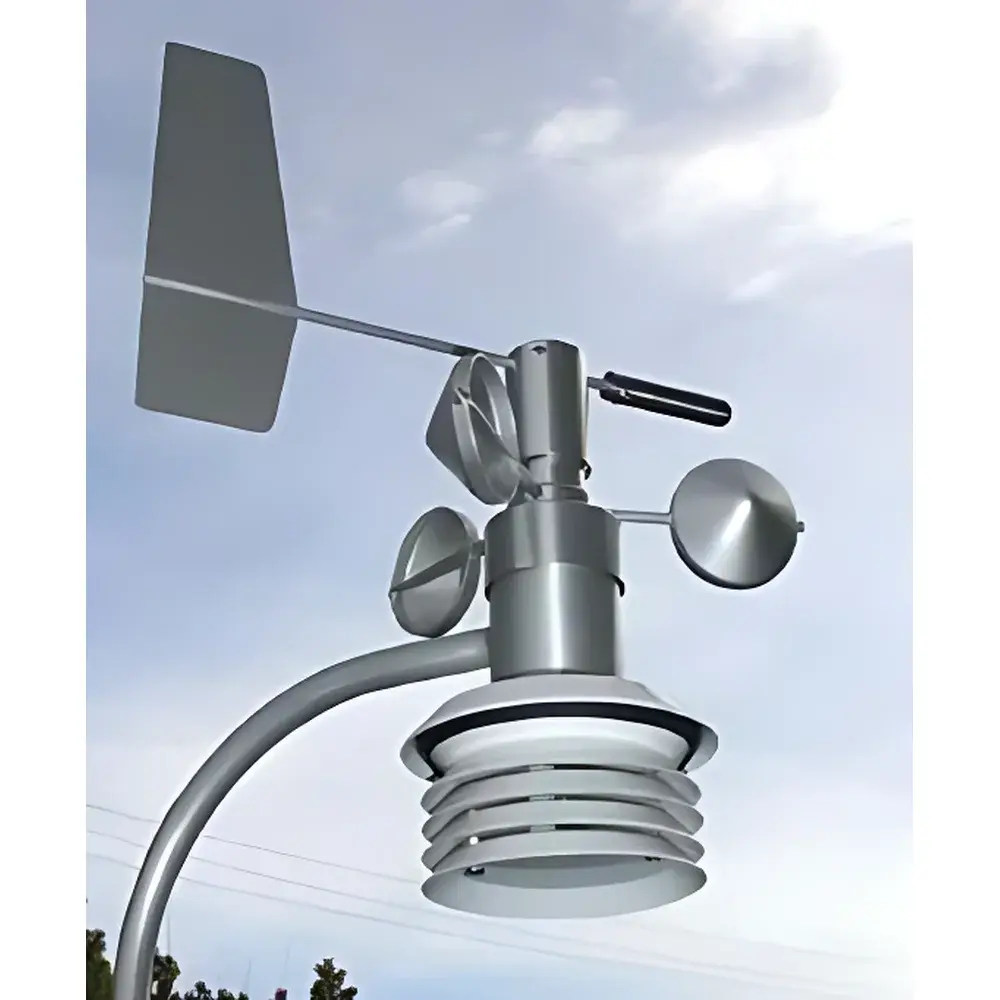
METONE Met Station One Integrated 5-Parameter Weather Sensor System
| Brand | METONE |
|---|---|
| Origin | USA |
| Model | Met Station One |
| Output Interfaces | RS-232, SDI-12 (customizable to RS-485/RS-422) |
| Wind Speed Range | 0–50 m/s |
| Wind Speed Resolution | 0.1 m/s |
| Wind Speed Accuracy | ±2% |
| Wind Direction Range | 0–360° |
| Wind Direction Resolution | 1° |
| Wind Direction Accuracy | ±5° |
| Temperature Range | −50 to +50 °C |
| Temperature Resolution | 0.1 °C |
| Temperature Accuracy | ±0.1 °C |
| Relative Humidity Range | 0–100% RH |
| RH Resolution | 1% RH |
| RH Accuracy | ±4% RH |
| Atmospheric Pressure Range | 500–1100 mbar |
| Pressure Resolution | 0.1 mbar |
| Pressure Accuracy | ±2 mbar |
Overview
The METONE Met Station One is an integrated, solid-state 5-parameter weather sensor system engineered for continuous, unattended environmental monitoring in field-deployed applications. Unlike traditional mechanical anemometers or analog transducer arrays, this unit employs precision solid-state sensing elements—including ultrasonic wind measurement technology (for wind speed and direction), capacitive relative humidity sensing, platinum resistance temperature detection (PT100-class), and piezoresistive barometric pressure transduction—to deliver synchronized, high-reproducibility meteorological data without moving parts. Designed for long-term stability under variable thermal and moisture loads, the Met Station One operates across a wide ambient temperature range (−50 to +50 °C) and is rated for outdoor exposure in non-corrosive, non-explosive atmospheres. Its compact monolithic housing enables rapid deployment on towers, masts, agricultural plots, forest canopies, and ecological research sites where spatial constraints and logistical portability are critical.
Key Features
- Solid-state architecture with zero mechanical wear—no bearings, cups, or vanes requiring maintenance or recalibration.
- Simultaneous acquisition of five core atmospheric parameters: wind speed, wind direction, air temperature, relative humidity, and barometric pressure.
- Dual-standard digital output: native RS-232 and SDI-12 protocols compliant with industry-standard dataloggers including Campbell Scientific CR1000, CR3000, CR6, and third-party SCADA systems.
- Optional interface expansion to RS-485 or RS-422 for extended cable runs (>1 km) and multi-drop network configurations.
- Low power consumption (<1.5 W typical), supporting solar-battery operation in remote deployments.
- IP65-rated enclosure with UV-stabilized polycarbonate housing and corrosion-resistant mounting hardware.
- Factory-calibrated traceable to NIST standards; calibration certificates available upon request.
Sample Compatibility & Compliance
The Met Station One is optimized for open-air ambient air sampling and does not require inlet conditioning, filtration, or aspiration for standard meteorological use. It complies with fundamental requirements of IEC 60068-2 environmental testing standards for operational robustness (including thermal shock, humidity cycling, and vibration). While not certified to IEC 61326-1 for EMC in safety-critical industrial control environments, it meets FCC Part 15 Class B and CE RED Directive limits for radiated emissions in scientific instrumentation applications. Data integrity aligns with GLP principles for environmental field studies; metadata logging (timestamp, sensor status flags, supply voltage) supports audit-ready documentation per ISO/IEC 17025 laboratory accreditation frameworks.
Software & Data Management
Raw sensor outputs are protocol-compliant ASCII strings formatted per SDI-12 v1.3 and RS-232 Modbus RTU conventions, enabling seamless ingestion into Campbell Scientific LoggerNet, PC400, or third-party platforms such as LabVIEW, Python-based PySerial/SDI12 libraries, or cloud-edge gateways (e.g., ThingsBoard, Ignition SCADA). The device supports configurable sampling intervals (1 s to 30 min), burst-mode averaging (e.g., 1 Hz wind sampling averaged over 1–10 min), and diagnostic registers reporting sensor health, heater status (if optional heating module installed), and communication error counters. No proprietary software is required; configuration is performed via ASCII command set or integrated within datalogger program logic.
Applications
- Agricultural microclimate monitoring for irrigation scheduling, frost prediction, and evapotranspiration modeling (FAO-56).
- Ecological field research in grasslands, forests, and alpine zones requiring low-footprint, low-power instrumentation.
- Boundary-layer meteorology studies supporting eddy covariance flux tower networks (e.g., AmeriFlux, ICOS).
- Calibration reference for satellite-derived land surface temperature and atmospheric profile validation.
- Supporting compliance with site-specific environmental impact assessments (EIA) under EPA and EU Directive 2008/50/EC ambient air quality standards.
- Integration into distributed IoT weather mesh networks for hyperlocal forecasting and disaster early-warning systems.
FAQ
Is the Met Station One suitable for marine or coastal deployment?
Yes—its IP65 rating and stainless-steel fasteners provide resistance to salt-laden air; however, optional conformal coating and periodic cleaning are recommended for sustained marine exposure.
Can the sensor be powered directly from a 12 V DC battery system?
Yes—it accepts 9–16 V DC input with reverse-polarity and overvoltage protection; typical quiescent current draw is <120 mA at 12 V.
Does the unit include onboard data storage?
No—Met Station One is a real-time sensor only; data logging must be performed externally via connected datalogger or host PC.
What is the recommended recalibration interval?
METONE recommends verification every 24 months under normal field conditions; full recalibration is advised after physical impact, prolonged exposure above 60 °C, or significant drift observed in comparative intercomparison studies.
Is firmware upgradable in the field?
Firmware updates are supported via RS-232 using METONE’s documented bootloader protocol; no hardware modification is required.







