
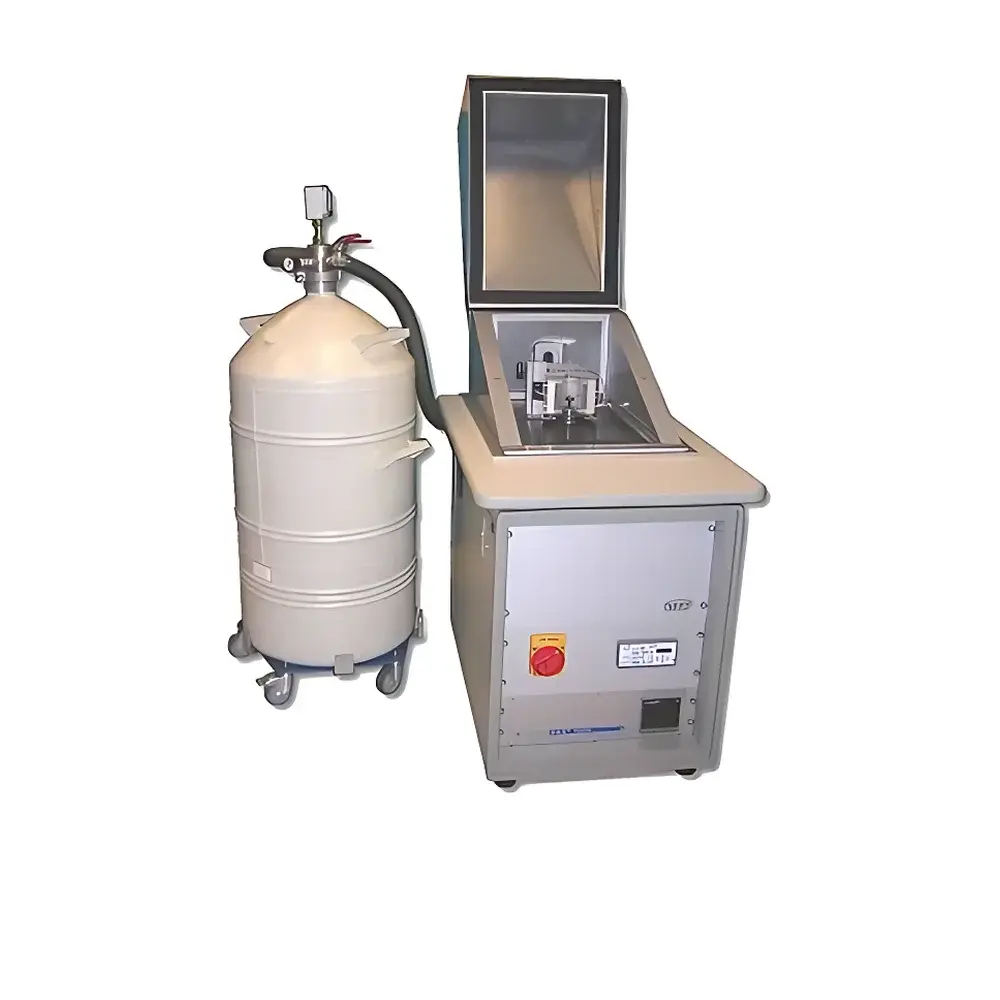
Metravib VHF104 Ultra-High-Frequency Dynamic Mechanical Analyzer
| Brand | Metravib |
|---|---|
| Origin | France |
| Model | VHF104 |
| Instrument Type | Dynamic Mechanical Analyzer (DMA/DMTA) |
| Temperature Range | −50 to 110 °C |
| Temperature Accuracy | ±0.5 °C |
| Temperature Stability | ±0.1 °C |
| Heating/Cooling Rate | 0.1–10 °C/min |
| Frequency Range | 100–10,000 Hz |
| Force Range | ±150 N |
| Displacement Range | ±10,000 µm |
| Strain Range | 10⁻⁶–30% |
| Deformation Modes | Tension, Compression, Annular Shear |
| Standard Masses | 5, 10, 20, 40, 80, 200 g |
Overview
The Metravib VHF104 Ultra-High-Frequency Dynamic Mechanical Analyzer is an engineered solution for high-throughput viscoelastic characterization of polymeric, elastomeric, and porous materials in the critical 100 Hz to 10 kHz frequency domain. Unlike conventional resonant or forced-oscillation DMA systems—whose mechanical compliance and inertial limitations restrict operation below ~100 Hz—the VHF104 employs a broadband acoustic transmission principle grounded in linear system theory. A calibrated piezoelectric actuator applies a controlled sinusoidal excitation across the sample, while a high-fidelity laser Doppler vibrometer or capacitive receiver captures the transmitted displacement response at the far end. The complex transfer function (H(ω) = Xout(ω)/Xin(ω)) is directly inverted to compute storage modulus (E′), loss modulus (E″), and tan δ with no reliance on time–temperature superposition (WLF or TTS) or extrapolation. This first-principles approach delivers intrinsic material behavior at frequencies relevant to real-world service conditions—including tire tread noise, vibration damping in automotive NVH components, and acoustic absorption in foams—without the multi-hour thermal ramping and interpolation required by traditional low-frequency DMA.
Key Features
- True ultra-high-frequency operation: validated measurement range from 100 Hz to 10,000 Hz—enabling direct access to glass transition relaxation peaks, secondary relaxations (β, γ), and filler–polymer interfacial dynamics inaccessible to standard DMA.
- Acoustic transmission architecture: eliminates fixture resonance artifacts and inertial loading errors inherent in cantilever- or dual-clamp-based systems; supports non-contact or minimal-contact configurations for fragile, low-stiffness, or highly damped specimens.
- Thermally stabilized chamber: Peltier-based temperature control spanning −50 °C to +110 °C with ±0.1 °C short-term stability and programmable ramp rates from 0.1 to 10 °C/min in both heating and cooling directions.
- Multi-mode mechanical actuation: compatible with tension, compression, and annular shear geometries using interchangeable fixtures and standardized mass kits (5–200 g) to optimize signal-to-noise ratio across stiffness ranges.
- High-resolution transduction: force resolution ≤0.01 N, displacement resolution ≤10 nm, strain resolution down to 10⁻⁶%, enabling quantitative analysis of microstructural transitions in elastomers, thermoplastic vulcanizates (TPVs), and open-cell polymer foams.
Sample Compatibility & Compliance
The VHF104 accommodates solid, viscoelastic, and heterogeneous samples including rubber compounds, silicone gels, PU foams, fiber-reinforced composites, and thin films (thickness ≥0.5 mm). Its non-resonant design avoids modal interference in porous or low-density media—making it uniquely suited for ASTM E1492 (acoustical impedance of sound-absorbing materials) and ISO 9053 (airflow resistance of porous materials) correlation studies. All hardware and software comply with ISO/IEC 17025 requirements for testing laboratories. Data acquisition and reporting support audit trails aligned with FDA 21 CFR Part 11 for electronic records and signatures, and optional GLP/GMP-compliant configuration packages include user role management, instrument calibration logging, and electronic signature workflows.
Software & Data Management
VHF Control Suite v4.x provides intuitive experiment sequencing, real-time FFT-based spectral monitoring, and automated batch processing for multi-sample screening. Raw transfer function data are stored in HDF5 format with embedded metadata (temperature, frequency sweep parameters, fixture ID, calibration coefficients). Built-in modules perform Kramers–Kronig validation, Cole–Cole plot generation, Arrhenius and Vogel–Fulcher–Tammann fitting, and master curve construction without WLF assumptions. Export options include CSV, MATLAB .mat, and universal MDF4 for integration into enterprise LIMS or statistical process control (SPC) platforms. Software validation documentation (IQ/OQ/PQ protocols) and 21 CFR Part 11 readiness packages are available upon request.
Applications
- Rubber and elastomer development: rapid quantification of Payne effect, Mullins effect, and filler network dynamics under high-frequency cyclic loading mimicking road contact conditions.
- Acoustic material engineering: direct measurement of complex Young’s modulus and loss factor in sound-deadening foams, laminated composites, and metamaterials used in aerospace and automotive cabin NVH mitigation.
- Biopolymer and hydrogel characterization: detection of hydration-dependent relaxation modes and crosslink density variations in medical-grade silicones and injectable biomaterials.
- Quality control of thermoplastic elastomers (TPEs): high-speed comparative screening of batch-to-batch consistency in dynamic moduli across production lines.
- Research into polymer nanocomposites: resolving interfacial relaxation times between matrix and nanofillers (e.g., carbon black, silica, graphene) at frequencies where interfacial slippage dominates macroscopic response.
FAQ
How does the VHF104 differ fundamentally from conventional DMA instruments?
It replaces forced oscillation with broadband acoustic transmission, enabling direct, model-free calculation of viscoelastic functions without time–temperature superposition.
Can the VHF104 measure materials with very low stiffness, such as soft gels or foams?
Yes—its low-force actuation (<±150 N) and high-displacement sensitivity (±10,000 µm) allow stable measurements on compliant materials without fixture-induced artifacts.
Is temperature calibration traceable to national standards?
Yes—each system ships with NIST-traceable temperature sensor calibration certificates and optional on-site verification per ISO 11357-2.
What sample geometries are supported out-of-the-box?
Standard configurations include rectangular bars (tension/compression), cylindrical rods (annular shear), and custom-machined holders for irregular shapes; geometry-specific calibration files are provided.
Does the system support automated unattended operation?
Yes—fully programmable temperature–frequency sequences, auto-load/unload via optional robotic interface, and email/SNMP alerts upon completion or fault condition.



