
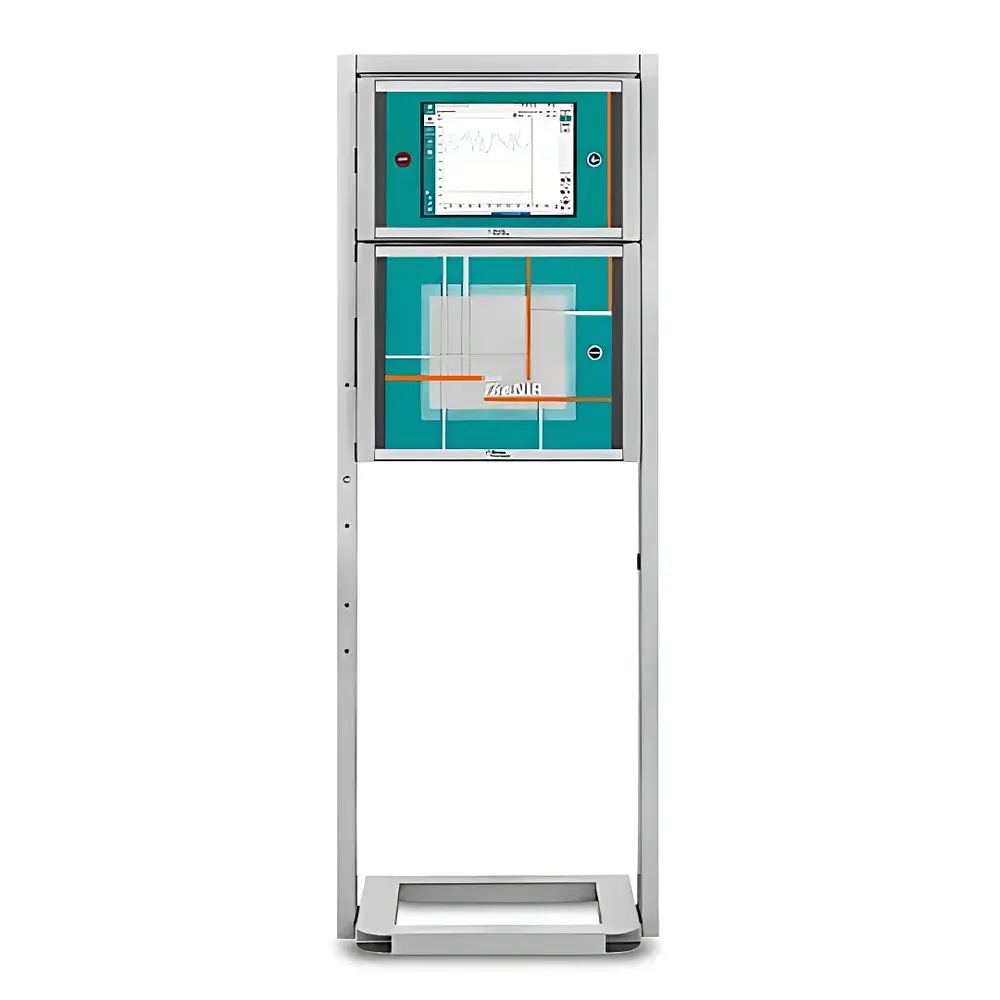
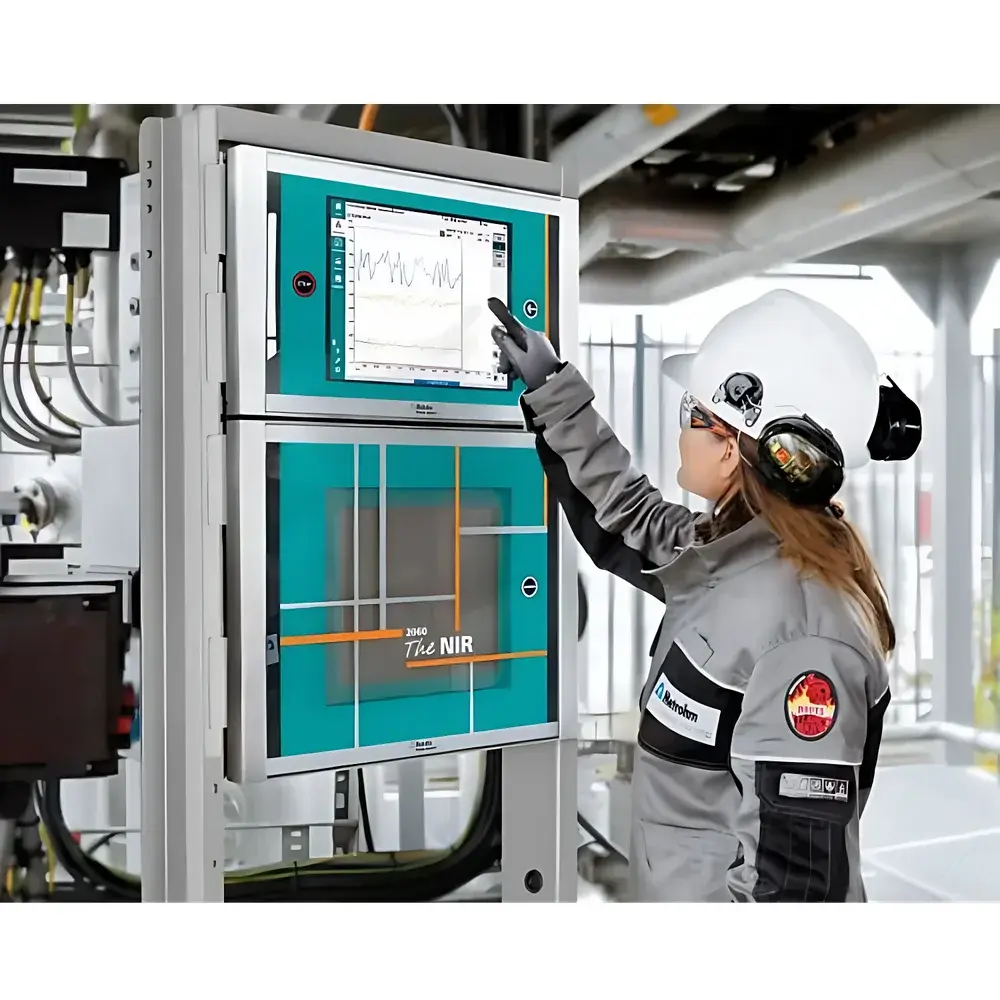
Metrohm 2060 Online Near-Infrared Spectrometer
| Brand | Metrohm |
|---|---|
| Origin | Switzerland |
| Manufacturer Type | Original Equipment Manufacturer (OEM) |
| Product Category | Imported Instrument |
| Model | 2060NIR |
| Instrument Type | Online NIR Spectrometer |
| Application Scope | General-purpose (Academic & Research Laboratories) |
| Operating Principle | Grating-based, Non-scanning Array Detector |
| Wavelength Range | 1000–2250 nm |
| Scan Rate | 5000 spectra/s |
| Spectral Sampling Interval | 0.5 nm |
| Measurement Mode | Real-time In-line Analysis |
| Chemometrics Software | IMPACT / OMNIS |
Overview
The Metrohm 2060 Online Near-Infrared Spectrometer is an engineered solution for real-time, non-destructive, reagent-free chemical analysis in continuous industrial processes. Based on grating-dispersive optics coupled with a thermoelectrically (TE) cooled InGaAs photodiode array detector, the 2060NIR delivers high signal-to-noise ratio (SNR), spectral stability, and robust performance under dynamic process conditions. Unlike scanning NIR systems, its non-scanning architecture enables acquisition of full-spectrum data at up to 5000 spectra per second—critical for capturing transient process events in reactors, dryers, granulators, or blending vessels. Designed explicitly for Process Analytical Technology (PAT) frameworks per ICH Q8/Q9/Q10 guidelines, the 2060 platform supports Quality by Design (QbD) implementation by providing timely, traceable, and multivariate spectral data directly from the process stream—without bypass loops, sample extraction, or manual intervention.
Key Features
- Modular hardware architecture: Separable Human Interface (2060HI) and NIR analyzer boxes enable flexible installation, scalable channel expansion, and reduced footprint in space-constrained environments.
- Up to five independent measurement channels per NIR analyzer box, supporting simultaneous multi-point monitoring across unit operations.
- TE-cooled InGaAs array detector with integrated temperature stabilization ensures long-term spectral reproducibility and minimizes thermal drift—essential for unattended 24/7 operation.
- High-throughput optical design optimized for both transmission and reflectance configurations, compatible with MicroBundle multimode fiber optics (up to 100 m length) or single-fiber probes for liquid-phase applications.
- IECEx-certified explosion-proof variants (2060-Ex and 2060-REx) compliant with Zone 1/21 hazardous area requirements; IP65-rated enclosure for dust and water ingress protection.
- Embedded dual-software architecture: OMNIS for automated spectral acquisition, preprocessing, and chemometric modeling; IMPACT for real-time visualization, alarm management, and integration into distributed control systems (DCS) or SCADA environments.
Sample Compatibility & Compliance
The 2060NIR is validated for in-line analysis of heterogeneous and homogeneous process streams—including powders, slurries, granules, emulsions, and transparent to semi-opaque liquids—without sample dilution or conditioning. Its optical interface accommodates standard fiber-optic probes (e.g., immersion, flow-cell, or reflectance types) conforming to ASTM E1655–22 for NIR method development and validation. The system supports audit-trail-enabled operation per FDA 21 CFR Part 11 and EU Annex 11 requirements when deployed with configured user access controls, electronic signatures, and immutable data logging. All firmware and software modules undergo rigorous GLP/GMP-aligned verification protocols during factory acceptance testing (FAT).
Software & Data Management
OMNIS serves as the embedded chemometrics engine, enabling real-time calibration transfer, spectral preprocessing (e.g., Savitzky–Golay smoothing, multiplicative scatter correction), and quantitative/qualitative PLS, PCA, or SIMCA model execution. IMPACT provides the operational interface: graphical timeline-based sequence programming, customizable dashboard views (trend plots, histograms, tabular reports), and configurable threshold alarms triggered by spectral residuals or predicted property deviations. Both platforms support native communication via Modbus TCP/RTU, OPC UA, and discrete I/O signals—ensuring seamless integration with PLCs, DCS, and MES layers. Raw spectra and processed results are stored in vendor-neutral HDF5 format, facilitating third-party data mining and AI-driven process optimization workflows.
Applications
The 2060NIR is routinely deployed in pharmaceutical manufacturing (e.g., API crystallization endpoint detection, tablet coating uniformity monitoring), fine chemical synthesis (reaction stoichiometry tracking, solvent concentration control), food & beverage processing (moisture, fat, protein quantification in extrudates or dairy streams), and polymer production (monomer conversion, additive dispersion homogeneity). Its ability to operate without consumables or wet chemistry makes it ideal for PAT-compliant continuous manufacturing lines requiring rapid feedback for closed-loop control strategies.
FAQ
Can the 2060NIR be integrated into an existing DCS without custom middleware?
Yes—IMPACT natively supports Modbus TCP and OPC UA, enabling direct read/write access to process tags without intermediary gateways.
Is calibration model transfer between instruments supported?
Yes—OMNIS includes standardized spectral preprocessing pipelines and instrument standardization routines compliant with ASTM E2862–21 for cross-platform model portability.
What is the maximum allowable fiber-optic distance between the analyzer box and probe?
With MicroBundle fiber, the recommended maximum is 50 m for optimal SNR; single-fiber configurations support up to 100 m for clear liquid applications.
Does the system meet regulatory requirements for electronic records in GMP environments?
Yes—when configured with role-based access control, audit trail logging, and electronic signature enforcement, it satisfies FDA 21 CFR Part 11 and EU GMP Annex 11.
How many analyzer boxes can connect to a single 2060HI unit?
Standard configuration supports one analyzer box (5 channels); the 2060-R variant supports two boxes (10 total channels) via daisy-chained Ethernet.






