
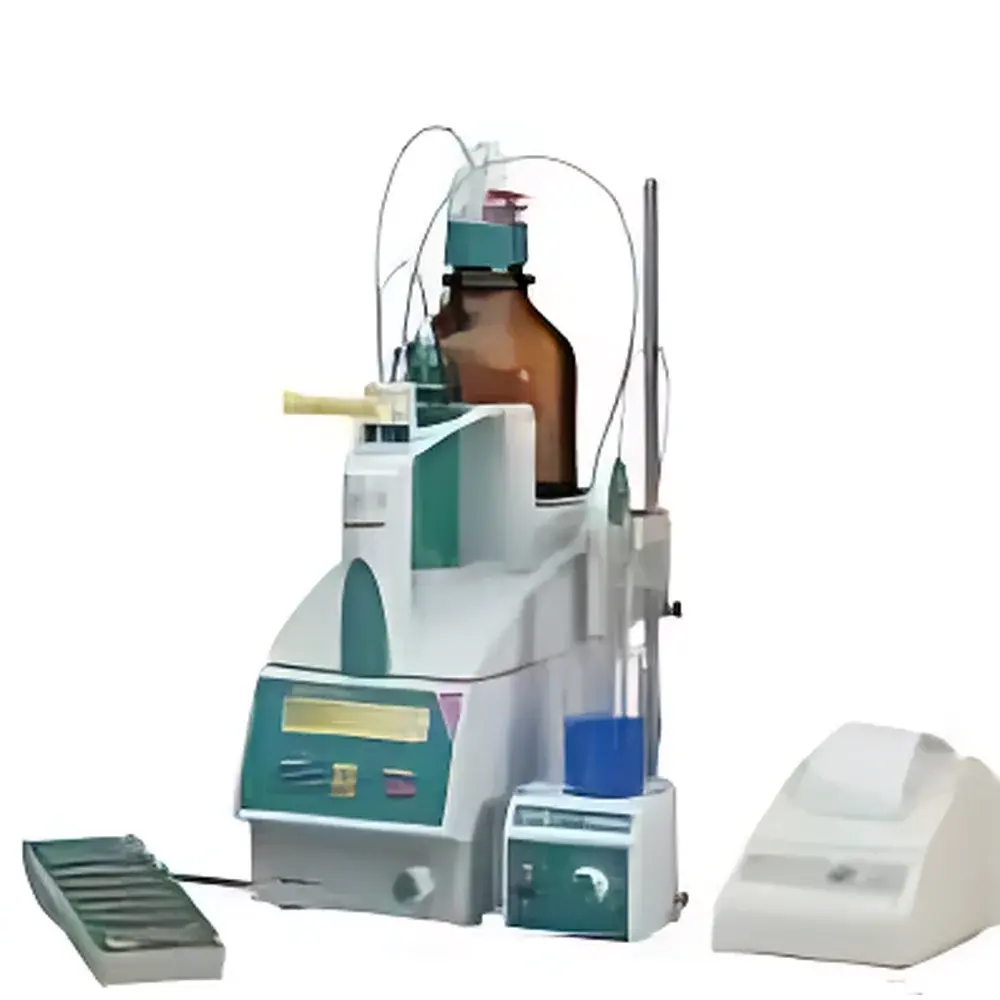
Metrohm 702 Economy Automatic Potentiometric Titrator
| Origin | Switzerland |
|---|---|
| Manufacturer Type | Authorized Distributor |
| Origin Category | Imported |
| Model | 702 Economy |
| Price | Upon Request |
| pH Range | 0 to ±20.00 |
| Potential Range | 0 to ±2000 mV |
| Current Range | 0 to ±200.0 µA |
| Temperature Range | −150.0 to +450.0 °C |
| Burette Volumes | 1, 5, 10, 20, or 50 mL |
| Burette Resolution | 1/10,000 of selected volume |
| Absolute Burette Error | ±0.02 mL (with 10 mL burette) |
| Relative Accuracy | ±0.2% (with 10 mL burette) |
| Input Impedance | >10¹³ Ω |
| Current Compensation | <3.1 × 10⁻¹³ A |
| Thermal EMF Compensation Drift | 15 µV/K |
| Electrode Inputs | 2 high-impedance measuring electrodes, 1 reference electrode, 1 polarizable electrode, 1 temperature sensor |
| Polarization Range | Current 0 to ±127 µA |
| Differential Amplifier | Optimized for low-conductivity non-aqueous titrations |
| Method Storage Capacity | 100 pre-programmed or user-defined methods |
| Dimensions (W × H × D) | 150 × 450 × 275 mm |
Overview
The Metrohm 702 Economy Automatic Potentiometric Titrator is a rigorously engineered benchtop analytical instrument designed for high-reproducibility potentiometric titration in regulated and routine laboratory environments. It operates on the fundamental principle of monitoring potential change across a redox, acid–base, precipitation, or complexometric reaction system using ion-selective or redox-sensitive electrodes. As the titrant is delivered incrementally under software-controlled dosing logic, the instrument detects the inflection point of the potential curve—corresponding to the stoichiometric endpoint—with micro-liter-level precision. Developed by Metrohm—a leader in electrochemical instrumentation with over 60 years of titration system innovation—the 702 Economy model delivers metrological integrity aligned with ISO/IEC 17025 requirements while maintaining operational simplicity for daily QC workflows.
Key Features
- Full automation of titration sequences including dosing, endpoint detection, rinsing, and electrode conditioning—reducing manual intervention and inter-operator variability.
- Dual high-impedance input channels (≥10¹³ Ω) ensure stable signal acquisition from glass pH, ion-selective, and redox electrodes—even in low-conductivity media such as hydrocarbon solvents.
- Integrated polarization module supports amperometric and coulometric titration modes, enabling precise control of current (0 to ±127 µA) and applied potential (0 to ±1270 mV in 10 mV increments).
- Thermal EMF compensation (15 µV/K drift specification) minimizes temperature-induced baseline drift during extended analyses or ambient fluctuations.
- Modular burette selection (1, 5, 10, 20, or 50 mL) with 1/10,000 volumetric resolution and certified accuracy (±0.02 mL absolute error for 10 mL burette; ±0.2% relative accuracy) ensures traceable delivery across concentration ranges.
- Differential amplifier architecture specifically optimized for non-aqueous titrations—including ASTM D664 (TAN), D2896 (TBN), D5554 (bromine number), and D3229 (mercaptan sulfur)—where background conductivity is inherently low.
Sample Compatibility & Compliance
The 702 Economy supports a broad spectrum of sample matrices: petroleum distillates, lubricants, transformer oils, pharmaceutical excipients, organic synthesis intermediates, and aqueous electrolyte solutions. Its hardware and firmware comply with critical regulatory expectations for analytical instrumentation used in GxP environments. While the device itself does not carry FDA 21 CFR Part 11 certification out-of-the-box, its method storage architecture (100 secure, timestamped, and user-accessible methods), audit-ready event logging, and deterministic endpoint algorithms support validation protocols required under GLP, GMP, and ISO 17025. Preloaded standard methods conform to ASTM D664, D2896, D5554, D3229, ISO 3675, ISO 6293, and USP , facilitating immediate deployment in refinery QC labs, API manufacturing sites, and university teaching laboratories.
Software & Data Management
The instrument operates via Metrohm’s intuitive TitraLab® PC-based control software, which provides full method development, sequence scheduling, real-time curve visualization, and automated report generation. All raw titration curves, derivative plots, and metadata—including operator ID, date/time stamps, electrode IDs, environmental conditions, and calibration history—are stored in encrypted, tamper-evident files compliant with ALCOA+ data integrity principles. Export formats include CSV, PDF, and XML for LIMS integration. The system supports electronic signatures when deployed with validated authentication modules and networked domain controllers—enabling alignment with FDA 21 CFR Part 11 Annex 11 requirements where configured per site-specific validation documentation.
Applications
- Petroleum & Lubricants: Total Acid Number (TAN), Total Base Number (TBN), bromine number, mercaptan sulfur, chloride content, and corrosion inhibitor quantification per ASTM and IP standards.
- Pharmaceuticals: Assay of active ingredients (e.g., amine hydrochlorides, carboxylic acids), residual solvent analysis, and excipient purity testing under USP monographs.
- Power Generation: Analysis of turbine oils, insulating fluids, and boiler water chemistry for acidity, alkalinity, and anion content.
- Academic Research & Teaching: Hands-on instruction in electroanalytical fundamentals, method validation, and uncertainty propagation in volumetric analysis.
- Chemical Manufacturing: Quality control of catalysts, surfactants, and polymerization inhibitors where stoichiometric equivalence must be verified without spectrophotometric interference.
FAQ
Does the 702 Economy support thermometric or photometric titration modes?
No—it is dedicated exclusively to potentiometric, amperometric, and coulometric detection principles. Thermometric and photometric modules require higher-tier Titrando platforms.
Can I import custom titration methods from older Metrohm instruments?
Yes—TitraLab® software supports backward-compatible method migration from Titrino and early Titrando generations, provided firmware versions are aligned.
Is temperature control of the titration vessel integrated?
The 702 Economy includes a temperature sensor input and compensation algorithm but does not feature built-in Peltier or jacketed vessel heating/cooling; external thermostatted cells are recommended for controlled-temperature studies.
What electrode types are validated for use with this system?
Metrohm-certified pH glass electrodes (e.g., 6.0234.xxx), redox electrodes (6.0351.xxx), ion-selective electrodes (e.g., 6.0501.xxx for fluoride), and double-junction reference electrodes (6.0732.xxx) are fully supported and characterized in factory calibration reports.
How is system performance verified post-installation?
Metrohm provides NIST-traceable verification kits—including certified buffer solutions, KCl standards, and volumetric check standards—for IQ/OQ execution. Full PQ protocol templates are available upon request for GxP-regulated users.
Related Products




